Aggregating Compensation Data From Job Postings and Salary Pages
Live job postings reveal real-time pay budgets more reliably than outdated salary surveys.

Aggregating compensation data from job postings has become the default approach to pay benchmarking because the old approach, the annual survey, can't keep up. JobsPikr's 2026 benchmark report states that most widely-cited salary reports lean on self-reported numbers collected months before anyone reads them, and in a market where AI and ML job postings jumped sharply from 2024 to 2025, a benchmark from last year isn't just stale. It actively misleads anyone using it to set pay.
Pay transparency law is quietly solving half this problem on its own. Remote postings make the effect bigger than any one law intends: a remote role open to any US resident usually has to satisfy every state's disclosure rule at once, since the company can't know in advance which state the applicant lives in. One job posting ends up carrying compliance obligations from a dozen different legislatures, and the side effect is that far more roles come with a real number attached than the plain text of any single law would suggest.
That number means something a survey response doesn't. When a company puts a salary range on a live posting, somebody signed off on a budget, under a hiring deadline, for a role they need to fill now. That's a different kind of data point than an HR manager filling out a survey field from memory three months later. JobsPikr's own pipeline, which pulls in and normalizes more than 100 million postings in real time, treats live postings as the more honest signal for exactly this reason: postings reflect what an employer is willing to pay today, not what someone remembers paying last quarter.
Source heterogeneity and anti-bot friction in data collection
Wanting this data and getting it cleanly are two very different problems. Job postings live across job boards, company career pages, staffing sites, professional networks, and dedicated salary sites, and none of them agree on how to structure a page. Each one updates on its own schedule and defends itself against bots to its own degree, so a pipeline built for one source often breaks the moment it meets the next. JobsPikr's own platform pulls from more than 70,000 sources globally, updated daily, and that number alone gives a sense of how wide the net has to be cast before the data starts to look complete.
Career pages built on applicant tracking systems like Greenhouse, Lever, and Workday add a layer of trouble on top of that: these pages load job content with JavaScript, so a plain HTTP request comes back with an empty shell.
Salary formatting makes things messier still, and it varies even within a single source in the same crawl. None of these are edge cases. They show up constantly, often from the same employer posting to the same board.
Then there's the problem of the same job looking like two different jobs depending on where you check. That gap doesn't mean one source is lying and the other is telling the truth. It usually comes down to who self-reports, what time window a platform averages over, and which slice of workers actually show up in that platform's data. None of this means the data is broken beyond use. It means the pipeline has to treat heterogeneity and anti-bot defenses as problems to design around, not reasons to give up on the source.
The three-tier extraction architecture: structured markup, JavaScript rendering, and LLM-powered parsing
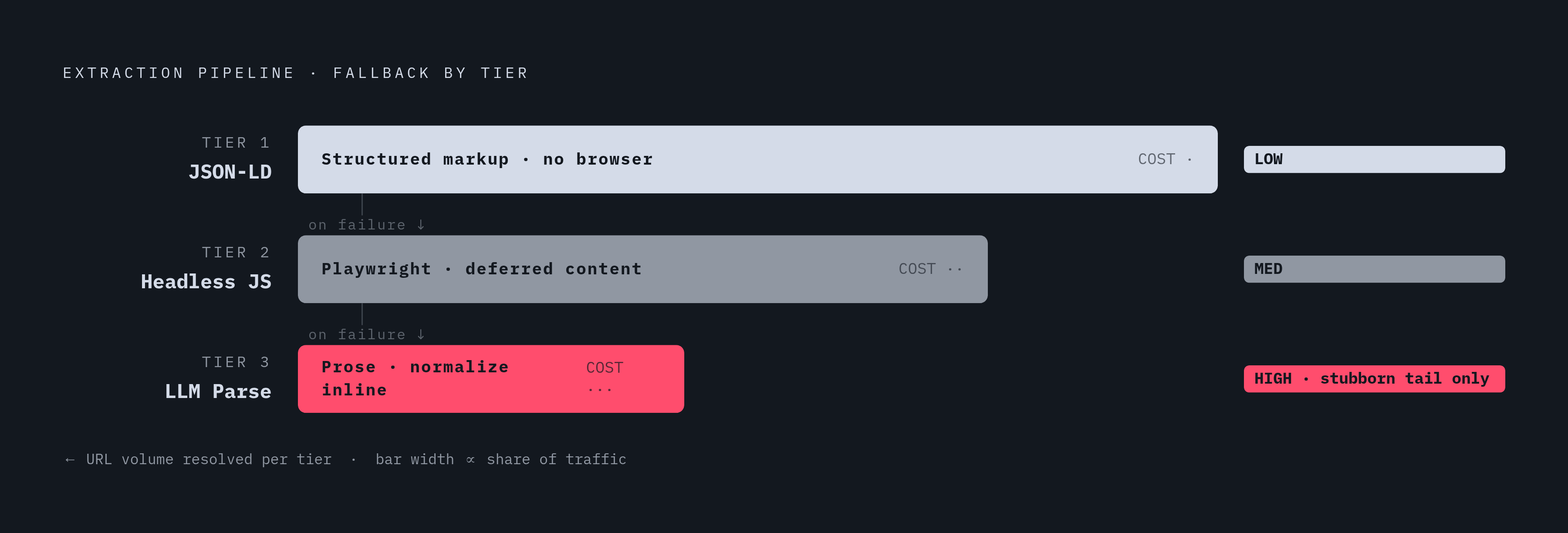
No single scraping method handles every page on this list, so a pipeline built to last needs three separate approaches, each one used where it actually fits.
The first and cheapest option is structured data extraction from JSON-LD markup. When that markup exists, pulling data from it is fast and stable, because the fields are already named and don't shift when the page's visual design changes. The practical move here is to grab the raw HTML, find the JSON-LD block, and lift the salary fields straight out of it, skipping the fragile CSS selectors that break every time a company redesigns its careers page. Not every employer bothers to include this markup, and some that try get it wrong or leave fields out, so relying on Tier 1 alone leaves real gaps in coverage.
The second tier is JavaScript-rendered scraping, built for the pages that only show their content after a browser runs the page's code. The page needs a headless browser, or a service built to render pages, to actually produce content worth extracting. Playwright tends to handle this more reliably than older HTTP-based tools because it renders the full page, deferred content included, before any extraction begins. This tier costs more than Tier 1 in both time and compute, since spinning up a full browser context and waiting for a page to finish loading takes real cycles that a simple request never needed.
The third tier brings in LLM-powered extraction, reserved for pages where the salary appears in plain prose, in a format that shifts unpredictably, or on a page that changes its structure often enough to break a hand-built parser. An LLM reads the page for meaning rather than position, so it can pick out "competitive compensation starting at $120K" buried in the third paragraph of a job description with no markup anywhere near it. It can also normalize the format on the spot, turning "$80K–100K/yr" directly into a clean object with a minimum, a maximum, a currency, and a pay period, all in the same pass.
None of these three tiers replaces the others. A working pipeline routes each URL to the cheapest tier that can reliably pull the fields it needs, falls back to the next tier when that fails, and saves the LLM approach for the stubborn tail of sources that resist every structural shortcut.
Handling the salary format problem: parsing, normalizing, and canonicalizing compensation fields
Pulling a salary string off a page is only step one. Until that string gets turned into a clean, consistent record, it isn't data yet, and this is the stage where a lot of homegrown pipelines quietly fall apart. A pipeline has to expect all of them, every time.
Turning that mess into something usable means handling a short list of jobs on every single record: stripping currency symbols, expanding shorthand so "K" becomes three zeros, splitting a range into a minimum and a maximum, figuring out whether the number is hourly, weekly, monthly, or annual, and converting anything that isn't annual into an annual figure so comparisons actually mean something.
The ambiguous cases need a rule, not a guess. A posting that says "up to $150K" should be entered into the dataset with a maximum of $150,000 and a minimum left blank, not get thrown out because it doesn't fit a clean min-max pattern. A posting that just says "Competitive" should get flagged as non-numeric and kept out of any quantitative average, rather than getting quietly coerced into a zero that would drag down every number near it.
Once a record clears all of that, it needs somewhere consistent to live. Free text doesn't hold up once the dataset needs to be queried, compared, or fed into anything downstream.
Scaling the crawl: request volume, rate management, and anti-bot handling at production scale
Getting the format right doesn't matter if the crawl can't run at the volume a useful dataset demands. Covering enough of the market to say anything meaningful means sending enough requests that naive scraping patterns get caught, blocked, or buried in CAPTCHA walls well before the dataset reaches any real size.
The irony is that the sources with the richest salary data are usually the ones guarding themselves the hardest. High-traffic job boards and professional networks watch for behavioral patterns, session habits, and request rates, and they respond to anything that looks automated with IP bans or with incomplete or deliberately altered data. A scraper can keep running for hours against a source like that and never know it stopped getting real information.
Operating at this scale takes a specific set of defenses working together. And retry logic with exponential backoff on 429 and 403 responses keeps the crawl from hammering a server that's already told it to slow down.
Handling all of this inside the application itself turns into its own full-time engineering job. A unified web data API that takes care of rendering, anti-bot defenses, IP rotation, and structured output in one call lifts that burden off the application layer. The pipeline code stays focused on routing requests and normalizing what comes back, while the API handles the mechanics of getting the page.
Producing AI-ready compensation output: format choices for LLM and RAG pipelines
How the data leaves the pipeline matters just as much as how it got collected, because the output format decides how much of that signal survives once it reaches an AI system. Raw HTML almost never belongs anywhere near that last step.
Markdown and structured JSON are the formats that actually work for LLM and RAG pipelines, because both strip out the noise that HTML drags along, cut down on token usage, and hand the model clean context to work with. A job posting page is full of navigation bars, footers, cookie banners, and sidebar ads, none of which say anything about pay, and all of which burn tokens a model could spend reasoning about the job description instead. Stripping the boilerplate down to the job description and the compensation fields gives the model something far more useful to work with.
Once a record has already gone through normalization and landed in its canonical schema, JSON is the obvious choice for storing and moving it. It drops straight into a database, a vector store, or an API response without any extra parsing step standing in the way. For pages where Tier 3 extraction is doing the work, the prompt sent to the model should ask for a structured JSON object with named fields from the start, rather than a paragraph summary that still needs a second pass to pull anything usable out of it.
This also sets up the groundwork for agentic compensation research, where an AI agent gets a prompt like "benchmark ML engineer salaries across these ten cities" and handles the planning, fetching, and aggregating on its own. For an agent to actually act on what it finds, the web data behind it has to arrive clean and structured, ready to use without reformatting. The Model Context Protocol (MCP) is becoming the standard interface for this kind of work, letting an AI agent discover scraping tools and call them directly as part of its own workflow. The underlying point stays the same whether a human or an agent is on the receiving end: the data has to show up in the shape the consumer actually needs, not the shape it happened to be collected in.
Monitoring compensation signals over time rather than running one-off crawls
A compensation dataset that sits untouched after it's built turns into exactly the kind of lagging indicator this whole approach was meant to replace. That makes ongoing monitoring just as important as getting the initial extraction right.
JobsPikr's platform updates its listings from more than 70,000 sources every day, and that pace let it catch a specific AI role's pay climbing at a notable rate year over year, quickly enough for clients to make reskilling decisions before that window closed. Only a system ingesting continuously could.
Continuous monitoring also catches changes a single crawl would miss entirely, like an employer quietly revising a salary range on a posting that's already live, often in response to candidate pushback or a shift in budget. A one-time crawl just captures whichever version happened to be live at the moment it ran, and never knows what changed after.
Spotting real trends, like senior ML engineer pay shifting in a specific metro over six months, takes a time series built from consistent, continuous ingestion, not a single snapshot or an occasional pull.
Using aggregated compensation data responsibly
None of this means posting-based compensation data tells the whole story, and pretending otherwise would undercut everything the pipeline is built to do. The honest objection to this approach deserves a straight answer: job postings show real-time market activity, but the ranges employers list aren't standardized, say nothing about where that number sits in the company's broader pay philosophy, and never capture what the candidate actually negotiated at the end.
Ghost job postings add another wrinkle. Flagging and down-weighting postings that have sat untouched for a long time helps limit the damage, though it doesn't erase it completely.
Platform divergence belongs in the same conversation. When the same role title shows salary figures more than $100,000 apart depending on the source, that gap is a signal the dataset's output needs to carry metadata showing which population and which methodology produced each number, so anyone using it downstream knows what they're actually looking at. Self-reported salary platforms carry their own well-known skew too: someone who just landed a great offer is far more likely to log it than someone who settled for less, which pushes the reported averages upward in a way that doesn't reflect the full market.
The right way to use posting-based compensation data is as a leading indicator of where the market is moving and a live check on whether current pay bands still hold up, rather than as a stand-in for payroll data pulled directly from internal records when the question demands precision about what people are being paid. HeroHunt.ai's 2026 AI role analysis links every data point back to its source for exactly this reason. That kind of transparency about where a number came from is what makes a dataset trustworthy, not just large.