Automating SERP Rank Tracking for Thousands of Keywords
Build a pipeline that tracks daily SERP movement across locations and devices at scale.

Rank tracking was built for spreadsheets. An analyst opens a tool, glances at colored arrows, updates a client deck, and calls it a day. That loop works at a handful of keywords. It gets slow as the list grows. At 10,000, it's not slow anymore. It's over. Pulling the data, computing week-over-week deltas, formatting per-client reports, and delivering on schedule across thousands of keywords every day cannot be sustained by humans, no matter how many analysts you hire. The arithmetic just doesn't allow it.
But raw volume isn't the only thing that changed. The SERP itself has gotten more complicated. A keyword sitting at position one can still be buried under ads, a map pack, a People Also Ask block, a featured snippet, and an AI Overview before your client's blue link even appears. The position number says one thing. The searcher's screen says another. If you track position alone, you get a number that described the old web, not the page people actually scroll.
There are two things that separate accurate rank tracking from everything else, no matter how many keywords you track. The first is location precision. The second is refresh frequency. Daily SERP movement is the ground truth now.
All of this points in one direction. You don't solve this by hiring more analysts or buying more dashboard seats. It means thinking in pipelines.
How query volume actually compounds before a single line of pipeline code is written
Here's the arithmetic teams keep getting wrong. Every keyword has to be queried per location, per device type, and per tracking depth. Those multipliers stack on top of each other like compounding interest.
A small operation works as an example. Take a modest keyword set, nothing dramatic. Now track it across two locations and two device types. Queries. And if you go deeper into the search results instead of stopping at the first page, you multiply the API calls per keyword again. Google has restructured how deep result pages work, and that change has made the problem worse: a tracking job that once needed a set number of API requests now needs far more for the same coverage.
The trap is pricing infrastructure against keyword count instead of actual query volume. Teams build a prototype, see it works, move it to production, and then the bill arrives. Your budget was based on the wrong number from the start.
The four operational layers every production rank-tracking pipeline needs
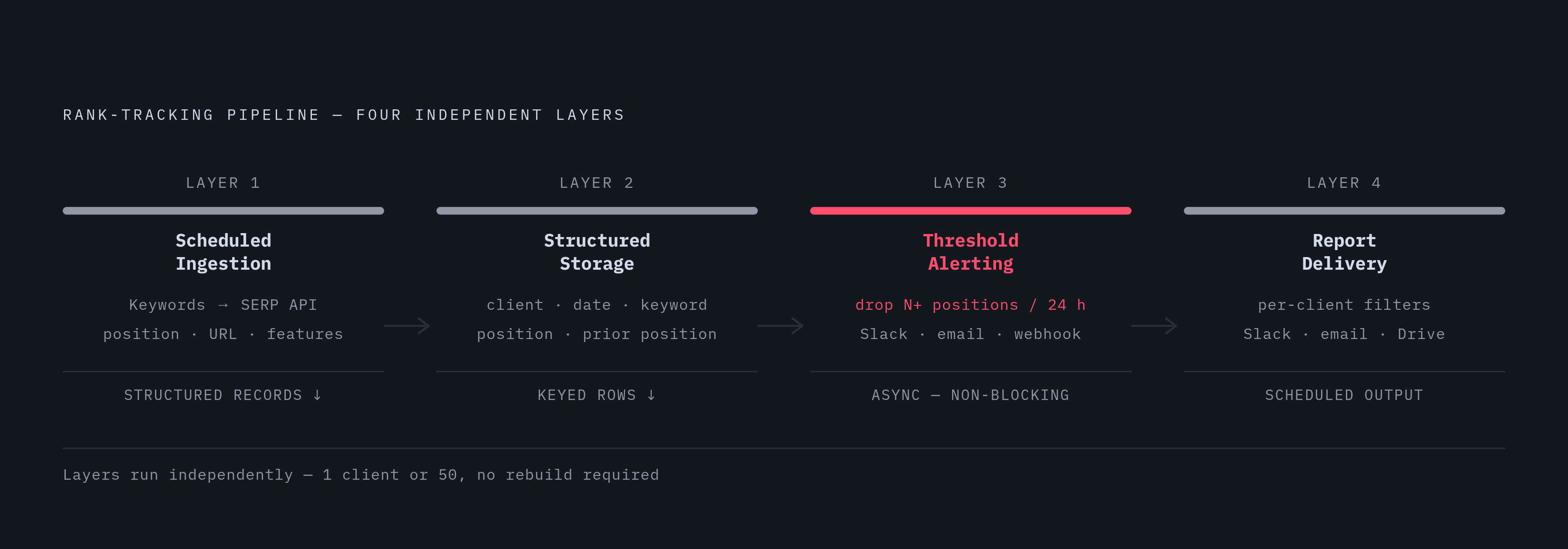
A production rank-tracking pipeline is not a rank checker running in a loop. The real thing has four distinct layers, and each one does one job and hands its output to the next. Here's the map.
Layer 1: Scheduled data ingestion. Keywords get grouped into batches and dispatched to a SERP API on a fixed daily schedule. The API returns structured position, URL, and SERP-feature data. Not raw HTML. Your application shouldn't have to parse anything.
Layer 2: Structured storage. Each result lands in a data store keyed by client ID, date, keyword, position, and prior-day position. That schema is what makes everything downstream possible: delta calculation, trend analysis, per-client filtering.
Layer 3: Threshold alerting. Logic runs against the stored data after each ingestion cycle. When a keyword drops more than a set number of positions in a 24-hour window, the system fires an alert. Delivery routes to Slack, email, or a webhook.
Layer 4: Scheduled report assembly and delivery. Per-client filters and formatting templates get applied to the stored data on a fixed cadence. Reports go out to Slack, email, or Google Drive with no analyst touching anything.
These layers are separable by design. Alerting runs in the background without blocking data collection. That separation is what lets a team grow from one client to fifty without rebuilding from scratch.
What the ingestion layer has to handle that a simple API call does not
The ingestion layer is where prototypes go to die. One synchronous API call in a dev environment won't show you what production has to survive. At thousands of keywords, the problems multiply.
Batching comes first. A production system dispatches keywords concurrently, never sequentially, because sequential processing cannot finish inside a daily window when the volume gets high. That's straightforward to say and fiddly to build.
The harder problem is proxy and anti-bot resilience. Accurate location-level SERP data means querying from the target geography. That's ongoing infrastructure work. It competes with product development for engineering time, and it never stops.
Then there's the structured output contract. The ingestion layer has to deliver clean data: position, URL, keyword, SERP features. All in a consistent schema, JSON or clean Markdown. The storage and alerting layers consume that without any per-response parsing logic. Raw HTML is not an acceptable output contract for a pipeline.
The strongest argument against building this layer yourself is the overhead. Proxy pools, rate limits, SERP structure changes. All of it diverts engineering talent from the strategic work the pipeline was supposed to enable. This is where a SERP data API changes the math. When the API handles proxy rotation, anti-bot resilience, and structured output as infrastructure, your team gets to focus on the storage schema, the alerting logic, and the report assembly. Those are the layers that are actually specific to your product.
How to design the storage schema and alerting logic so the pipeline can act on rank changes, not just record them
A pipeline that stores data but can't surface signal is a data lake with no outlet. The schema and alerting design decide whether you're producing insight or just archiving numbers. The minimum viable schema is not complicated, but it has to be right. Each row should carry: client ID, keyword, date, current position, prior-day position, URL ranked, and SERP feature flags. They tell you if a featured snippet, an AI Overview, or a local pack is present. They matter more than they look like they do. A ranking gain that comes with a CTR loss is not a win. The feature flags are what let the pipeline tell those two apart.
Delta calculation is the core operation. Do that once and your alerting logic filters without recomputing on every query. It's an old database trick, but most rank-tracking setups skip it and then wonder why their alerts are slow.
Alerting breaks into three useful patterns. The first is the absolute drop: a keyword falls more than N positions in a 24-hour window. The second is SERP feature state change: an AI Overview appears above a keyword the client holds at position one. Pure position tracking misses that entirely, and it's the exact moment visibility gets displaced. The third is striking distance: keywords approaching the top-three threshold. Those are upside signals, not damage control. The ones who alert on good news get more done.
Routing should be configurable per client. Slack for internal teams, email for client-facing delivery, webhooks for downstream systems like ticketing or CMS tools. One size fits one client. Build it that way from the start.
Tracking position alone in 2026 misses the real SERP. A keyword that moves from position eight to position three with no corresponding CTR improvement is telling you something specific: a SERP feature is absorbing clicks above the organic results. If your pipeline only tracks position, you'll report a win to the client while most searchers never see their link. The feature flags are what surface that distinction.
When to build the ingestion and storage layers versus buy a purpose-built platform
This is the question everyone asks, and it has a real answer. It's not a values question. It turns on keyword volume, customization requirements, and whether rank data has to flow into systems you already own.
Start with the managed platforms. At moderate scale, they're genuinely good. STAT Search Analytics and AccuRanker refresh daily, ship bulk APIs for data warehouse export, and capture SERP features including AI Overviews without you writing a single parsing routine. AccuRanker's AccuLLM module adds tracking across ChatGPT, Perplexity, Google AI Mode, and others, as a separate module with its own cadence. SE Ranking exposes its data through an API and an MCP server on every plan tier, and its SE Visible product tracks AI answer visibility across ChatGPT, Gemini, Perplexity, Google AI Mode, and Google AI Overviews as a standalone product, while traditional rankings live in the separate SE Ranking suite.
The custom pipeline case starts to win at high volume. Above a certain keyword threshold, enterprise SaaS pricing disappears into custom quotes. Once you're in that territory, building on a SERP API beats managed software on both price and control. A custom pipeline means you define your own storage schema, alerting thresholds, delivery routing, and integration contracts. A SERP data API like DataForSEO gives you a raw feed, with standard Google organic SERP requests starting at a low per-thousand rate and a higher-cost live mode. You shape that feed into whatever reporting structure you need.
The heuristic is simple. If rank data needs to flow automatically into your existing reporting infrastructure, BI tools, or data warehouse, and your keyword volume is high enough that SaaS per-keyword pricing becomes significant, build the custom pipeline on a SERP data API. Both answers are right. They're right for different teams.
How agentic workflows and MCP integrations are changing what the pipeline's output layer can do
The output layer used to end at scheduled reports and threshold alerts. It doesn't anymore. AI agent integrations are making the response to a ranking event programmable, not just observable.
The Model Context Protocol is the shift that makes this possible. An SEO MCP server connects an AI assistant to live ranking data, keyword volumes, SERP features, and audit results through natural language in a single session. The assistant never pulls or parses raw API responses. It just asks.
Real examples are already shipping. SE Ranking's MCP server exposes a large suite of tools through one authenticated remote endpoint. Combined with n8n, which can connect that MCP server with Claude and GA4, the operational model shifts from reactive data pulls to scheduled, agentic workflows. A community-built Google Search Console MCP in n8n exposes 18 tools any MCP client can call, including search performance data, through one workflow. The Ahrefs MCP, released in late 2025, covers Site Explorer, Keywords Explorer, Site Audit, Rank Tracker, and Brand Radar through one server.
The agentic pattern goes like this. An agent monitors rankings continuously. The agent surfaces the root cause and drafts a refresh brief. And within bounded parameters, it can execute the refresh itself and surface the change for human approval. That's the difference between checking and acting. You get a draft response.
Putting the pipeline together: a reference architecture from ingestion to delivery
Here's the full reference architecture, stage by stage. You can build it with different tools at every step, but the shape stays the same. Stage 1: Keyword corpus management. Maintain a structured keyword registry keyed by client ID, target URL, location, device type, and tracking depth. This registry is the input contract for ingestion. Version-control it so changes to the keyword set are auditable.
Stage 2: Scheduled batch ingestion. A cron job or workflow scheduler (n8n, Airflow, or a simple serverless function) dispatches batches from the registry to the SERP data API daily. The API returns structured position and SERP-feature data in JSON. The ingestion job writes results to storage and records failed batches for retry.
Stage 3: Storage and delta computation. A relational or columnar store holds the full history keyed by client, keyword, date, position, prior position, URL, and SERP feature flags. A delta computation job runs right after each ingestion cycle and updates the delta column.
Stage 4: Alert evaluation. Alert rules are evaluated against the delta store after each cycle. Triggered alerts route to the configured channel (Slack webhook, email, or downstream webhook) with the keyword, the position change, the client, and the current SERP feature context. Stage 5: Report assembly and delivery. A scheduled job applies per-client filters and formatting templates, assembles the report, and delivers it to email, Google Drive, or Slack on the client's cadence: weekly, biweekly, or monthly.
Stage 6: Agentic investigation layer. This one is optional and progressive. Alert events trigger an AI agent that queries live SERP data through the MCP or API layer, investigates root cause, and surfaces a structured brief. It's additive. It doesn't change the earlier stages.
The architecture is tool-agnostic at every stage. The keyword registry can live in a spreadsheet or a database. The scheduler can be a cron job or n8n. The SERP data source can be a managed platform's bulk API or a raw SERP API. Storage can be Postgres, BigQuery, or a data warehouse.
That's the real point. The same design handles a small keyword set or an enormous one if the ingestion and storage layers are sized correctly. Build the pipeline once, and the keyword list becomes a config file, not a headcount problem.