Webhook-Driven Competitor Alerts for Event-Driven Sales Plays
Pricing changes and job postings reveal competitor moves weeks before they announce them.
Which competitor signals are worth monitoring
Not every twitch on a competitor's website deserves a Slack ping. Some signals move deals. Most just move pixels, and treating them the same way is how reps learn to ignore the whole channel.
Pricing and packaging changes sit at the top of the list, mostly because competitors almost never announce them. They just edit a page and move on. If nobody's watching that page, the sales team finds out from a prospect mid-call, weeks after the fact. That's the wrong order of operations, full stop.
Feature launches tell a similar story on a slower clock. Changelogs, release notes, and doc updates show where engineering time is actually going. A competitor quietly publishing API docs for a webhook system, or dropping a migration guide, is telling the market where it's headed in plain text, no press release required.
Job postings are the earliest tell of all, often six to twelve months ahead of anything in the product itself. A burst of machine learning engineering roles means a build is underway behind the curtain. One SaaS competitive intelligence setup caught a rival hiring solutions engineers with healthcare backgrounds well before any public healthcare push, a heads-up that showed up on a job board before it showed up anywhere else.
Marketing shifts and review site sentiment round things out, and they tell different halves of the same story. Homepage copy sliding from "affordable" to "enterprise-grade" is a repositioning tell you can set a clock to. G2, Capterra, and TrustRadius sentiment tells you what customers are actually saying, which is often a more honest story than whatever the marketing team is publishing that week.
Removal gets skipped constantly, and it shouldn't be. Page diffs catch what a competitor quietly deletes, whether it's a pricing tier that vanishes, a feature claim that disappears, or an integration that's no longer listed. Nobody announces a retreat because no one wants to disclose weakness, so retreats stay invisible in a press release. If you're only watching for additions, you're missing half the picture.
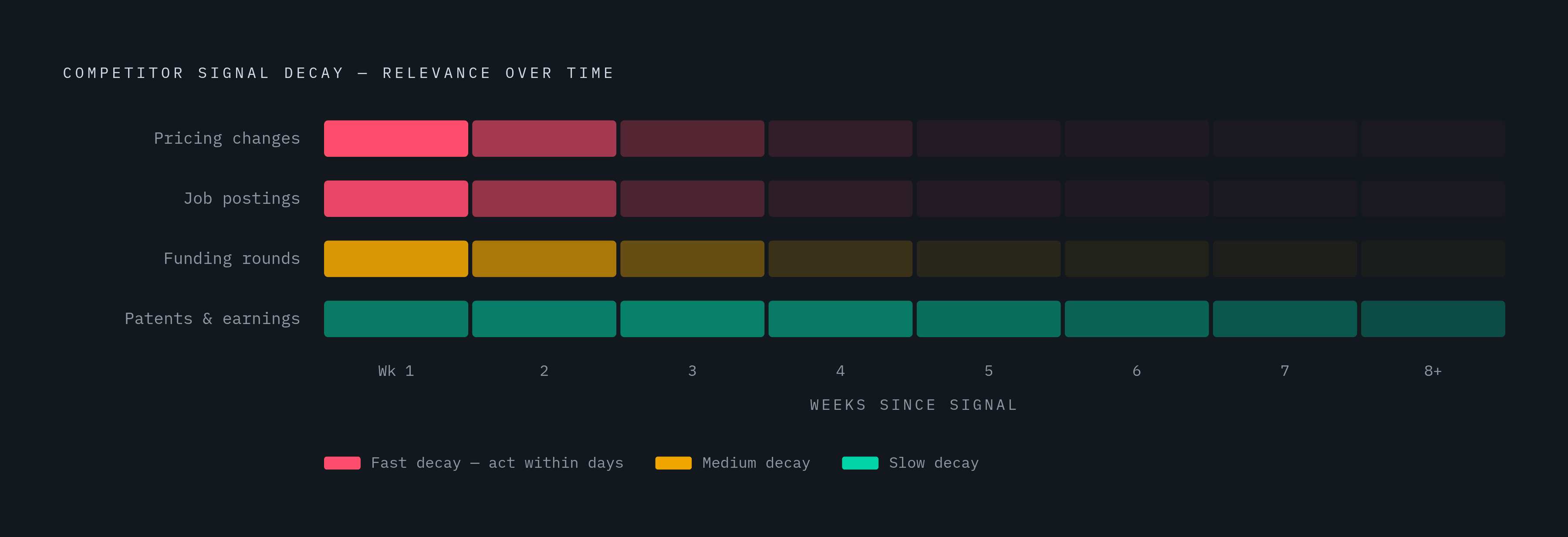
Signals also decay at different speeds, and most teams get the response speed wrong relative to the decay rate. A job posting or a pricing change is red-hot in the first week or two and loses relevance fast. A funding announcement has a similar shelf life. Patent filings and earnings commentary decay slower, but for sales plays, speed of delivery makes a signal usable. Filter for relevance to open deals and named accounts, not everything happening everywhere. Broadcast everything and reps train themselves to mute the channel within a month.
Continuous competitor page monitoring and change detection
Most of the modern web isn't static HTML. Pricing pages render with JavaScript. Job boards load content dynamically. Anti-bot systems sit in front of both. A scheduled script hitting a fixed URL every night misses most of what's actually changing, and teams that still run this way are the ones getting the pricing surprise mid-call.
Continuous monitoring, done right, works differently: point it at a URL (or describe what you're looking for in plain language), set a check interval, and get back a diff, not a fresh copy of the whole page. The system reports what changed, not just that it looked.
That monitoring layer needs a few specific things to work for competitive alerts.
Anti-bot handling matters because detection now checks network reputation, TLS fingerprints, and behavior patterns together, not just one flag. Residential proxy networks have become standard for tough targets like e-commerce and job boards, and skipping this step is the fastest way to get blocked and never know it.
Managed scraping infrastructure has mostly replaced the self-built proxy stack teams used to run in-house. Zyte API's request volume grew 130% year-over-year, which tracks with the broader move away from maintaining a scraping farm nobody wants to own.
There's also a real split between extraction driven by a model that reads the page and old-school selector scraping (CSS selectors, XPath). Selector scraping breaks the moment a site redesigns. AI extraction, where you describe what you want in plain language instead of pointing at a specific HTML tag, holds up far better: researchers at McGill University found setup time dropped from weeks to hours even when page structures changed. For competitor monitoring, that gap is the whole game, because target sites redesign without sending anyone a memo first.
Purpose-built monitoring APIs handle the full loop: register a URL, define what counts as a real change, fire a webhook the moment that condition is met. No manual diffing, no retry logic to babysit by hand. That's the piece of infrastructure that turns polling into an actual event system: it converts raw change detection into triggered events, and most teams try to build it themselves before giving up around month two.
Markdown cuts token usage substantially compared to raw HTML, which matters because the monitoring output usually feeds an LLM next. That model classifies the change before any webhook fires, and token costs pile up fast once you're watching more than a handful of pages.
Structuring the webhook payload so downstream systems can act without human interpretation
A webhook carrying a blob of raw HTML, or a message that just says "competitor page changed," still needs a human to read it and figure out what to do. That defeats the point of building the pipeline. The payload has to carry enough structure that a CRM rule, a Slack formatter, or an AI agent can act on it with zero interpretation required.
A workable payload for a competitor alert webhook needs enough fields that downstream systems can act without human interpretation, things like what changed, which accounts are affected, and what play the signal maps to, captured in a recommended_play field.
Before any of that gets assembled, there's a classification step. An LLM or a rules engine reads the raw diff, figures out what kind of signal it is, writes the summary, and scores urgency, all before the payload goes out. Clean input matters here more than anywhere else in the pipeline. Feeding that classifier garbage HTML produces garbage classification: wrong signal type, wrong urgency, wrong play triggered three steps downstream.
JSON is what makes this reliable. Its key-value structure is what CRMs, Slack apps, and automation tools actually parse without falling over, and Enforcing a schema at extraction time produces more consistent JSON output than leaving it to freeform generation. Enforcing a typed schema up front, instead of hoping the model produces well-formed JSON on its own, is what stops a missing field or a type mismatch from quietly breaking an automation three steps downstream.
Wiring competitor alerts into CRM records, Slack, and sales engagement platforms
The affected_accounts field is doing the real work here. It's what lets an alert land on the desk of the account executive who owns that specific deal, instead of sitting in a shared Slack channel that fifteen people mute by Thursday. That routing decision is the entire difference between a useful alert and background noise, and most teams underbuild it.
On the CRM side, a few patterns recur. A pricing change on a competitor's page can create a high-priority task on the relevant opportunity record, attach the diff as a note, and tag the right battlecard automatically. A job posting in a new vertical can flag accounts in that vertical and drop them into a sequence inside the sales engagement platform. And if a competitor gets mentioned repeatedly across a deal's call transcripts, pulled in through a conversation intelligence integration, that can bump the deal's risk score and alert the sales manager without anyone combing through transcripts by hand.
A Slack message built from this payload should carry the competitor name, the signal type, a one-sentence summary in plain language, the source URL, and a direct link into the CRM opportunity. Reps should be able to read the whole thing and act right there, not click through three dashboards to reconstruct context that should have been in the message to begin with.
The recommended_play field can trigger sequence enrollment directly: a pricing-objection sequence, a competitive displacement sequence, or a vertical-expansion counter-play starts automatically, whichever fits the signal, instead of waiting for a rep to remember it exists and go dig for it.
The webhook relationship runs both directions now, too. The same receiver that lets a form tool create a CRM record can let an AI agent push enriched competitive data back into that record. A webhook is a two-way channel now. It's a two-way channel, and The direction of travel is already visible in platform integrations that open live pipeline data to AI-compatible tools across the major vendors. The direction of travel is a market where webhook signals feed AI agents that read and write pipeline context, not just one or the other.
Speed tier decides which architecture actually fits. Platforms span a range from real-time delivery to near-real-time and daily-batch refresh, and the latency tier shapes what the tool can actually do for active deals. Everything described here is built for the real-time tier, because anything slower gives up the first-mover advantage that makes a competitor alert worth building. A pricing change your rep hears about tomorrow is a pricing change the prospect already brought up on today's call.
Choosing the right tools for each layer of the pipeline
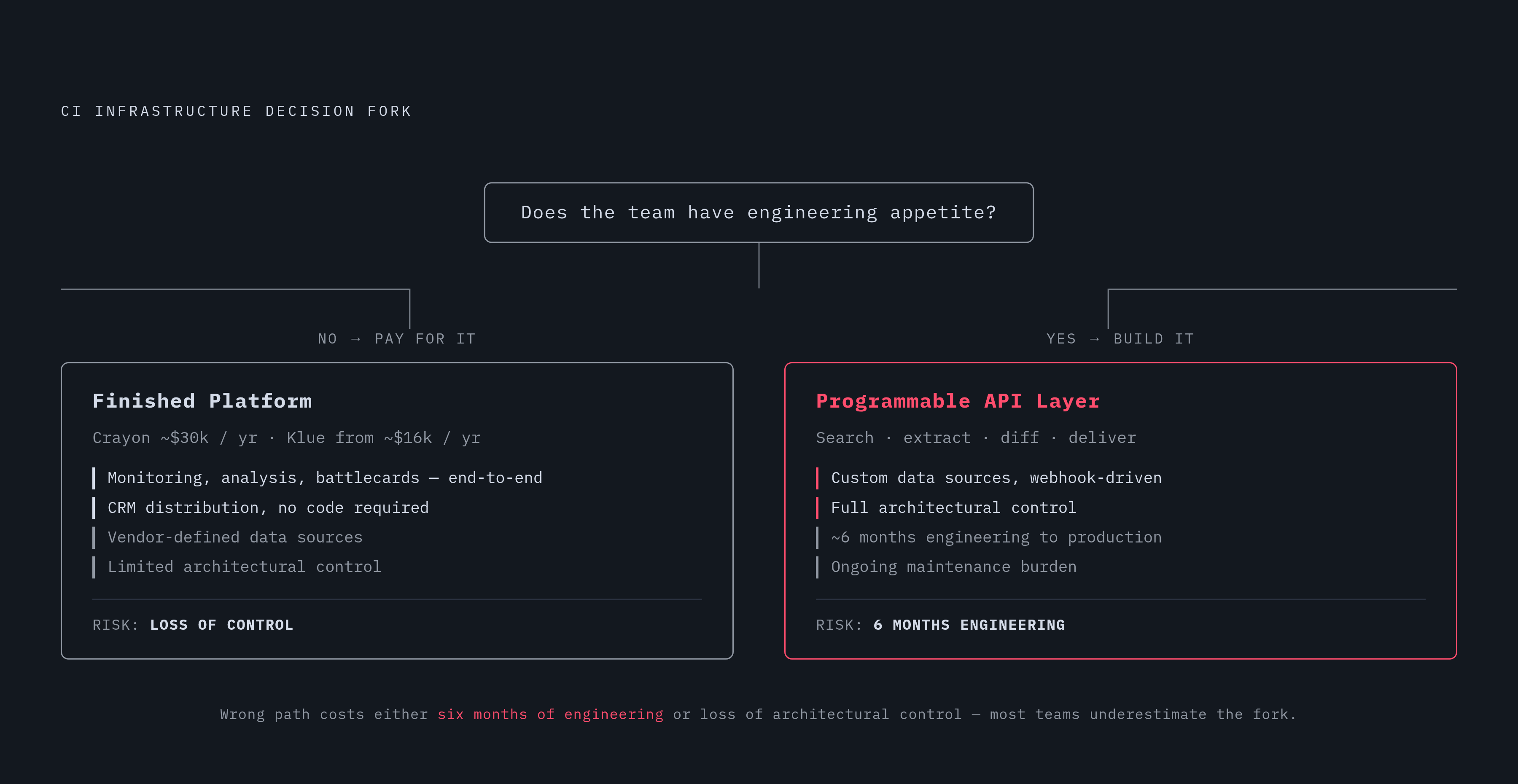
Two paths exist, and picking between them comes down to one honest question: does the team have engineering appetite, or does it want to pay someone else to carry that weight?
Finished CI platforms handle the whole workflow end to end: monitoring, analysis, battlecard delivery, CRM distribution. Pay the subscription, work inside their data sources and output formats, done. That's the right call for a team that wants battlecards and enablement dashboards showing up in Salesforce without writing a line of code, and trying to build that in-house is usually a six-month detour nobody signed up for.
The other path is a programmable API layer: search, extract, diff, deliver, as raw building blocks. That's the route for teams with custom data sources or ones that actually want the webhook-driven architecture described above, built to fit internal tools instead of a vendor's fixed workflow.
Among finished platforms, Crayon and Klue come up most. Crayon monitors competitor websites, review sites, social media, SEC filings, and job postings, and pushes automatically generated battlecards into Salesforce through its Compete product, with a separate Measure product tracking CI's actual impact on deal outcomes. Among teams using its battlecards, 71% report improved win rates, and 93% of those report gains north of 20%. Pricing runs custom, with a median contract around $30,000 a year (Vendr data) and enterprise deals starting near $15,000 a year. It holds a 4.6 on G2 and fits mid-market to enterprise teams with a dedicated CI owner on staff.
Klue takes a similar collection-and-battlecard approach but pairs it with win/loss analysis that blends AI-automated insight with human interviews, plus a Gong/Chorus integration for tracking competitive mentions at the call level. Its Compete Agent AI feature reportedly lifted customer win rates by 28% against top competitors, and the platform counts over 250,000 users globally. Pricing starts around $16,000 a year (Vendr data), and it holds a 4.8 on G2. The choice between the two comes down to one question: is win/loss analysis the priority, in which case it's Klue, or is end-to-end CI with measurable deal impact the priority, in which case it's Crayon.
A handful of more specialized tools sit below those two, and they're worth knowing by name rather than category. Kompyte, now under Semrush, covers CI and battlecards for mid-market teams starting at $300 a month, with unlimited battlecards and Salesforce, HubSpot, and Slack integrations. Salesmotion works at the account level instead of the competitor level, watching over 1,000 public and private sources for leadership changes, hiring trends, product launches, and funding rounds, starting at $85 a month. Owler runs on community-sourced competitor news, with a free tier and a Pro plan at $39 a month, a fit for early-stage teams that don't need enterprise pricing. Gong surfaces competitive mentions and objection patterns straight out of call transcripts, best run alongside a dedicated CI platform rather than as a standalone. ZoomInfo rounds things out with org chart mapping, contact data, and company-level signals, integrating with both Salesforce and HubSpot.
None of these tools replace the judgment of deciding which signals actually matter to a given deal, and no vendor is going to sell that judgment to you. But paired with a webhook pipeline that fires the moment something changes, they turn competitive intelligence from a quarterly document nobody reads into something the sales team acts on the same day it happens.