Building Account-Level Intelligence From Job Posting Aggregation
Pooled job postings reveal hiring patterns that single roles miss, unlocking sales signals.

Treating a job posting as anything other than a spending signal wearing a hiring costume is a mistake. Most job openings get posted within 30 days of budget approval, making a job posting really a spending signal wearing a hiring costume. Someone signed off on money before that listing ever went live.
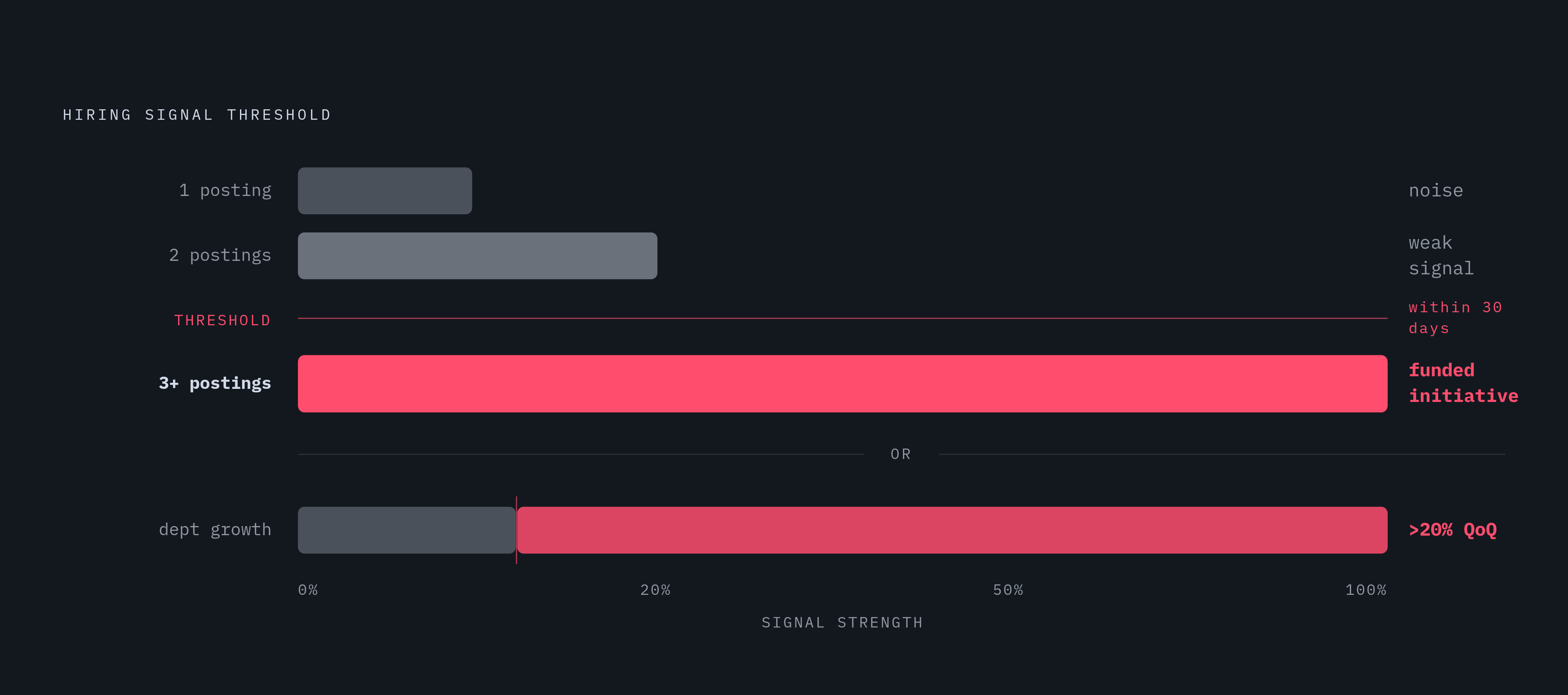
But one posting doesn't tell you much on its own. Below that, it's noise.
Timing matters as much as the pattern itself. The buying window opens when postings go live and closes as the company evaluates, so quick outreach lets a vendor shape criteria instead of bidding on an already-written RFP. And this isn't just a nice theory. Champify's 2025 research found selling into accounts with active buying triggers produces meaningfully higher win rates than cold outreach, justifying the engineering effort behind this pipeline. Practitioners treat a single posting as no signal, instead requiring 3+ related roles within 30 days or department growth above 20% quarter-over-quarter as the minimum meaningful pattern.
The current job posting landscape and unusually rich AI-skill signals
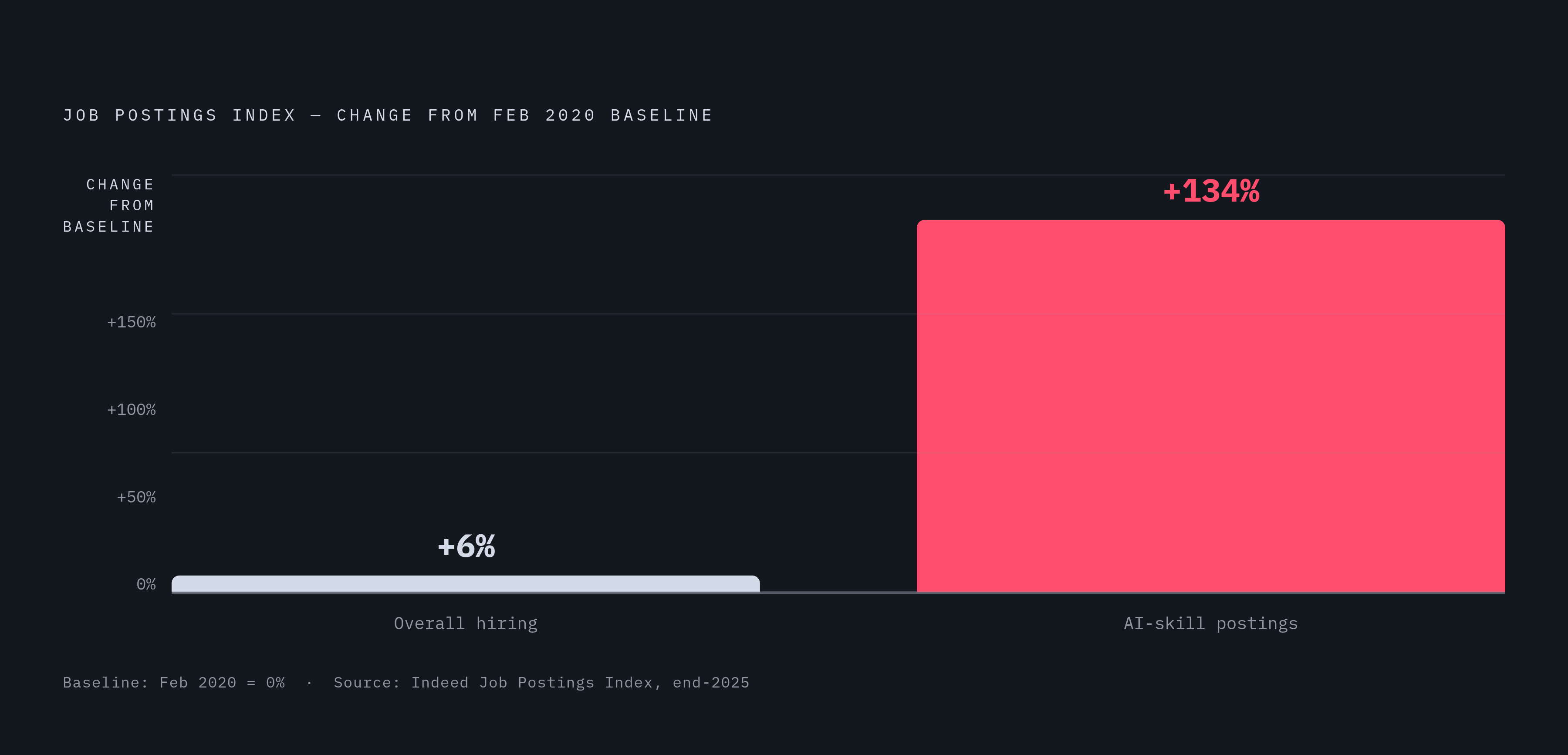
2026 is a strange and useful moment for this kind of tracking. Overall hiring has basically flatlined. Indeed's Job Postings Index was just 6% above its pre-pandemic, February 2020 baseline by end of 2025. Indeed Hiring Lab reported that AI-mentioning postings, by contrast, surged 134% above that baseline over the same stretch. Same market, wildly different trajectories.
It's not evenly spread, either. And this isn't just an internet-forum observation. A Federal Reserve FEDS Notes paper by Liu and Webber mapped job postings onto AI adoption states, treating AI-skill posting volume as a measurable proxy for tech investment. That a central bank research team runs the same analysis a scrappy sales-intel team might is a decent sign the signal is real.
Knowing the signal exists is the easy part, though. Turning a stream of scattered postings into something a sales team can act on requires a different kind of thinking, one that operates at the account level instead of the posting level. According to Indeed Hiring Lab, the signal is sector-specific, with data and analytics postings containing AI-related terms at far higher rates than marketing or human resources postings, and knowing which sectors are dense with AI mentions helps prioritize where to focus aggregation. In a flat overall market, a company posting AI-skill roles is concentrating limited budget, giving vendors an unusually high signal-to-noise ratio.
Account-level aggregation reveals patterns that single-posting analysis misses
A single job posting is a data point. It is not intelligence. Intelligence appears only once you start aggregating: looking at role clusters across one account, tracking how fast a department is growing over rolling time windows, and watching which technology terms keep reappearing across multiple postings from the same company.
Take role clusters first. If an account posts for an ML engineer, LLMOps specialist, and data infrastructure engineer within a short window, that signals coordinated buildout, not isolated hiring. That's a coordinated buildout, probably tied to one budget line and one executive sponsor. Department growth velocity reveals urgency: not just whether a team is hiring, but how fast headcount is expanding. A department that added two roles this quarter is doing routine maintenance.
Then there's the technology layer. Framework, cloud platform, and tooling mentions accumulate across an account's postings, often revealing what it's building toward months before any vendor relationship is announced.
None of this works, though, if the underlying data is dirty. Many postings are ghost jobs, never intended to be filled, and if unfiltered before velocity is calculated, they inflate the whole pattern. The May 2026 Zenodo dataset tackles this with LLM-derived ghost-job labels, flagging probably-genuine postings versus corporate wallpaper. That filtering step has to happen upstream.
There's a historical dimension too, and it's arguably the most useful lens of all. What was this account posting for 18 months ago, versus today? A team quietly shifting from DevOps to LLMOps hiring is signaling a platform shift. It's signaling a platform shift; that delta over time tells more than any single quarter's snapshot. Seeing that, though, requires actually having the data to compare. Which raises the obvious next question: where does all this posting data originate?
Sourcing job posting data at the coverage and freshness the pipeline needs
APIs give programmatic access to a continuously updated or on-demand database. Bulk datasets serve historical analysis, delivered in one go. DIY scraping scripts hand a team full control, and full responsibility for upkeep.
Coverage is the first thing to get right. For account-level aggregation to work, data must span job boards, career pages, ATS platforms, and aggregators, since gaps in any source create blind spots. Coresignal, for example, covers a large historical archive across those source types back to 2020, with richly enriched records, which matters once historical comparison enters the workflow.
Freshness is the second thing, and it's less forgiving than most teams expect. Career pages change layout without warning; LinkedIn's public jobs page structure changed more than once in 2025 alone, breaking scraper logic each time. Betting an entire pipeline on one DIY source is risky when the goal is catching signals within a narrow, time-sensitive window.
On pricing, the options split roughly by scale. Teams building their own scraping layer can start with entry-level plans from ScraperAPI or ScrapingBee, both handling proxy rotation and basic CAPTCHA solving automatically. Pay-as-you-go job scraper APIs generally offer competitive per-record pricing with volume discounts at scale. At the enterprise end, Bright Data runs tiered per-record pricing across datasets and scraper APIs on subscription, and as of 2026 offers a free tier on scraper APIs only, not datasets. For teams needing to catch new postings the moment they go live, search-based discovery tools help: DataForSEO prices SERP data from $0.0006 per task pay-as-you-go, while SerpApi starts at $25/month for 1,000 searches, both suited to monitoring a long account list.
None of this is free of labor, obviously. Maintaining DIY scrapers typically takes a substantial number of hours per month per target, which adds up fast across dozens of career pages. That's the argument for a managed web data API layer instead, handling proxy management, JavaScript rendering, and CAPTCHA resolution, and returning clean Markdown or JSON. It keeps engineering time pointed at the intelligence logic, which actually differentiates the pipeline, rather than at plumbing that breaks every time a website redesigns its footer.
Extracting structured account intelligence from raw job description text
Getting raw postings is only step one; turning messy HTML into structured fields (role, department, seniority, tech stack) is where intelligence gets built.
Traditional extraction methods (CSS selectors, XPath, regex) are fragile by nature. They break every time a career page is redesigned. LinkedIn's structure changed more than once in 2025, so that's a recurring maintenance bill, not a hypothetical risk. The more durable approach is LLM-powered extraction: feed the model the page's HTML or cleaned Markdown, describe the fields needed in plain language, and let it return JSON regardless of layout shifts. The model reads meaning, not DOM position, which is why it survives redesigns that would snap a selector-based script.
The format that data arrives in before extraction directly affects how often the pipeline mislabels a role or misses a skill mention. That's a real design decision. It's a real design decision that shows up directly in how often the pipeline mislabels a role or misses a skill mention.
What should that schema actually capture? At minimum: role title, inferred department, seniority level, technology stack mentions, required-experience floor, posting date, and ghost-job confidence flag. That's a reasonable starting point, and it doesn't need to be invented from scratch. The May 2026 Zenodo dataset, covering US software-engineering postings, shows production-grade labeling at scale: LLM-derived tags for seniority, experience floor, ghost-job assessment, an eight-value skill-theme axis, and a seventeen-value role-family axis. It's a useful reference point for anyone designing their own schema.
There's a cost trade-off worth being honest about. LLM extraction is slower and pricier per page than pure selector logic. Most pipelines land on a hybrid: selectors for stable, predictable sites, LLM extraction for volatile structures or new schemas. Looking further out, vision models extracting data directly from screenshots, paired with self-adapting agents, point toward pipelines needing far less manual babysitting. The NEXT-EVAL study found Flat JSON gives LLMs the best extraction accuracy, an F1 of 0.9567, versus Slimmed HTML or Hierarchical JSON, showing data format is a design decision, not cosmetic.
Storing and querying account intelligence so patterns accumulate over time
None of the extraction work matters if the output lands in a spreadsheet that gets overwritten next week. A flat file or single-run export can't answer the key question: how has this account's hiring changed over the last two quarters? Answering that requires a persistent store built to be queried.
Two kinds of storage do different jobs. A relational store handles structured fields (posting date, role family, seniority, technology tags, department) and supports SQL-style velocity queries, like counting ML-related postings per account within a rolling 30-day window. A vector store handles the fuzzier, semantic side: cleaned job description text feeds a retrieval pipeline, letting agents find accounts posting roles resembling a target profile without exact keyword matches or re-scraping. That's particularly handy for spotting accounts building toward a product category before they've settled on the industry-standard vocabulary for it.
The historical query is where the payoff becomes obvious. Comparing what an account posted 18 months ago against now can reveal a genuine strategic pivot, like a shift from DevOps to LLMOps hiring, reading as technology displacement rather than routine churn. That comparison is impossible without a store built for it from day one.
One non-optional requirement for driving real outreach decisions: every stored record needs its source URL, capture timestamp, and extraction method. That's what lets someone on the sales side actually audit a signal score and check the evidence before picking up the phone. The operational shift is event-driven rather than polling-based: the system watches career pages for change and fires ingestion and scoring only when something moves. Less wasted traffic, fresher signals, lower cost.
Interpreting aggregated patterns as account-level buying signals
With the data flowing and stored, the real question is: what actually counts as a signal worth acting on?
Start with a genuinely counterintuitive one. Emergence Capital's survey of B2B software companies found that 36% decreased SDR/BDR headcount over the past year, the highest reduction rate of any sales role, while only a small share grew that function. Flip that around: a company actively building out its SDR team is doing something unusual, making it one of the strongest intent signals for vendors selling into the pipeline-generation stack. It's a specific role, in a specific function, running against the broader trend, and that specificity is exactly what makes it trustworthy.
That's the shape a good signal map should take across the board: pre-defined patterns tied to a product's actual buying cycle, so the team isn't reinterpreting every new posting from scratch. Role clusters are the clearest general case.
Department growth velocity works as a threshold condition. Growth below a meaningful bar in a given department is background noise. Growth above it is a funded initiative with a real budget line behind it, and it should be flagged as an alert rather than filed away. Technology stack mentions follow a similar logic: one appearance of a framework name in a posting means little, but that same name showing up repeatedly across an account's listings, especially recently, is a much sturdier signal than a single mention buried in a job description nobody read twice.
None of these signals should get equal weight, either. Confidence scoring weights recency, cluster size, role seniority (a VP of AI Infrastructure posting outweighs a junior analyst role), and corroborating signals like a funding round or leadership change. And ghost-job filtering has to happen before any of this scoring runs, not after. Counting a ghost posting toward department growth inflates the calculation, so filtering belongs at extraction, upstream of interpretation, not patched on afterward. Three or more related postings, e.g., ML engineer, data infrastructure engineer, LLMOps architect, from the same account within 30 days signal a coordinated buildout, with the cluster, not any single posting, as the trigger.
Combining job posting signals with other account data to raise confidence
Job posting data is a leading indicator. It is not, on its own, proof of anything. Confidence climbs considerably once hiring patterns get combined with other corroborating signals: a funding announcement that creates fresh budget, a leadership change that brings in new vendor preferences, or a competitive displacement event where a rival vendor just lost a customer.
Account intelligence platforms in 2026 reflect this reality directly. They combine verified contact data, firmographics, buyer intent signals, and technology stack information into one synthesis, with job posting data as just one input. No single data source, however rich, tells the entire story of an account's buying behavior.
Cross-referencing that against job posting patterns narrows the actual buying window considerably, catching accounts earlier and with more confidence than either signal alone could manage. Organizations using intent data this way report a meaningful lift in sales efficiency, since effort redirects toward genuinely in-market accounts instead of a list that was never going to convert.
That's the whole case for building this pipeline. A job posting by itself is a rumor. Aggregated, filtered, weighted against seniority and recency, and cross-checked against funding and leadership data, it becomes something closer to a fact a sales team can act on with a straight face. Account intelligence platform research shows that intent data from content and search behavior surfaces accounts researching solutions 3–6 months before traditional indicators appear, and can be cross-validated with job postings to narrow the true buying window.
Sources
- January 2026 US Labor Market Update: Jobs Mentioning AI Are Growing Amid Broader Hiring Weakness - Indeed Hiring Lab
- The Fed - AI Adoption and Firms' Job-Posting Behavior
- B2B Companies Hiring SDRs, BDRs, and ADRs: What the 2026 Hiring Data Reveals | Salesmotion
- Job Posting Data Aggregation: Multi-Source Guide for 2026
- 9 Best Job Posting Data Providers in 2026 (Scale vs Speed)
- Build vs Buy: Job Data Aggregation for Your Product
- Best Job Posting Data APIs in 2026 (Compared)
- Extracting structured labor market information from job postings with generative ai - Amazon Science