Building a Price Intelligence Feed From Competitor Websites
A blueprint for tracking competitor price changes through five coordinated pipeline layers.
Building a price intelligence feed from competitor websites is a pipeline problem. Its five layers, which are discovery, scraping, normalization, storage, and alerting, must work together to deliver prices that a pricing team or AI agent can trust. A script can collect a number. A reliable feed must also know what that number means, when it was observed, and whether it deserves attention.
Why competitor prices now change faster than any manual process can track
Leading brands now reprice hundreds or thousands of times per day in response to algorithmic pricing, inventory signals, and promotions. A weekly export cannot describe that market while it is happening. By the time someone opens the spreadsheet, the prices may already belong in the history table.
Meanwhile, AI shopping agents compare prices before a human sees a product page, so stale pricing data can directly cost conversions. Adobe Analytics reported dramatic year-over-year growth in generative AI traffic to US retail sites in July 2025 versus July 2024. Current pricing data is therefore becoming load-bearing infrastructure.
The five layers every price intelligence pipeline must have
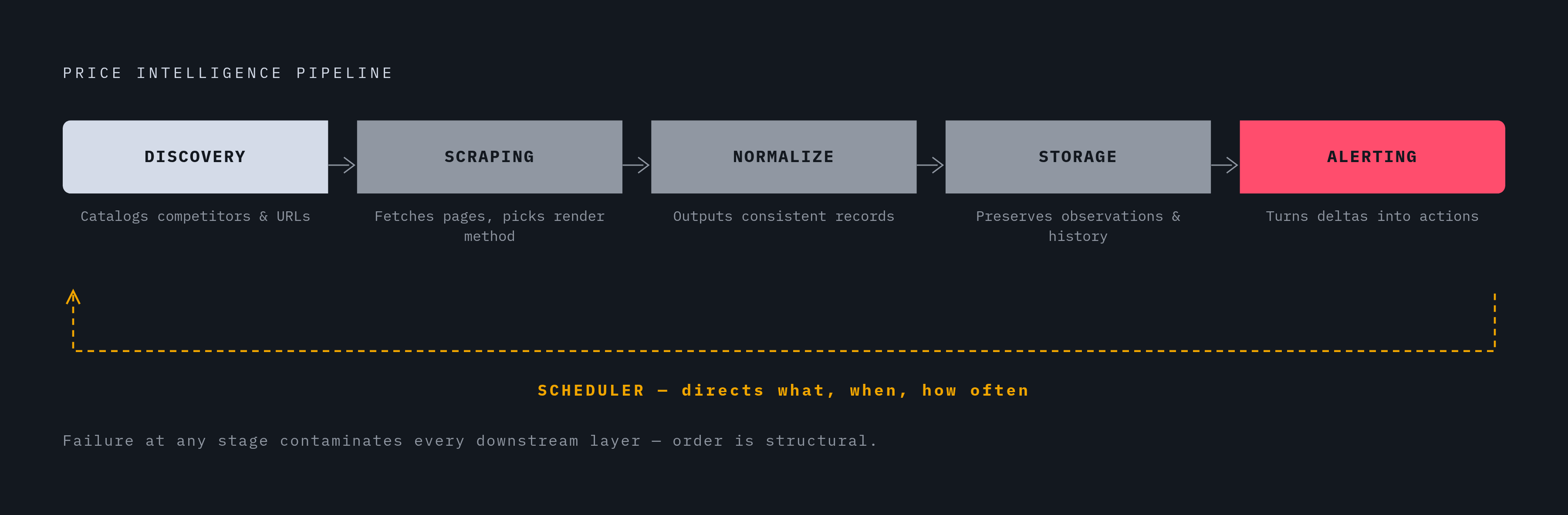
Picture the pipeline as a line moving from discovery through scraping, normalization, and storage to alerting. Discovery maintains the catalog of competitor products and URLs. Scraping fetches those pages with the rendering method each site requires. Normalization turns the output into consistent records, while storage preserves both current observations and price history. Alerting then turns meaningful differences into something a person or agent can act on.
The order matters because a failure in one layer contaminates everything downstream. A perfectly extracted price for the wrong product is still wrong, just neatly formatted. The scheduler supplies the feedback loop around these five layers by deciding what to check, when, and how often. Without it, a fast-moving promotional category gets no more attention than a category whose prices barely move. The architecture needs both a path for data and a way to direct the next fetch.
Building the discovery layer: mapping competitors beyond obvious direct rivals
Discovery begins with a harder question than which websites belong to direct rivals. A competitor may sell a variant, bundle, or private-label equivalent that competes for the same demand without sharing an identical SKU. Intelligence Node describes AI-driven product matching that connects catalog entries to similar products, variant sizes, and adjacent listings. Matching accuracy therefore sets the boundary of what the feed can meaningfully compare.
Intelligence Node notes that marketplace sellers on platforms like Amazon change prices by the hour, making those listings part of the shopper’s real competitive set. Across markets, discovery must resolve the same physical product through different regional URLs, currencies, pack sizes, and languages. This means keeping seed URLs up to date and crawling each competitor’s product hierarchy from time to time to find new listings, discontinued SKUs, and changes to categories. The output is a URL queue prioritized by category volatility, competitive sensitivity, and time since the last fetch.
Scraping the right way: matching the fetch method to what each target site actually requires
Some sites show prices in the initial HTML, but others need JavaScript rendering or interaction before the price appears. Using too little machinery can return blocked or stale content. Using too much wastes compute on pages that never needed a browser. Fetching a simple page with the heaviest stack on hand is like hiring a removal van to collect a sandwich.
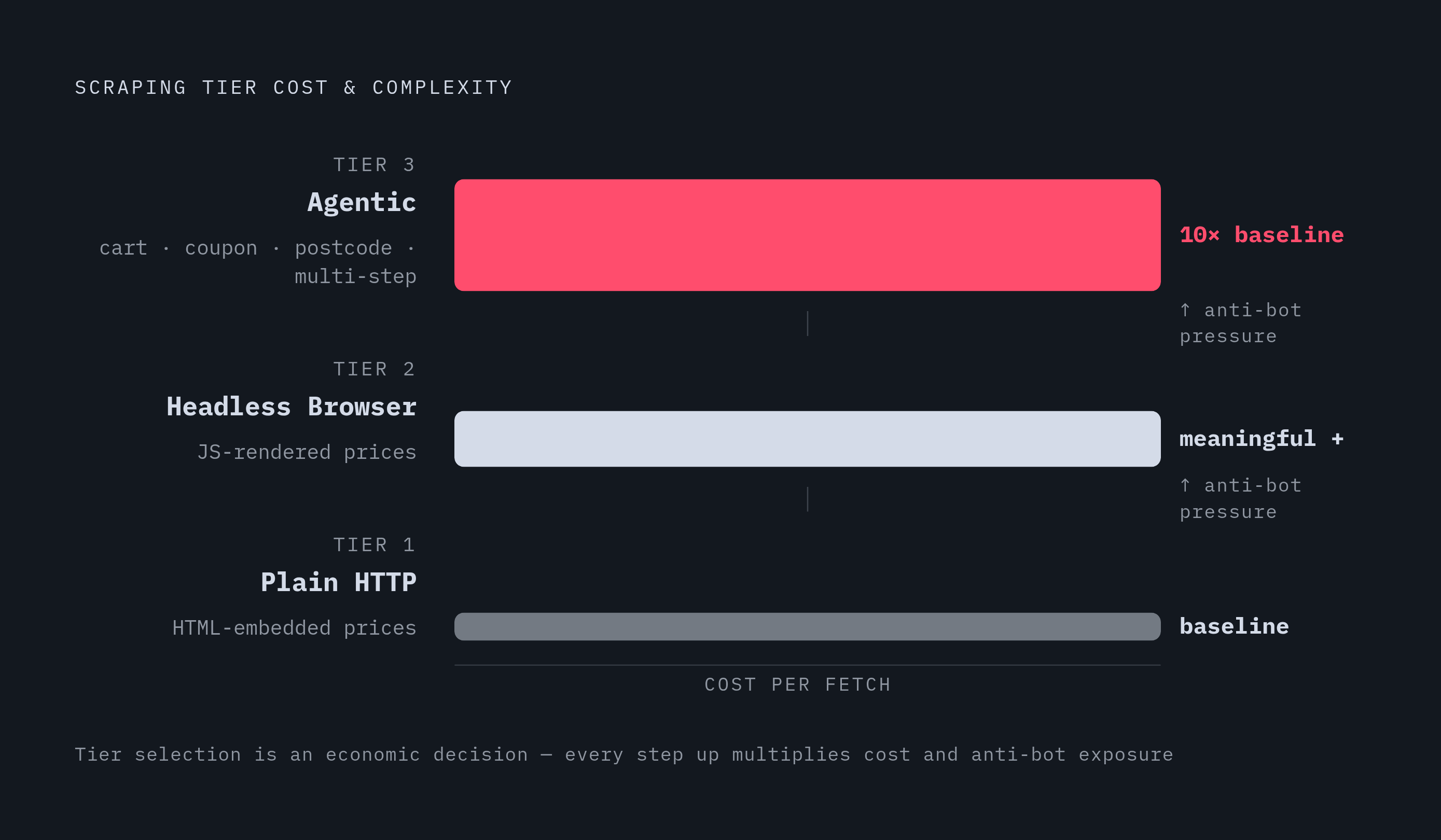
Start with plain HTTP and TLS impersonation through curl_cffi for targets that expose prices in their initial response and do not run advanced bot detection. Move to a headless browser when JavaScript rendering is required. The shift from one browser automation tool to another is a maintenance-driven choice tied to decay in the former's stealth ecosystem. For prices hidden behind cart actions, coupon checkboxes, postal code lookups, or multi-step flows, agentic execution occupies the hardest tier. Those targets need more than a selector pointed at the first page.
Protection adds a separate constraint to rendering. Cloudflare, Akamai, DataDome, and HUMAN Security (formerly PerimeterX) use checks including TLS fingerprinting, JavaScript execution behavior, and mouse or keyboard biometrics. Cloudflare Turnstile combines JavaScript fingerprinting, behavior analysis, and sometimes visual challenges, making it a particularly difficult gate.
Cost rises with each escalation. Headless rendering costs meaningfully more per page than plain HTTP, while residential or premium proxies can push a fully proxied browser fetch an order of magnitude or more above the baseline. Freshness must be sized with that cost. Daily refreshes may suit slow-moving categories, whereas fast or promotional categories may need several checks per day. Every increase in frequency also increases cost and anti-bot pressure.
Normalization: why the schema matters more than the scraper
A successful fetch only proves that the pipeline received content. After a successful fetch, whether the extracted number is the active sale price or the crossed-out original, or a pack price or a unit price, remains unverified. Normalization is where those distinctions become explicit. Without them, the feed can produce confident, wrong data while the scraper reports success. That is worse than an obvious failure because the wrong number arrives wearing a clean shirt.
At minimum, the record needs a product identifier, competitor name, observed price, display currency, and price type, including list, sale, MAP, or per-unit. It also needs the seller or marketplace where applicable, stock status, visible shipping cost, observation timestamp, and source URL. Cart-only prices, coupon toggles, postal code lookups, and volume thresholds require logic that preserves the conditions behind the number. A price after a coupon is not interchangeable with a list price.
Sending structured JSON or clean Markdown to downstream AI also saves the tokens that raw HTML would waste. An alert that omits whether a price is list, sale, or effective-after-coupon cannot support a sound comparison. Normalization therefore deserves the same engineering rigor as fetching, rather than whatever time remains after the browser finally works.
Storage design for price history: choosing the right database tier for the workload
Once records are comparable, storage must support two different workloads. New observations arrive as transactional writes, while delta queries, trend views, and category aggregates demand analytical reads. For most teams starting out, PostgreSQL with the TimescaleDB extension handles both adequately. It scales better than SQLite for millions of price points and adds time-series compression and automated partitioning without a new query language. At petabyte-scale or under heavy analytical workloads, ClickHouse offers stronger query performance and compression through columnar storage.
The schema matters as much as the database choice. Append each observation with its timestamp rather than overwriting the current price, and preserve its source URL so downstream users can retrieve the original page. Index on (product_id, competitor_id, observed_at) to keep delta queries fast as history grows. Retention policy then determines how long raw observations remain, when they become daily or weekly aggregates, and what gets archived or purged. These choices set how much storage costs and how much detail from the past alerts can use.
Alerting that is actually actionable: what a price change notification must include
An alert that says “price changed” is a work assignment pretending to be an answer. A useful notification includes the old and new observed prices, both timestamps, each price type, the competitor and seller, and the source URL. Where tracked, it also shows changes in shipping cost, stock status, or discount eligibility. That context lets the recipient understand and verify the comparison without reconstructing it from raw source content.
Different changes also deserve different interpretations. A list price cut may signal lasting repositioning, while a coupon event may be temporary and a shipping change may alter landed price without changing the product price. Stock changes can provide context for an approaching price move. Thresholds should therefore be configurable by category, because a few percentage points can be meaningful in a thin-margin category and noise elsewhere.
For AI-native teams, the same payload should be structured JSON that an agent can consume directly, including through an MCP server integration. Intelligence Node reports that native AI-agent and MCP integration is a standard 2026 evaluation criterion for buying teams. This moves the feed from a dashboard destination into an input an agent can query while reasoning.
Where agentic scraping fits and where it does not
An agent can also participate earlier in the pipeline, but that does not make it the right tool for every page. Traditional scrapers follow hard-coded selectors, while agentic scrapers use natural-language prompts and LLM reasoning to navigate pages and discover data schemas. They help most with awkward flows that have login walls, AJAX tabs, consent modals, or several steps before a price appears. This is navigation work.
The tradeoff is throughput. Traditional scrapers can process many thousands of pages per hour on a single node, while agents process roughly one to two orders of magnitude fewer. That gap makes agents impractical as the primary fetch mechanism for catalogs containing tens of thousands of SKUs. Lower inference costs improve the economics, but cheaper tokens do not by themselves remove the throughput constraint.
The practical fit is a hybrid pipeline. Traditional scraping handles frequent bulk collection, while agents tackle difficult gates, cart-only prices, multi-step coupons, and implausible normalized observations that need another look. MCP connects this work to agent reasoning by making live price observations available without an export step. An agent can then query the feed during a repricing recommendation loop without becoming the engine for every routine fetch.
The build-versus-buy decision at different scales of catalog and request volume
The economic comparison starts with three costs that are easy to undercount, namely proxy bandwidth, compute, and engineering maintenance. At low SKU volumes, a self-hosted HTTP stack with residential proxies can be cost-effective for targets that yield to TLS impersonation. Maintenance follows the competitor’s timeline. Anti-bot updates do not consult the sprint plan before arriving.
As catalogs reach tens of thousands of SKUs per month, managed APIs can become cheaper overall by handling rendering, proxy rotation, anti-bot access, and structured output. Their customers share the costs of infrastructure, but a team that maintains its own stack pays all of its own engineering overhead. The comparison must cover how often prices need a refresh and how hard the targets are to fetch, as well as the catalog count. It must also account for how much normalization and alerting the team still wants to own.
Available tooling spans Visualping’s free self-serve monitoring tier, per-request APIs, and negotiated enterprise contracts averaging tens of thousands of dollars annually for platforms like Klue and Crayon. The inflection point comes when anti-bot updates, proxy rotation failures, and rendering regressions cost more to maintain than a managed API.
Keeping the pipeline accurate as competitors actively resist it
A feed needs ongoing work whether it is built or bought. Competitors change how their pages are built, anti-bot vendors update their detection signatures, and the way JavaScript rendering works changes. Some failures remain invisible to ordinary error logs, including a cached fallback price, an extracted crossed-out original, or an alert threshold that misses a flash sale. A successful request is not a certificate of truth.
Price plausibility validation should flag observations that fall outside a believable range for the category before they reach alerting. Coverage monitoring should track successful fetches against attempted fetches per competitor domain, since a sudden drop can signal new protection or a site restructure. Schema drift detection should flag when null-field counts rise above a baseline. Together, these checks distinguish a changing market from a deteriorating instrument.
A rival that reprices several times daily during promotions may warrant more frequent checks in those windows and a lower baseline outside them. Those adjustments connect discovery, fetching, normalization, storage, and alerting into a maintained system. A pipeline that monitors itself gets more accurate over time. One that does not merely drifts.