Validating and Normalizing Web-Sourced B2B Data Before CRM Import
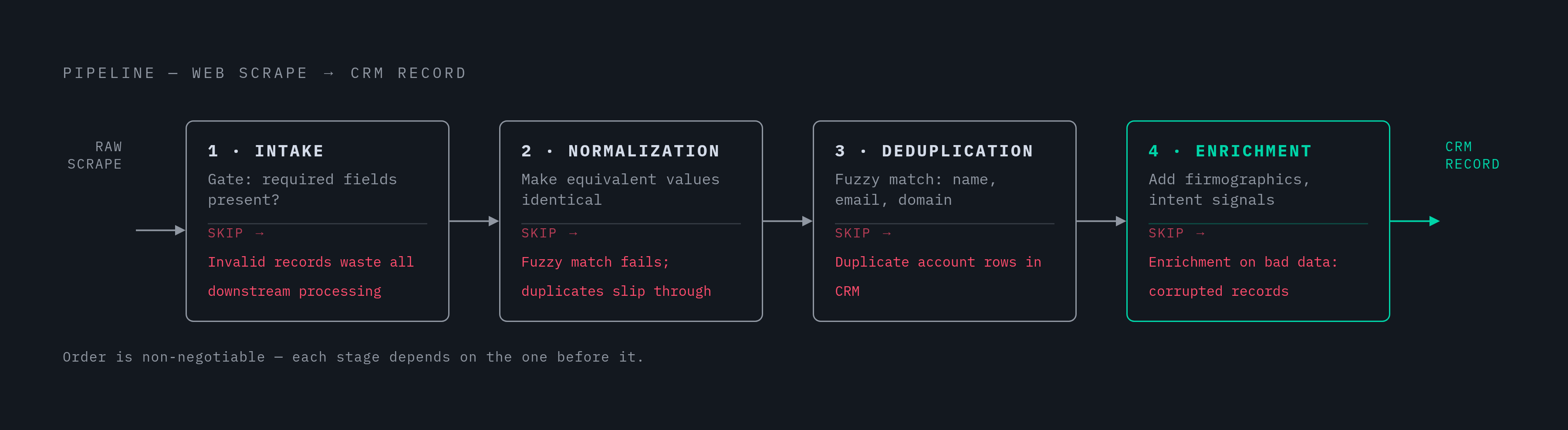
A four-stage pipeline transforms messy web data into clean CRM records.

A web scrape is a guess dressed up as a fact. It tells you what a page said at one moment, not what's true about the company or person behind it, and treating that guess as a verified contact is where most CRM headaches start.
Three compounding failure modes arrive together in every raw scrape. The first is formatting chaos: the same job title is entered into your import batch three different ways, "VP Sales," "Vice President, Sales," and "VP of Sales," and your CRM reads those as three separate humans instead of one. The second is decay. B2B contact data goes stale at a fast clip every year, so a good chunk of any list is already wrong before anyone runs a single workflow on it. Public trade registers and the databases that depend on them move slower than real companies do, so an acquisition or an office move can sit unprocessed for weeks or months while automated tools keep pulling the old, wrong address. Websites redesign constantly, and a small change, moving a price tag, renaming a CSS class, adding a section, can quietly break an extraction script so it returns blank fields or wrong values without throwing a single error. And at the company level, matching logic often can't tell that "Logistics BV" and "Logistics B.V." are the same business, so duplicates get planted in the database before a record ever reaches the CRM.
None of this stays theoretical for long. Salesforce's State of Sales research found that reps spend under 30% of their time actually selling, with the rest eaten up by account research, field validation, deduplication, and fit scoring. Feeding that system bad data makes the drain worse. The CRM treats a verified contact and an educated guess the same way. It just stores what it's given, and the sales team inherits the cleanup bill.
The four-stage pipeline that turns a raw scrape into a trustworthy CRM record
Turning a scraped guess into something a sales team can trust takes four stages, run in a fixed order: intake, validation, normalization, and activation, because skipping a stage or running them out of sequence produces predictable failures.
Each stage has one job. Intake decides what's even allowed in the door, checking for complete fields before anything gets processed. Validation checks that what made it through intake actually matches the formats, value lists, and relationships it's supposed to. Normalization takes values that mean the same thing and makes them look the same, so later steps don't have to guess. Activation enriches the records that survive all of that with the firmographic and contact details a scrape could never capture, right before the record enters the CRM.
The order isn't a style preference. Running normalization on data nobody's validated wastes processing power cleaning up records that should have been thrown out already, and running enrichment before normalization just manufactures duplicate account rows that sit in the CRM forever. Good go-to-market teams don't treat this as a one-and-done import job, either. Leading GTM teams treat this as a continuous process, not a one-time import project, revalidating records on a regular cadence, triggering the pipeline after every import, and flagging conflicting field values automatically.
Stage one: intake filtering before a record enters the pipeline
Intake is the gate, not the fix. Its only job is deciding what's even allowed to enter the pipeline, and it's the cheapest step in the entire process by a wide margin. Rejecting an incomplete record before anyone processes it costs essentially nothing. Catching that same bad record after it's already been enriched, deduplicated, and imported into the CRM costs multiples more.
The minimum required fields for a B2B contact to be processable, not just present on the page, are: company name, business email, country, industry, and account owner. Missing any one of those means the record can't be routed, scored, or segmented correctly, no matter how good the rest of the data looks.
Completeness is only half the gate. Format checks run alongside it. Email addresses need both a syntax check and a domain check, confirming the domain actually exists and accepts mail. Phone numbers get a basic sanity check at this stage, just confirming the value looks like a real number, with the detailed E.164 formatting saved for the normalization stage. Website URLs get checked for whether the domain resolves at all, since a scraper that hit a dead page will often hand back a URL that looks fine but leads nowhere. Postal codes and country codes get matched against known formats for the geography they claim to belong to.
Then there's the relational check, which catches a quieter kind of error. A contact record pointing to a company account that doesn't exist in the CRM becomes an orphan, and orphaned records break segmentation and forecasting later on. That check has to happen here, at intake, not after the record's already been imported.
HubSpot's property validation rules can enforce email format, phone format, and picklist values at the form level, though picklist enforcement isn't natively available through the API. Salesforce uses formula-based validation rules, optionally paired with field-level requirements, to reject bad entries before they're saved. Page layout requirements in Salesforce only apply in the user interface and get bypassed entirely by API calls, so they can't be trusted as the actual data gate.
Records that fail intake shouldn't just vanish. Route them to a quarantine queue for a human to look at. A dropped record isn't a solved problem, it's an invisible one, and invisible data-quality debt is the kind that compounds quietly until someone notices the pipeline's reports don't match reality.
Stage two: normalization so that equivalent values become identical
Passing every format check at intake doesn't mean a record is safe to use; normalization exists to make equivalent values identical, so every system downstream treats equivalent things as equivalent without a human stepping in to interpret anything.
Skipping this step produces failures that are silent, which makes them worse. A campaign built to target "Director"-level contacts will quietly miss everyone stored as "Dir." or "Directeur," and the filter won't throw an error. It'll just run correctly and return a wrong result. "Acme Inc." and "Acme, Incorporated" get stored as two separate accounts, and the same company ends up getting the same outreach twice. Territory rules keyed on state or country choke on "Calif." or "N.Y.," and leads get misrouted or stuck unrouted entirely. And a revenue-by-industry report becomes meaningless the moment "SaaS," "Software," and "software as a service" are treated as three separate buckets inside the same field.
Some fields carry more downstream impact than others here, because a field used more often in matching or reporting amplifies any error it contains. Job titles are a good place to start: mapping "VP Sales," "Vice President, Sales," and "VP of Sales" to one canonical title and function using NLP-based entity recognition improves match rates by 15 to 25% compared to just matching exact strings. Phone numbers need to be normalized into E.164 format, with the country code and number strung together consistently, because numbers pulled from directories and map listings arrive in every format imaginable, and no CRM deduplication tool can match "+1 (415) 555-0132" to "14155550132" without this step done first. Country and region values need to collapse down to ISO full names, since "United Kingdom," "UK," "U.K.," and "Great Britain" sitting in the same field break territory logic and make any geography-based report unreliable. Company names need their legal suffixes stripped for the matching key, while the original name stays preserved in a separate field, so "Logistics BV" and "Logistics B.V." resolve to the one entity they actually are. Dates and currency need to standardize to ISO 8601 and one declared base currency before any of it touches financial or time-series reporting.
Industry fields deserve their own mention, because free text is the enemy here. Controlled taxonomies, meaning dropdown menus and predefined value lists enforced at both the form level and the API level, keep this from sprawling. Free-text industry fields will generate dozens of variants of the same sector within months if left open.
None of this is a one-time cleanup project. A repeatable loop runs six steps: audit the current state of your fields, define the canonical standard, transform records in bulk, deduplicate, enrich, and monitor, then start the loop again. Treating cleanup as a one-off job instead of running the loop brings the mess back within a quarter. Normalization also makes the next stage, deduplication, possible. Without it, your matching logic has to fight formatting variation and genuine entity confusion at the same time, and it tends to lose on both fronts.
Stage three: deduplication using fuzzy matching, not exact strings
Once values are normalized, duplicates stop hiding behind spelling differences, and that's the only condition under which deduplication actually works well. Exact-string matching alone isn't built for web-sourced data. Real records are full of spelling variants, nickname swaps, and domain aliases that look like different entities to a string comparator but are the same company or person in the real world.
The numbers make the case on their own. Naive exact-match deduplication misses 40 to 60% of true duplicates in practice. Catching the rest takes fuzzy matching logic that weighs name, email, and domain together instead of checking any one of them in isolation.
Here's roughly how that works without getting lost in the machine-learning weeds. The system builds a confidence score by looking at several signals at once: how well the name, company, and title line up together, whether a predicted email pattern matches what's on file, whether a LinkedIn URL correlates to a verified work email, and whether there are behavioral signals like a recent job change. Records that clear a high enough confidence threshold get merged automatically. Records that land in the gray zone get flagged for a human to review instead of being merged on the spot, because auto-merging a low-confidence match destroys data that happened to be correct. Over time, these systems also get smarter about which sources work best for which industries, company sizes, and geographies, so routing improves and fewer API calls go to waste.
Merging also needs a rule nobody can argue with later: when two records match, which field values actually survive the merge? That rule has to be explicit and set before deduplication runs. Leaving it implicit makes the results unpredictable, and the audit trail that's supposed to tell you what happened to a record disappears with it.
There's a version of duplication that most native CRM tools don't catch at all: cross-object duplicates. A contact can be correctly deduplicated on its own, but if that contact is linked to a company account that's itself a duplicate, the structural error survives the contact-level cleanup entirely.
The scale of what's at stake here is bigger than most people assume. Deduplication tends to produce a meaningful drop in total record counts even in a well-maintained CRM, and in a CRM that's been ingesting web-sourced data with no normalization step in front of it, that drop is bigger still. Inflated record counts don't just look messy. They overstate deal totals and segment sizes, and quota planning and campaign budgets built on those inflated numbers are decisions built on fiction. Fuzzy matching is, in a real sense, cleaning up a mess that normalization was supposed to prevent. Do the normalization work properly and deduplication gets faster, cheaper, and a lot more accurate.
Stage four: enrichment to fill what scraping cannot reach
A record that's survived intake, normalization, and deduplication is structurally sound, but sound isn't the same as useful. Verified email, direct dial, revenue band, tech stack, intent signals, these are rarely sitting on the page a scraper pulled from in the first place, and that's exactly the gap enrichment exists to close.
Firmographics, meaning industry, employee count, revenue range, and location, form the foundation for scoring whether a company actually fits your ideal customer profile. Without consistent firmographic fields, there's no way to look back at closed-won deals and identify the three to five traits that actually define a best-fit account. Technographic data, the tools and platforms a company already runs, changes the conversation. A contact at a company running a competitor's product needs a different pitch than a contact at a company running nothing at all. Verified email matters for a blunter reason: high bounce rates are the fastest route to getting your outreach domain flagged as spam, so email addresses should come from the company's own pages first and get SMTP-verified before they ever enter the database. Intent signals round this out, things like content consumption, hiring activity, and research patterns that suggest an account is actively shopping. Clusters of job postings, in particular, tend to signal where a company's product is headed months before any public announcement confirms it.
A skilled human researcher can enrich a record accurately, but it's slow and expensive per record. AI enrichment gets comparable accuracy done in seconds, at $0.03–$0.30 per record.
Every stage before this one exists to make enrichment worth doing. A clean, validated, deduplicated record is a solid place to land new information. Enrich a messy one and all you've done is make the mess more expensive to untangle later.