Review Site Monitoring for Competitive Sentiment Shifts
Catch competitive weakness signals in reviews before they become crises.

Google alone handles 73% of all online reviews. That single stat should stop most competitive intelligence teams cold, because it means the majority of what customers say about your competitors, in public, unprompted, is sitting in one place, and most teams still aren't pulling it in automatically. This piece is about building that pipeline: what to watch, what to pull out of each review, how to keep the data flowing, and what to actually do once you see a pattern.
Review sites are weird in a good way. Unlike an analyst report or a competitor's own marketing page, a customer review wasn't written to persuade anyone of anything. Someone had a bad week with a support ticket, or a great one setting up an integration, and they typed it out. That's the raw material. Most companies only look at it after a complaint has already blown up into a support fire or a lost renewal. By then the signal's been sitting there for weeks. The fix is watching reviews continuously. It's watching them the way you'd watch a stock ticker, continuously, structurally, and with alerts that fire before the fire does.
Which review platforms to monitor based on your market
Not every platform matters equally, and picking the wrong ones wastes engineering time on data nobody will act on.
B2B software companies should live on G2, Capterra, Gartner Peer Insights, Software Advice, and TrustRadius. What makes these useful isn't just review volume, it's structure: G2 in particular breaks ratings into sub-scores like ease of use, quality of support, and ease of setup. That means you can compare your product against a rival on a specific dimension instead of just eyeballing star counts. Trustpilot sits in an odd middle ground, it covers both B2B and consumer brands, but it doesn't carry those software-specific sub-ratings, so treat it as a general sentiment gauge rather than a feature-level one.
Consumer and ecommerce brands should point at Amazon, Walmart, and Target. These platforms produce the highest review volume by far, which makes them the best place to spot patterns at scale, not just isolated complaints from one loud customer.
Any business with a storefront, a service call, or a local footprint needs Google Reviews and Yelp in the mix. A single bad string of reviews on Google can sink foot traffic faster than almost anything else, so this isn't optional for local competitive tracking.
And then there's Reddit. It's where people say the unfiltered version of what they wrote a polite three-star review about elsewhere. Formal review sites get moderated, gamed, and sometimes incentivized. Reddit threads about "anyone else switching off [tool]" tend not to be.
Fields that carry competitive signal in a review
A review is not just a star rating and a paragraph. Everyone captures that, and it tells you the least.
The full record usually includes reviewer metadata (their role, company size, whether the purchase was verified), a timestamp, platform-specific sub-ratings, structured pros/cons fields, and sometimes explicit competitor mentions. Each of these carries weight differently:
Star rating trend over time. A single 2-star review means nothing. A competitor's rolling average dropping quarter over quarter is a leading indicator worth watching closely. Aspect sub-ratings. G2's breakdown of setup, support, and usability maps almost directly onto how you'd position against them in a sales deck. Verbatim complaint clusters. If "poor customer support" or "clunky onboarding" shows up over and over in a competitor's reviews, that's not an anecdote anymore, that's ammunition, but only once you've counted it, not just noticed it once. Switching language. Phrases like "we moved from X" or "compared to Y, this was easier" are gold. Most monitoring setups miss these entirely because they're buried in free text, not a tagged field. Churn signals. Watch for cancellation talk, downgrade mentions, or complaints that spike right after a pricing change. Reviewer segment. An enterprise buyer complaining about a broken integration with another vendor's product signals a bigger deal at risk and a more damaging churn case to cite in sales conversations, while an SMB user annoyed by a confusing onboarding email points to a smaller, lower-stakes fix. Same complaint category, very different weight.
None of this works across platforms unless it's normalized first. G2's rating scale, Trustpilot's, Amazon's star system, they don't speak the same language out of the box. Build one shared schema, rating, date, platform, reviewer segment, verbatim text, aspect scores where available, before any analysis touches the data. Skipping this step causes cross-platform comparison to quietly fall apart without anyone noticing until the numbers stop making sense.
Scraping architecture and the anti-bot reality of continuous review collection
A one-time scrape gives you a snapshot. Sentiment shifts are visible only in a time series, so regular, recurring collection is essential for anything called competitive monitoring, with higher frequency making sense when a rival has just changed pricing or shipped a major release.
Some scraping tools are designed to query multiple review platforms in a single run from just a product name or domain, normalizing the output into a consistent format automatically. That's a meaningful head start for teams that don't want to build five separate scrapers from zero.
The real obstacle is staying past the bouncer. It's staying past the bouncer. G2, Trustpilot, and Amazon all run aggressive bot detection, and the landscape is getting stricter, not looser. As of September 15, 2026, Cloudflare has begun blocking mixed-use AI crawlers on ad-supported pages for new domains, a shift that can directly hit pipelines targeting review sites sitting behind Cloudflare's infrastructure. Pipeline design has to account for that shift now, not after it breaks something in production.
Even the best providers in independent benchmarks don't clear a perfect success rate across every platform. Build retry logic and failure handling into the pipeline as a baseline assumption. Proxy choice matters too: residential proxies get through protected targets more reliably than datacenter proxies, but they cost more per gigabyte, so most teams end up mixing proxy types based on how hard a given target fights back.
Keep the collection layer stateless and restartable. Schedule the runs, export to persistent JSON or CSV, and pipe the output to webhooks, a BI tool, or a downstream LLM workflow. If a run dies halfway through, it should pick back up, not start over.
Build vs. buy for review monitoring infrastructure: where the economics land in 2026
Building this in-house sounds appealing until the maintenance bill arrives. Engineering time, proxy costs, and constant patching every time a target site changes its anti-bot rules add up to a recurring cost that never really ends.
Managed scraping services span a wide range, from cheap monthly plans for basic needs up to custom enterprise pricing for high-volume operations. For most teams pulling review data at moderate scale, the managed route wins once total cost of ownership gets calculated honestly. Building in-house only pencils out at extreme scale or when requirements are genuinely unusual, not because it feels more "in control."
The costs that sneak up on teams aren't the obvious ones. A provider advertising a high success rate still leaves thousands of failed requests at scale, and some billing models charge for those failures anyway. Storage, ETL processing, and schema validation all scale with volume too, quietly adding infrastructure overhead nobody budgeted for. And engineering time spent chasing anti-bot updates doesn't stop after launch, it just keeps recurring, month after month, like a subscription nobody remembers signing up for.
Turning collected reviews into structured competitive signal: sentiment analysis approaches compared
Positive, negative, neutral. That's the floor, and treating it as the ceiling is where most sentiment projects quietly fail. Binary sentiment tells you a competitor's reviews got worse. It doesn't tell you why, or on what dimension, or whether it's fixable.
Aspect-based sentiment analysis (ABSA) is the actual target here. It splits sentiment out by dimension, pricing, UX, support, integrations, performance, rather than collapsing a whole review into one tone. A single comment can praise support and trash pricing in the same breath, and a system that flattens that into one score is corrupting the analysis before it starts. Extra care is needed when a review mentions both your product and a competitor's, since misattributing which sentiment belongs to which company is a common and easy-to-miss failure mode.
On the model side, research from Krugmann and Hartmann found zero-shot LLMs can match or beat traditional transfer-learning methods for sentiment classification accuracy. LLMs also handle sarcasm, emojis, and context better than older lexicon-based approaches, which matters a lot on consumer platforms where people don't write in complete, polite sentences. Smaller language models cost less to run, but research has found notable gaps in reproducibility and reliability for smaller models compared to more established approaches. For most competitive monitoring work, LLMs should be the default choice for anything nuanced; smaller models make sense only for high-volume, lower-stakes classification where cost is the deciding factor.
Beyond plain positive or negative, some tools now detect specific emotions: frustration, urgency, relief. A frustrated review signals higher churn risk on the competitor's side, while a merely negative one does not carry the same weight. A frustrated review and a merely negative one point to very different levels of churn risk on the competitor's side.
Pipeline patterns for continuous competitive sentiment monitoring
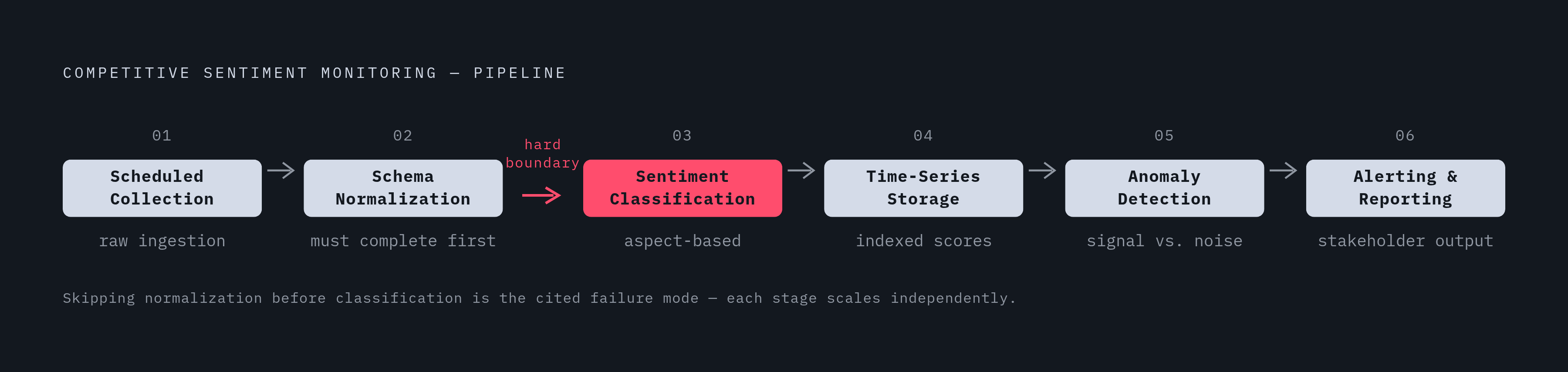
The pipeline itself follows a fairly consistent shape: scheduled collection, schema normalization, aspect-based sentiment classification, time-series storage, anomaly detection, then alerting or reporting.
Collection cadence should be weekly minimum, moving to daily in fast-moving markets or right after a competitor launches something or changes pricing. Normalization has to happen before classification touches the data, since G2, Trustpilot, and Amazon each structure their review data differently, and skipping normalization is how cross-platform comparisons quietly produce garbage numbers.
The modular version of this stack keeps each source's collection separate, merges everything into one shared dataset, then runs classification as its own post-processing step. That separation matters practically: it means collection and analysis can each scale on their own schedule, and a hiccup in one doesn't take down the other.
Competitive patterns to surface and how to act on them
None of this infrastructure earns its keep unless it changes a decision. So here's what to actually do once the patterns show up.
When a competitor's negative reviews cluster tightly around one weakness (say, "complex setup") and that's a place your product genuinely wins, use their customers' own words in comparison pages and sales enablement. Specific language beats vague claims every time. "Easier to use" is forgettable. "No IT ticket required to onboard" (because that's literally what their reviewers are complaining about) sticks.
When sentiment is sliding but review volume holds steady, that's usually a sign of quiet, accelerating churn risk among their base, not a random dip. That's the moment to time an outbound push or a paid campaign aimed at their customer list, while the frustration is fresh and before a competitor's retention team gets ahead of it.
And when a new complaint theme appears right after a competitor raises prices, layering review sentiment on top of pricing data tells a much sharper story than pricing alone ever could. Pricing data says they made a move. Review data says whether it backfired.