Managed Scraping API Shortlist for Startups That Can't Afford a Single Blocked Request
Four managed APIs compete on billing model and block resilience, not just feature labels.
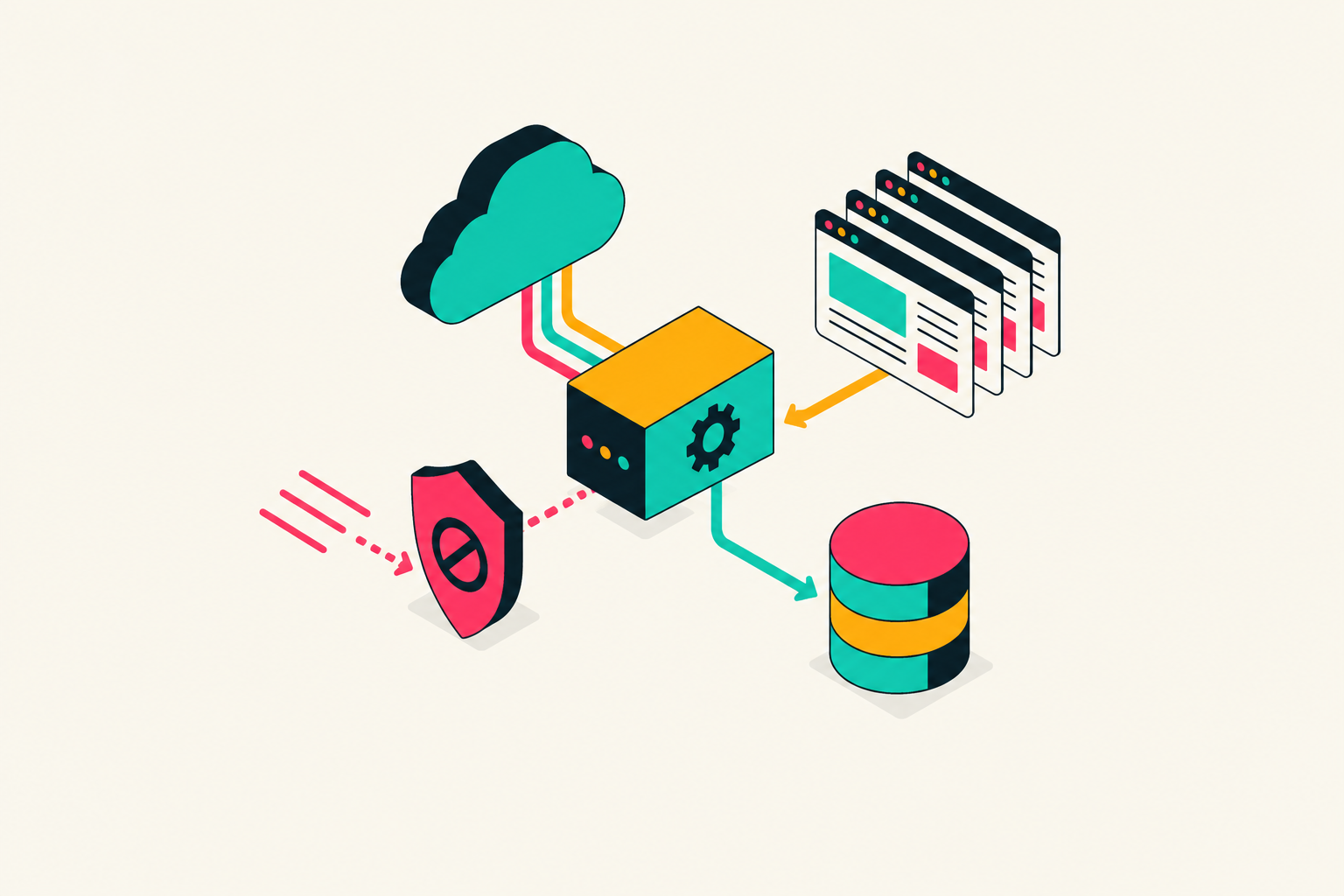
For high-volume startups blocked by anti-bot systems, the managed scraping API shortlist starts with Zyte for managed crawling, ScrapeGraphAI for AI-native extraction, and Scrapewise for page access with client-owned parsing. SearchApi fits search-results workloads. The deciding factors are billing on usable delivery, anti-bot depth, retry behavior, and IP quality (the available evidence cannot establish a promise of zero blocks).
Why "managed" does not automatically mean "block-resilient"
Modern target sites make scraping hard even before the number of requests starts to matter. Dynamic single-page applications can return an empty shell to a plain HTTP request, while anti-bot platforms can return a CAPTCHA. For an AI pipeline, that is an empty lunchbox with a delivery receipt.
Requests can be blocked at three layers, namely IP reputation, browser fingerprinting, and request frequency. Web application firewalls can pre-flag cloud-provider networks, recognize an implausible browser identity, or challenge traffic arriving too quickly. Fixing only one layer leaves the others exposed. A fresh IP does little good if every request wears the same suspicious fingerprint.
The managed scraping market in 2026 wraps different products in similar language, including “anti-bot bypass,” “residential IPs,” and “AI-powered.” Those labels say what a product can do but leave open what happens when a target rejects traffic under load. The useful distinction is whether the provider absorbs that rejection or passes it into the client’s pipeline. A startup that depends on each result needs to know who handles that rejection before it finds out in production.
How billing model determines whether a blocked request costs you twice
Pay-per-call billing turns a blocked request into both missing data and a charge. On heavily defended domains, meaningful block rates can push invoices far above projections based on headline request prices. The startup pays for the attempt, then pays again to try to obtain the result. Failure gets its own line on the bill.
Pay-per-successful-result billing places retry and failure costs with the provider instead. That aligns the provider’s incentives with delivery, although it does not itself prove that the returned content is usable. Credit-multiplier plans introduce another complication because JavaScript rendering and residential routing each consume additional credits. When those multipliers compound, the advertised price says little about what it costs to extract the data.
A cheaper pay-per-call plan can still look good in a spreadsheet. Compare plans by cost per usable record. On hard targets, that denominator changes the buying decision because failed attempts consume money without producing data. Before comparing features, ask what happens to the balance after a blocked response or timeout. If the answer is ambiguous, price the service as pay-per-call.
What anti-bot depth actually means beyond proxy rotation
Proxy rotation is the entry requirement. A provider also needs to handle browser fingerprints, TLS signatures, behavioral timing, and CAPTCHA challenges. Each layer can expose a request that looks convincing at another layer.
ScrapeGraphAI’s 2026 comparison describes a request lifecycle that begins with proxy selection based on the domain, geography, and target’s defenses. Quality services maintain per-IP reputation scores rather than treating every address as interchangeable. Dispatch then requires browser-like headers, TLS fingerprints matched to real browsers, and realistic timing. Reused fingerprint templates give targets a pattern to recognize, even when the IP keeps changing.
JavaScript rendering adds a separate burden because headless Chromium must execute the page and capture its DOM. This is resource-intensive, which explains its higher credit cost and makes it an important failure point. CAPTCHA handling must also happen within the request flow, or the session is abandoned. “Supports rendering” does not answer whether a provider can deliver a rendered page through a challenge.
Infrastructure can undermine all that browser work. A convincing fingerprint on a datacenter IP can still attract a Cloudflare Enterprise challenge because the network itself is suspect. To interrogate a vendor’s claim, ask for success rates split by Cloudflare-protected, DataDome, and PerimeterX targets. Then ask whether those rates are independently benchmarked or self-reported. A single blended percentage hides the difficulty of the targets behind it.
Retry logic and session management — the layer between anti-bot and uptime
Even a strong anti-bot stack has failures. Provider-side retries can absorb them by re-dispatching a request with a different IP or fingerprint before returning a result. The pipeline sees success, but response time increases. Whether that recovery produces an additional charge depends on the billing model.
Client-side retries move that work across the boundary. The API returns a 4xx or 5xx response, and the startup must handle backoff, timeouts, and queue management. Under pay-per-call billing, each new attempt also adds another charge. The engineering bill is less visible, but real. A service that delegates recovery is managing less of the workload than its headline may suggest.
How sessions behave needs just as much attention in the documentation and in tests. Pagination, login flows, and multi-step extraction depend on consistent cookies, headers, and identity across requests, and that consistency becomes harder at high concurrency. One fetch that works says little about how a full crawl will go. During a trial, deliberately request a hard target and observe whether failures surface as errors or are absorbed as retried successes.
IP infrastructure — what "millions of IPs" means in practice for a startup
Raw pool size is a marketing number unless it comes with useful composition and coverage. Block resilience depends on which networks the addresses belong to, where they can route requests, and how quickly they are rotated before reputation degrades.
Datacenter IPs offer the lowest cost and fastest throughput, but face the highest block risk on enterprise anti-bot systems. Residential IPs belong to real ISP subscribers and receive more trust from web application firewalls, at a higher request cost. Their pool freshness affects how quickly used addresses can be cycled out. Mobile IPs have the highest trust and expense, making them relevant when targets specifically detect non-mobile traffic patterns.
These categories turn an impressive pool claim into a testable purchasing choice. Geographic coverage helps only in the places the workload needs, and premium routing must deliver enough more data to be worth its price. During a trial, request the same hard target through the same provider using datacenter and residential routing. Compare the success rates.
Which managed scraping APIs belong on the shortlist—and what do benchmarks show?
The available material supports a shortlist by workload. It does not establish independently measured success rates or average response times across these providers on the same real targets. Nor does it show that these providers can run without blocks at billions of requests per month. That distinction limits the conclusion. A product description can earn a trial, but it cannot substitute for one.
Zyte fits teams seeking managed crawling at scale, with published pricing and a pay-as-you-go entry point before volume is known. Its trade-off is higher response time than lighter-weight providers, which is more significant for latency-sensitive pipelines than bulk collection. The supplied comparison covers billing and cost per usable record rather than measurements of how well the service works on each target.
ScrapeGraphAI’s own 2026 comparison describes an AI-native pipeline that handles proxy selection, rendering, and CAPTCHA before an LLM returns structured JSON from a natural-language prompt. Its distinctive benefit is extraction by meaning rather than CSS-selector matching, reducing the need to maintain parsers when layouts change. That fits teams that feed page data into AI workflows. The extraction step adds latency and cost relative to raw HTML, however, so it is a weaker fit when a team already maintains its own parser.
Scrapewise’s September 2026 guide positions its product for teams that need page access while retaining control of extraction. Its documented scope includes proxy rotation, rendering, anti-bot handling, retries, and geo-targeting relevant to European price monitoring. It describes pricing based on the usable records that calls return. That makes it a candidate for teams with existing parsing logic, with billing treatment and session recovery still subject to trial testing.
It belongs on a different branch of the shortlist because it delivers search data rather than scraping arbitrary URLs. Its successful-search billing aligns payment with delivery, but plan-based hourly limits need scrutiny for concentrated workloads. For SERP tracking, a finished-data API avoids assembling a general scraping pipeline for a narrower job.
Running a realistic trial before you commit
A useful trial starts with the hardest targets. Find out which anti-bot systems they use, what JavaScript they need, and where requests need to be routed before choosing candidates. Then run the same sample of your own URLs through each service. Record success rate and response time, and count only rendered content as success, treating an empty shell or CAPTCHA page as a failure.
Next, make failure visible in the billing account. Deliberately trigger a failure on a hard target and inspect whether the balance changes. A pay-on-success service should not charge for that failed delivery, while a pay-per-call service deducts a credit. Then interrupt a session mid-crawl or request a target known to rate-limit aggressively. Observe whether the provider recovers transparently or leaves an error for client code to handle.
The trial should also expose costs outside the API invoice. Include the engineering time needed to maintain parsers, implement retries, and process failed requests that still incur charges. Output format changes that calculation for LLM and vector-database pipelines because raw HTML requires cleaning, while suitable Markdown or validated JSON can avoid that step. Clean output is not just cosmetic. It can remove preprocessing work and unnecessary token spend.
Finally, ask for pricing at the projected 6-month volume. Model the mix of rendering and residential routing the trial actually required, since credit multipliers become more expensive as those features account for more traffic. This is also where response time belongs beside cost per usable record. A retried success may satisfy a bulk job while arriving too late for a latency-sensitive pipeline.
When a scraping API is the wrong answer entirely
Some projects that look like scraping jobs are monitoring jobs in disguise. For competitive pricing intelligence, restock alerts, regulatory filing detection, and dependency release tracking, teams may need an alert when a value changes. A monitoring tool or structured-data API can be the better fit. Downloading the whole page is not the objective. The useful output is the change.
At the other end of the scale, raw proxies can offer better economics for teams with in-house scraping expertise and custom parsers. The crossover depends on engineering cost and target difficulty as well as volume. A lower proxy bill shifts responsibility for operating recovery and extraction to the client.
Legal exposure is another factor to be aware of in each public-data scraping project. Recent US decisions described in the brief show CFAA claims against public-data scrapers failing, while contract exposure and European GDPR obligations remain relevant. Teams therefore need to check terms of service and how they handle personal data.
The European Commission’s enforcement page places AI Act enforcement powers from August 2, 2026, while high-risk obligations have later application dates. Training-data disclosure and copyright opt-out duties apply specifically to GPAI model providers. For scraped-data pipelines, provenance belongs in the engineering plan. But before building that pipeline at all, apply the simpler test. If the actual need is “alert me when this value changes,” start with a monitoring or structured-data solution.