Cloudflare Fingerprinting Decoded and the API Layer That Clears It at Scale
Startups need a full-stack API to clear Cloudflare's seven fingerprinting layers at scale.
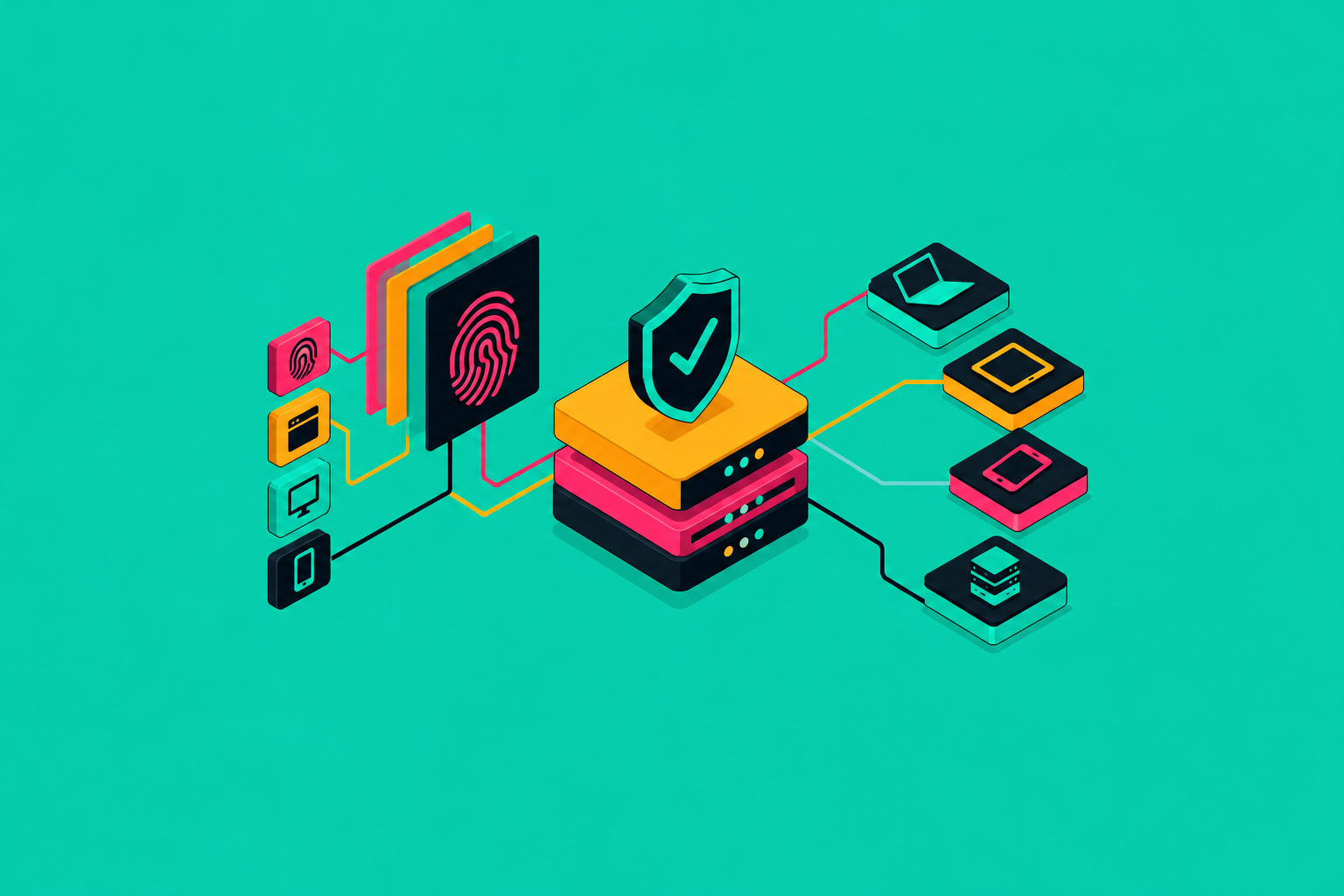
For high-volume startups blocked by anti-bot systems, a purpose-built managed web scraping API is the durable architectural choice because it can maintain consistency across Cloudflare’s seven fingerprinting layers. A TLS patch or proxy swap cannot do that alone. Understanding the full stack explains what an API must handle, why that work belongs server-side, and why access at scale increasingly includes consent and payment alongside fingerprinting.
Why the bot-majority web makes Cloudflare's detection stack more important than it was two years ago
Automated requests now make up the majority of HTML web traffic, driven by AI agents that fetch far more pages per task than people do. A person researching a topic might visit a handful of sites, while an agent can hit hundreds or thousands of URLs. Across millions of daily AI-tool users, those fetches become an enormous stream of requests to pages the users will never personally visit. The browser has acquired a very busy understudy.
Major CDNs and WAFs are sharpening detection just as agent-driven traffic makes reliable access a core engineering dependency. For AI teams, blocking is therefore no longer a niche scraper problem. Cloudflare is the wall many teams hit, and understanding its construction explains both why familiar fixes fail and what a durable alternative must do.
How Cloudflare moved from binary block decisions to composite trust scoring across seven simultaneous layers
Cloudflare’s detection computes a composite trust score from independent detection layers for its “bot or not” decision, with a scraper needing to satisfy all active checks together. Some checks run at the same time, while browser challenges can run only if the request passes earlier checks. Passing one does not buy immunity from another.
Cloudflare calls the central problem “stack drift”. Each layer must tell the same story about the client, so a Chrome User-Agent paired with a Node.js TLS stack becomes a strong bot signal. Neither feature needs to be independently damning for their disagreement to be useful. It is the digital equivalent of a passport and boarding pass with different names. That cross-layer comparison changes the engineering task from fixing individual signals to maintaining one coherent identity, which requires understanding what each layer reveals.
What each of the seven detection layers actually checks and where most scrapers fail first
The seven-part view separates TLS, HTTP/2, IP reputation, browser rendering fingerprints, JavaScript environment, automation markers, and behavioral analysis. The browser-side checks overlap within Cloudflare’s challenge environment. That distinction prevents a misleading checklist mentality. They are different ways to interrogate the same client.
TLS is where most scrapers fail first. Before an HTTP header arrives, the client sends a TLS ClientHello that Cloudflare fingerprints using JA3 and JA4. JA3, introduced in 2017, hashes the TLS version, cipher suites, extensions, elliptic curves, and point formats. JA4, introduced in 2023 and now Cloudflare’s production standard, covers TLS version, SNI presence, cipher and extension counts, ALPN, and separate cipher and extension hashes. Python’s requests and httpx, Node’s https module, axios and undici, and Go’s net/http produce handshakes unlike Chrome or Firefox, exposing differences in cipher sets, extension order, and GREASE values.
Chrome’s 2026 post-quantum key share adds another tell. Its ClientHello now includes ML-KEM, so a client claiming to be Chrome without that key share creates an immediate anomaly. The mismatch between the claimed browser and observed handshake persists after a User-Agent change.
HTTP/2 supplies a second fingerprint after the handshake. Cloudflare examines SETTINGS parameter order, INITIAL_WINDOW_SIZE and MAX_HEADER_LIST_SIZE values, pseudo-header order, regular header order, and HEADERS PRIORITY frame use. Application-level similarity is not enough. Standard Puppeteer-driven headless Chromium can pass TLS because BoringSSL matches Chrome, yet a Linux container and its driving process can alter HTTP/2 SETTINGS or pseudo-header order.
IP reputation runs in parallel with TLS. Cloudflare scores incoming addresses against global threat intelligence, including datacenter ASN ranges, Tor exit nodes, shared residential proxy history, and CGNAT classification. An address keeps its history even when the browser fingerprint looks right. A residential address can have a bad reputation too. The network origin contributes its own evidence.
Browser rendering fingerprints become visible when earlier checks allow a JavaScript challenge. Canvas hashes and WebGL renderers expose characteristics that must fit the rest of the claimed browser environment. This is not just a picture-drawing exercise. A plausible network identity can still disagree with what browser APIs reveal, leaving another inconsistency for the composite assessment.
The JavaScript environment extends those checks to AudioContext behavior and navigator properties. Cloudflare examines their consistency with the browser label. The navigator.webdriver property and Chrome DevTools Protocol signatures can expose standard Selenium and Playwright automation, while legacy patches including puppeteer-extra-plugin-stealth, playwright-stealth, and undetected-chromedriver are now detected on most Managed Challenge deployments.
With Cloudflare’s mid-2026 continuous behavioral validation, checks cover behavior through the whole session as well as at individual points. Clearing the opening checks therefore does not secure the whole crawl. A scraper can be flagged later, after its behavior supplies evidence that its initial fingerprint did not. Across these seven dimensions, consistency remains under examination rather than being awarded once at the door.
Why addressing any single layer in isolation still produces a block — and what “full-stack consistency” requires
A developer replaces requests with a TLS-spoofing library and clears the JA4 check, but HTTP/2 SETTINGS still reflect library defaults, the IP remains a datacenter address, and browser automation still exposes navigator.webdriver. The block now occurs at another layer. Debugging becomes harder because the successful change masks how much of the original problem remains.
The study also illustrates the stealth paradox. Anti-detection techniques could increase detectability because their patches introduced new inconsistencies. More camouflage can make the outline sharper.
Full-stack consistency requires a browser-grade TLS handshake, matching HTTP/2 settings and header order, a clean non-datacenter IP, a consistent JavaScript environment, human-like session timing, and no exposed automation markers. Maintaining that alignment is ongoing work because Cloudflare continuously updates its models. The addition of post-quantum TLS shows how a hardcoded profile that passed before can stop working overnight. If every repair must remain compatible with every other repair, what does a durable solution look like?
What DIY bypass options actually exist in 2026, what each one covers, and where each one breaks
TLS impersonation libraries address the network-facing part of that problem. curl_cffi wraps libcurl-impersonate to mimic browser TLS handshakes and HTTP/2 settings for Chrome, Edge, Safari, and Firefox. That can be enough for sites that reject default Python or Node clients. But it cannot run JavaScript, so it cannot handle interactive challenges. Browser environment, behavior, IP reputation, and automation markers also need separate treatment.
Stealth browser frameworks work further up the stack. Nodriver, created by the author of undetected-chromedriver, patches navigator.webdriver and Chrome DevTools Protocol signatures at the driver level to make automated Chrome look more like manual browsing. That addresses browser environment and automation-marker checks. It does not settle IP reputation or session-scale behavioral consistency.
Residential and mobile carrier proxies change where a request comes from on the network. Mobile carrier proxies are most effective for high-security targets, while residential proxies suit medium-difficulty targets. Datacenter IPs are ineffective against Cloudflare-protected scraping. Proxy networks nevertheless address reputation only, leaving fingerprints and behavior untouched.
These options are useful within their limits. Below roughly a thousand requests per day, a skilled engineer can feasibly assemble and maintain a multi-layer stack. Above that level, keeping profiles current, maintaining proxy pool health, and revising stealth patches typically costs more than a managed alternative. An LLM does not remove that burden, since a standard headless Chromium agent presents the same underlying browser fingerprints and can add more detectable browsing behavior. At a steady high volume, teams have to choose who will keep the stack working as well as which fixes to use.
What web scraping API architecture can handle Cloudflare-protected sites at high volume?
A purpose-built managed web data API absorbs the fingerprinting stack server-side. The client makes an API call while the infrastructure handles TLS impersonation, HTTP/2 consistency, IP rotation, JavaScript execution, behavioral timing, and automation-marker suppression. When fingerprint profiles degrade, keeping them aligned becomes a platform responsibility rather than another repair ticket for every team consuming the data.
That difference gives startups that handle large volumes a way to compare services. The relevant capabilities are maintained cross-layer consistency, JavaScript challenge handling, proxy reputation management, session-level behavior, and support for the workload’s output formats. A service that merely forwards requests through a proxy does not cover the same problem. For startups processing billions of requests per month, platform capacity also belongs in that comparison. The managed architecture described here is built to handle billions of requests, including workloads facing enterprise Bot Management configurations that block DIY stacks outright.
Basic scrapers often return raw HTML, while LLM and retrieval workflows need clean Markdown, structured JSON, or extracted link graphs. A managed API that handles both access and conversion removes two distinct sources of pipeline failure. The HTML has arrived, but it has brought its luggage.
Cloudflare’s Markdown for Agents points toward that convergence by letting agents request Markdown through the Accept header where sites support it. Its Browser Rendering endpoints expose /markdown, /json, /links, and /crawl paths aligned with retrieval needs. Native Python and Node.js SDKs, webhook events, MCP server access, and CLI tooling can shorten the integration path for managed platforms. These capabilities connect acquisition to the formats and interfaces AI teams already use. They do not, however, turn technical access into an unconditional right to retrieve content.
How Cloudflare's 2026 policy changes — default blocking, Pay Per Crawl, and verified bot identity — reshape what “cleared at scale” means going forward
Cloudflare’s default AI crawler blocking makes that boundary explicit. On September 15, 2026, it extended the default blocking introduced on July 1, 2025, to Training and Agent crawlers on ad-supported pages. Mixed-use crawlers blending search, training, and agentic browsing are blocked by default on pages with ads for new customers, new sites, and every free-tier site. The change leaves out existing paid customers who have their own settings. Cloudflare customers blocked hundreds of billions of AI bot scraping requests in the five months after July 1, which shows how big this dispute over access has become.
Pay Per Crawl adds a way to pay for access. Cloudflare uses HTTP 402 Payment Required so a crawler either presents payment intent through request headers for a successful 200 response or receives a 402 quoting the price. The mechanism also extends to APIs, data, and MCP tool calls through a monetization gateway. Consent is becoming machine-readable too. The Content-Signal header in Markdown responses encodes directives such as ai-train=yes, search=yes, and ai-input=yes.
Verified identity changes the question again. Cloudflare’s Web Bot Auth guidance describes User-Agent headers as easily spoofable and insufficient for reliable identification, so claiming to be a browser is not the same as establishing a legitimate agent identity. A managed API capable of conveying payment intent or verified identity headers is better positioned for this direction than a stack devoted only to fingerprint spoofing. “Cleared at scale” increasingly means technically consistent, identifiable, and permitted access. Understanding the full stack makes the architectural choice clear, because the durable API layer must handle both how a request looks and the terms under which it is allowed through.