How AI Agents Consume Web Data at Scale
Four pipeline stages explain how AI agents efficiently extract and use web data at scale.
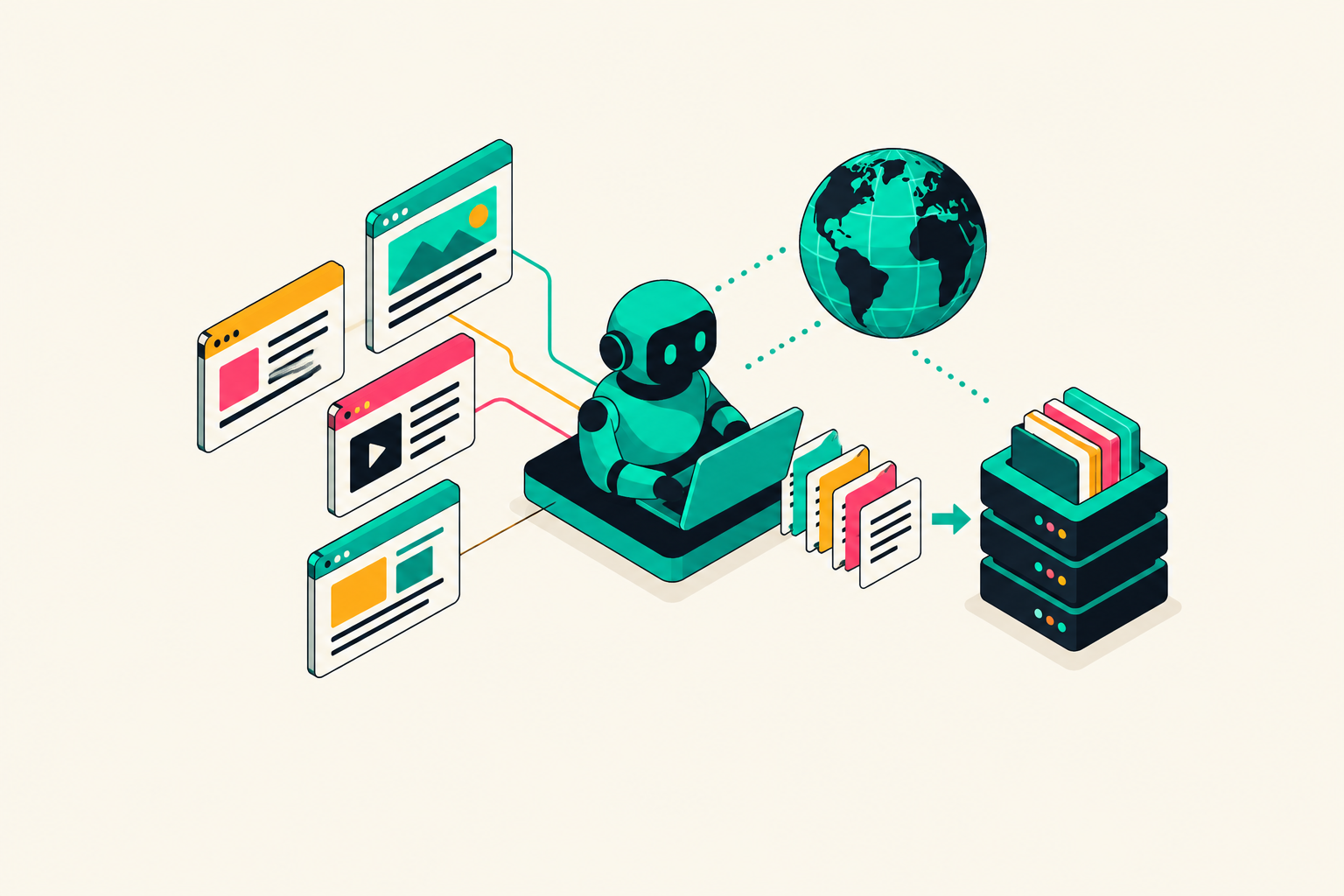
AI agents consume web data through four stages, which are rendering, extraction, structuring, and delivery. A unified web data API for AI agents puts those stages behind a single interface, covering search, scraping, crawling, and monitoring without separate integrations. A scalable system requires those stages to fit together more reliably than a working demo does.
Why AI agent traffic is now a distinct infrastructure problem
DataDome’s AI traffic trends report detected tens of billions of AI agent and LLM crawler requests across its customer base in a single twelve-month window, with the sharpest acceleration in the final months. These requests increasingly come from ordinary product use. The traffic is not one uniform workload, either. AI search crawlers index pages for answer engines, training crawlers collect content at volume, and task agents access pages in real time to complete work for users. Treating them alike hides how much data each needs, when it needs it, and how it uses the page.
WP Engine’s 2026 AI Agency Trends Report describes websites serving a dual audience of humans and machines. Pages built for humans return so much markup that they are noisy and costly for agents to read, while traditional crawler infrastructure cannot do enough to handle dynamic rendering and session state. A task agent needs more than a download. It needs a usable representation of the page it came to consult.
What the web data pipeline for AI agents actually consists of
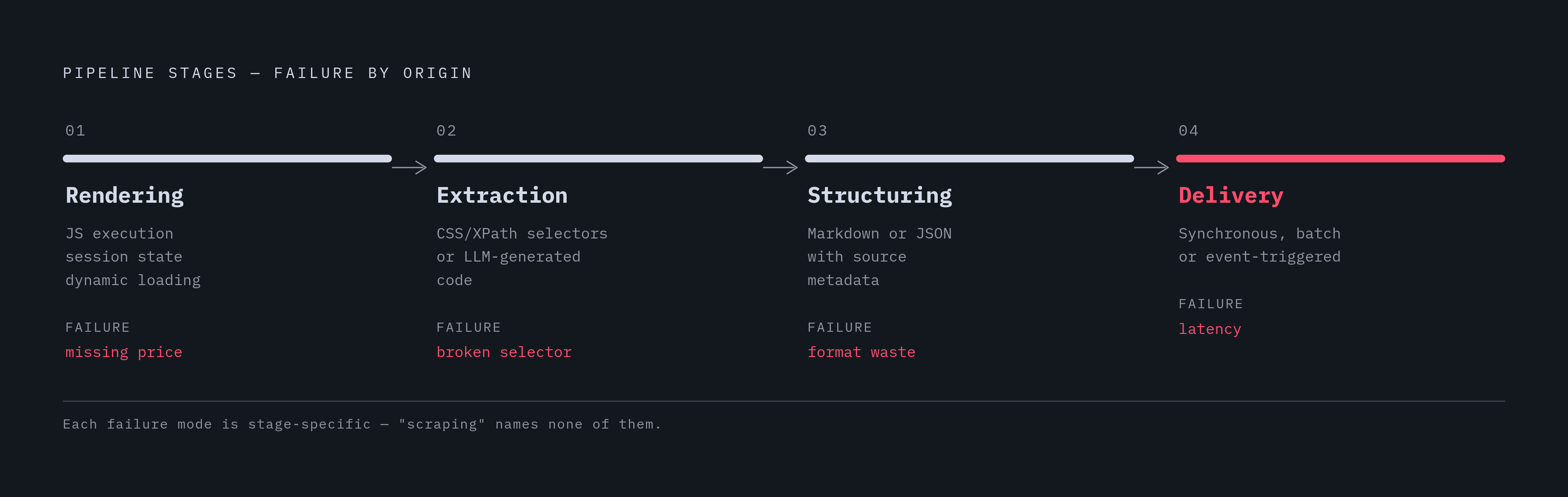
Rendering resolves the page after JavaScript execution, session state, and dynamic loading. Extraction then selects the relevant content from that resolved page. Structuring converts the selection into a format the model can use efficiently, while delivery gets the result to the agent at the required cadence and volume. The order is the map for this pipeline.
Missing content may begin with an unresolved page. Even when extraction gets the right content, it may arrive in a format that wastes resources, and even well-structured data may reach an agent too late. Calling everything “scraping” conceals those distinctions. It is rather like calling every kitchen problem “cooking” when the fridge has stopped working.
Stage 1 — Rendering: what it actually takes to see a modern page
Most web pages that matter to businesses need more than static HTML to be read. JavaScript-rendered pages, single-page applications, infinite scroll, and asynchronously loaded panels need browser execution to make the content an agent needs visible. Login-gated content and product configurators add session state and conditional views to the job. The initial response is only the beginning. Extraction cannot recover a specification or price that the browser has not yet resolved.
That browser work has a real infrastructure cost. A headless Chromium process has significant memory overhead, so launching a fresh instance for every request is not viable at meaningful volume. Session pooling, instance reuse, and intelligent routing become production requirements. The browser is not a disposable paper cup. Reusing infrastructure is part of making rendering economical, before any model begins reasoning about the page.
Access checks are another step that must be passed before extraction starts. Protection systems evaluate TLS fingerprints, browser API consistency, request timing, and behavioral signals. Managed web-data infrastructure like Olostep, a developer API that handles browsers, proxies, and anti-bot layers so AI teams can collect structured content at scale, is built to navigate exactly this layer. ScrapeWise’s April 2026 benchmark found that unassisted agents on standard headless infrastructure achieved substantially lower pass rates on protected targets than managed infrastructure using proper fingerprinting and residential proxies. An LLM does not change a browser’s fingerprint. The practical consequence is wasted inference on jobs that fail before there is useful content to extract.
The design should respect rate limits and robots.txt where applicable, with geotargeted proxies, sticky sessions for multi-step workflows, and controlled IP rotation serving legitimate access needs.
Stage 2 — Extraction: moving from a resolved page to the content that matters
Once rendering succeeds, the choice of extractor sets much of the pipeline’s maintenance burden. Traditional CSS and XPath selectors are fast and cheap per page when the target layout is stable. Their weakness appears when that layout changes. A selector can stop returning the right content without an obvious sign that it has failed, so a small site redesign can lead to a data problem that goes unnoticed.
For stable, high-volume targets, the efficient pattern is to use an LLM to generate deterministic scraper code once, then run that code at scale. Predictable work gets a predictable execution path. Self-healing extraction extends this pattern by monitoring scripts, detecting site changes, and regenerating extraction logic automatically, reducing the manual upkeep that erodes the initial cost advantage.
Agentic extraction earns its place where the page is genuinely unpredictable. These can be specifications written into prose, product content that changes with conditions, interactive login or consent flows, or a site whose data structure has yet to be explored. These jobs need interpretation or navigation. But ScrapeWise’s cost comparison found that agentic approaches cost much more per thousand pages than managed API infrastructure on protected e-commerce targets. Deterministic extraction suits stable volume, while agentic reasoning suits uncertainty that fixed code cannot handle well.
Stage 3 — Structuring: converting extracted content into something a model can reason about
Extracted content is not automatically good model input. Raw pages include markup and other noise that consumes tokens without helping the model understand the useful content. Formatting is therefore part of performance. Spending heavily to retrieve a page and then sending its clutter straight to a model is an expensive way to deliver the packaging with the parcel.
ScrapeGraphAI’s data format glossary recommends Markdown or plain text for reading tasks and JSON for structured fields, with raw HTML the worst choice for either. Markdown preserves headings, lists, and emphasis while remaining token-efficient and familiar from LLM training data. JSON serves a different purpose. It exposes prices, availability flags, metadata, and entity attributes as fields the agent can operate on.
For retrieval-augmented generation, format choice is only part of the work. Structured chunks with source URLs, timestamps, and section headings support retrieval better than an undivided Markdown blob because the retrieval layer can match metadata before the model reads the content. Provenance also makes the result usable after the source changes. A page fetched today may disappear tomorrow. Capturing what was retrieved, when, and from where gives an auditable pipeline more than a useful answer with no return address.
Stage 4 — Delivery: getting structured data to the agent at the right cadence and scale
Delivery must match the agent’s workload, even when every upstream stage works correctly. A user-initiated task agent needs synchronous delivery, requesting a URL and receiving structured content in the same call. Latency shapes the usefulness of that response. A batch research pipeline instead queues large URL sets, processes them in parallel, and receives a dataset, accepting delay in exchange for throughput and cost efficiency.
Monitoring requires a different trigger again. Rather than waiting for a fresh request, the pipeline watches a defined set of pages and pushes structured diffs when changes appear. This works well for competitive intelligence, price monitoring, and regulatory tracking. Change becomes the unit of delivery.
The Model Context Protocol, introduced by Anthropic in 2024, provides a standardized JSON-RPC 2.0 interface through which agents invoke external tools, including web data retrieval. At this boundary, web data APIs can become modular components. The integration format counts, too. With webhook events and SDK-native delivery for Python and Node.js, agents and developer pipelines get results in forms they already use, so there is no need to translate them on arrival.
How the pipeline behaves under the governance pressures reshaping web access in 2026
Web access is acquiring a governance layer that pipeline architecture cannot treat as an afterthought. Robots.txt, AI-specific exclusion signals, and emerging protocols shape the conditions under which content can enter the system. The signals are not yet settled or consistent. The 2025 AI Agent Index found that only a minority of the agents studied said outright that their crawler bots respect robots.txt, while task agents often ignored standard exclusion protocols entirely.
Cloudflare’s Content Signals data showed that, as of April 2026, only a small fraction of the most-visited domains had declared AI usage preferences, while a large majority had a robots.txt. Absence is not a complete access policy. For pipeline architects, these are signals to monitor as the access environment develops.
For new domains, Cloudflare blocks AI Training and Agent bots on ad-supported pages by default and lets Search bots through by default. That distinction makes the agent classes operationally consequential again. The practical design response is permissioned, identified access, with governance accounted for at the infrastructure level from the outset. Managed API infrastructure handles this pressure more cleanly than DIY agent setups, but the moving standards still require attention.
Where self-healing extraction and agentic monitoring change the pipeline’s operating cost over time
The launch bill is only the first bill. Site redesigns, anti-bot changes, and schema drift turn an initially successful scraper into recurring engineering work. At scale, those interruptions happen all the time. Architecture determines how much becomes background infrastructure work and how much lands in an engineer’s queue. A cheap request is less impressive when it comes with a permanent maintenance appointment.
Self-healing extraction moves layout repair out of that queue by detecting changes and regenerating extraction logic automatically. Zyte’s 2026 Web Scraping Industry Report says AI-augmented pipeline infrastructure brings the most value by cutting the upkeep needed over time. Throughput gains are secondary to preserving engineering capacity. When buying, that puts more weight on what it costs to keep the system useful than on the cost per successful demonstration.
A pipeline that watches competitor prices, product documentation, job postings, or regulatory pages can send structured changes between snapshots. It becomes a continuous intelligence feed. This is distinct from monitoring extraction health, although both reduce the gap between a change on the web and useful action downstream.
More reasoning is not automatically a better investment. Research published at AAAI 2026 found that LLM-heavy web agents are among the most computationally intensive AI systems, and greater energy use did not equate to better performance. The most energy-efficient agent in the study also performed best on step success rate. Efficiency belongs in the architecture. The finding reinforces the case for reserving agentic reasoning for work that actually needs it.
What does a production-grade unified web data API for AI agents look like?
A production-grade pipeline brings all four stages together with one model for reliability and observability. Managed browser infrastructure handles rendering with fingerprinting, session pooling, and residential IP routing rather than a local browser launched for every request. Extraction defaults to deterministic, schema-driven code on stable targets, with agentic fallback for unpredictable pages and self-healing for site changes.
Structuring then produces clean Markdown or JSON with source metadata, sized and chunked for the downstream task. Delivery exposes synchronous, batch, and event-triggered patterns through the same API surface. The agent’s workload determines the pattern. It should not require a different infrastructure stack every time the task moves from immediate research to large-scale collection or continuing monitoring.
For teams choosing a unified web data API, the useful comparison is coverage across search, scraping, crawling, mapping, batching, and monitoring, together with those stage-level requirements. A single interface earns its value by eliminating format mismatches, latency overhead, and observability gaps between disconnected tools. The interface alone is not the achievement. MCP integration makes the resulting pipeline callable by autonomous agents without a human triggering each workflow. At that point, web access becomes a dependable tool for getting useful input, rather than a recurring project in making websites behave.