Real-Time Web Data Delivery Without Multi-API Orchestration Tax
Unified web data APIs eliminate costly API orchestration while keeping AI models current.

A unified web data API for AI agents handles search, fetching, JavaScript rendering, cleaning, and structured delivery through one callable interface. It removes the application-side handoffs that cause the multi-API orchestration tax, with credentials spread across services, failures that cascade, and formats that have to be converted again and again. The right architecture pairs that interface with explicit freshness requirements, typed responses, and monitoring, rather than treating one endpoint as a promise that nothing can break.
Why AI pipelines treating the web as a static resource produce wrong answers
An AI assistant confidently cites a pricing page that changed two months ago. Its explanation is clear, its arithmetic is tidy, and its answer is wrong. The model cannot account for an update it never received. Confidence is not a freshness guarantee. Without a live web data path, even a well-written answer can be little more than an old receipt wearing a tie.
A retrieval-augmented generation pipeline with a stale retrieval index produces stale answers, while a compliance system that misses a regulatory update on a government portal faces asymmetric legal exposure. A pricing model built on yesterday’s data drifts from current conditions. These failures start before the model reasons over anything. Training data has a cutoff, and retrieval only closes that gap when the retrieved material is current.
How teams currently solve the live-data problem and why that approach compounds costs
The natural response is to add the missing capabilities. A search API finds pages, a scraping layer fetches them, a JavaScript rendering service exposes their content, and parsing and conversion steps make that content usable. Each component solves a real problem. Together, however, they create a chain with separate authentication, rate limits, response formats, and failure modes. The application now owns the handoffs as well as the result.
A renderer times out, a scraping key rotates, or a parser chokes on an upstream schema change. A silent failure then propagates as garbage data or a missing field that the model treats as valid. A call that succeeds late in the chain gives no proof that the earlier stages passed along useful content.
Developers have to keep track of separate API keys, rate-limit budgets, billing cycles, and documentation. Integration is never quite finished. When a provider changes its schema, deprecates an endpoint, or changes its CAPTCHA behavior, the fix may require coordination across several layers. What looked like a one-time assembly job becomes an ongoing maintenance obligation that grows with the pipeline.
The measurable shape of the orchestration tax: token waste, latency overhead, and cost compounding
The orchestration tax has three measurable dimensions, beginning with tokens. Raw HTML brings navigation menus, footer links, legal boilerplate, social widgets, and duplicate mobile markup into the model’s context window. Those tokens cost money but do nothing to make the answer better. They also dilute the useful content and degrade retrieval quality as volume grows. The model has been asked to read the page.
The same request also has a cost in latency. In a sequential stack, elapsed time includes the coordination between stages as well as the actual searching, rendering, and parsing. Handoffs can consume a meaningful fraction of wall-clock time. That distinction is important because faster individual services do not remove the coordination between them.
Both costs grow with production volume because each fetch can lead to extra calls for decomposition, aggregation, and format conversion. A workflow that was cheap to test may cost much more to run when every request repeats that extra work. Unnecessary infrastructure adds another burden. Most web data use cases need micro-batch or single-hop retrieval, yet a team that chooses streaming before defining its latency requirement can pay for complexity with no measurable benefit. Request volume and freshness requirements belong in the cost model.
Why the format question is not cosmetic: Markdown and structured JSON as the AI-ready baseline
Clean Markdown and structured JSON are the AI-ready baseline because they give the model content it can use without another round of parsing. Markdown preserves semantic hierarchy in lightweight, readable text and can be converted to structured HTML. It keeps headings without the surrounding machinery. For extraction tasks, structured JSON with typed schemas supplies fields the model can reason over directly. These formats serve different uses, but both move preparation out of the model’s way.
By contrast, raw HTML fails that baseline because it still contains presentation structure and noise that the pipeline must remove. Unstructured search snippets can also need extra model calls to pull out fields the model can use, which adds latency and token cost to every request. Cleanup is part of delivery. Stripping navigation, footers, legal text, and duplicate mobile markup improves the input before inference begins. Returning bytes is not the same as returning usable evidence.
Rendering comes before that cleanup, and it cannot be skipped when the content depends on JavaScript. Static HTTP GET requests cannot fully render many production websites that are built with JavaScript frameworks. The request may succeed but return no useful content. The model then gets garbage or nothing, with no clear sign of a transport failure. A data layer therefore needs to produce the page’s useful content before its choice of output format has any value.
What does a unified web data API for AI agents actually collapse, and where does MCP fit?
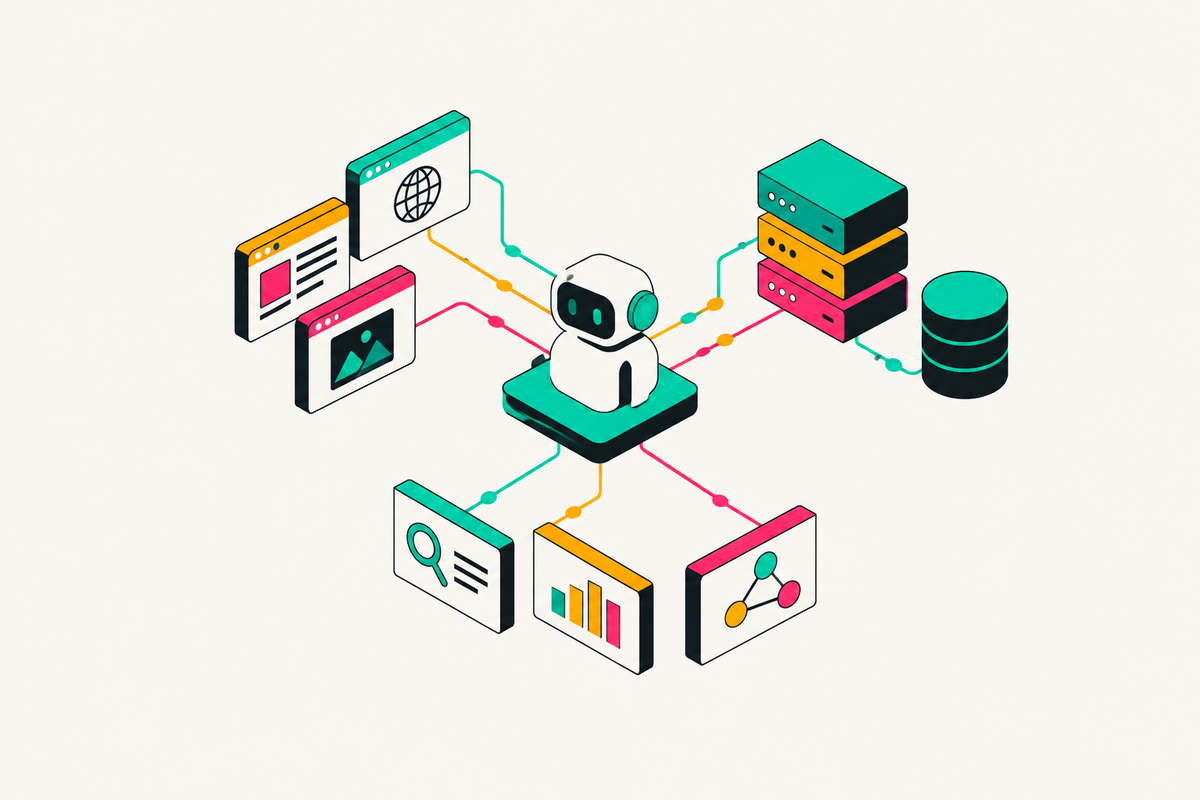
A unified API turns search, fetch, JavaScript rendering, noise removal, and structured delivery into one callable primitive. The application receives clean Markdown, HTML, or JSON without coordinating each stage itself. Many credentials become one integration credential. More importantly, the application no longer owns the seams between separate rendering, scraping, and conversion providers. The work still happens, but one service now handles its coordination behind a single service boundary.
That boundary also needs a clear failure contract. An empty result on failure forces an agent to guess whether nothing was found or something broke. Typed failure cases remove that ambiguity. A discriminated-union response lets the agent branch on the result it actually received. A single endpoint with vague errors would give the same old uncertainty a shorter address.
MCP changes how agents access that primitive. Specialized web-scraping MCP servers can handle browser rendering, CAPTCHA solving, IP rotation, and output normalization on the agent’s behalf. The July 2026 MCP specification revision moved toward a stateless architecture, reducing the friction of persistent per-client connections at high request volumes. That helps with integration and scaling, but more work is needed to make the system ready for production. A2A operates at a different layer, coordinating agents with other agents while MCP connects agents to tools, so the protocols compose.
Where the unified approach has real limits and what teams should verify before committing
The practical due diligence starts with security. MCP implementations have had high-severity vulnerabilities, including remote code execution, so production teams need to audit the specific implementation they plan to deploy against current CVE disclosures. A protocol name is not a security audit. MCP is a sensible default for single-user and small-team workflows and most new agent projects, but large multi-tenant systems need additional hardening. Strict security and observability requirements are not supplied by the specification alone.
Reliability deserves a separate check because consolidation relocates orchestration. A unified provider takes responsibility for more of the web data plumbing, while the team still owns the reliability of the application around it. Engineering work does not disappear. Agents may be API calls, but dependable behavior rests on the infrastructure beneath them.
Latency is another decision that an API cannot make on the team’s behalf. Requirements well within the minute range can often be met by micro-batch at a fraction of the cost of full streaming infrastructure. Has the chosen MCP implementation been audited, and does the deployment have the hardening required for its tenants? What latency requirement has been written down, and what evidence will show that the whole pipeline meets it?
How to evaluate a web data API for production AI pipelines: the criteria that actually differentiate providers
Single-call coverage is the first useful comparison because “unified” can describe either a working abstraction or a shared billing dashboard. A team evaluating providers should establish whether one call handles search, fetch, JavaScript rendering, noise removal, and structured delivery. Shared branding does not remove technical seams. If the application still coordinates separate endpoints that fail independently, much of the orchestration tax remains. Capability coverage has to describe the request path.
Output fidelity and failure semantics distinguish a usable service from a convenient wrapper. The relevant test is whether the API delivers clean Markdown, structured JSON, or cleaned HTML, rather than raw material that still requires application-side parsing. Success needs a content contract. Failure needs one too, with typed errors an agent can branch on rather than empty results that silently move downstream.
Scale should be judged by operational burden as well as request capacity. At a target of billions of requests, the question is whether the provider can support that volume without the team managing proxy pools, CAPTCHA services, or browser farms in-house. Integration tools deserve equal scrutiny. Native Python and Node.js SDKs, webhook events, MCP server access, and CLI tooling support both human developers and autonomous agents. Monitoring must then expose pipeline health, lag, and failure alerts so that bad model output is not the first sign of trouble.
The practical architecture for AI pipelines that need live web data without the orchestration overhead
For a team choosing its architecture, the first action is to write the latency requirement in seconds. Sub-second requirements call for streaming infrastructure, while seconds-to-minutes requirements are well served by micro-batch or single-hop API retrieval. Longer intervals belong in batch processing. A workflow that refreshes every five minutes does not need streaming simply because the data is described as live. A fraud detection system that needs a sub-second response must rule out micro-batch latency even if it would be easier to use.
Within that chosen cadence, the web data layer should be a single API primitive that searches, fetches, renders, cleans, and structures the result. The team should check that it has typed JSON schemas for extraction tasks, typed failure responses that agents can use to make decisions, and clean Markdown for the model to read. Keep those contracts explicit from the start. They determine whether the agent can use the result directly or must spend another model call interpreting it.
The remaining work is to make that path observable and safe. Teams should set up lag monitoring, failure alerting, and pipeline health dashboards from day one, then check for MCP server support where autonomous agents need it. Enterprise deployments require implementation-specific security checks and multi-tenant hardening. Those decisions remain separate from the choice of retrieval cadence, even when one provider supplies the web data layer. Choose the cadence, define the output and failure contracts, and assign responsibility for monitoring and security before committing to the integration.