Web Data Monitoring and Freshness Strategies for Agentic Pipelines
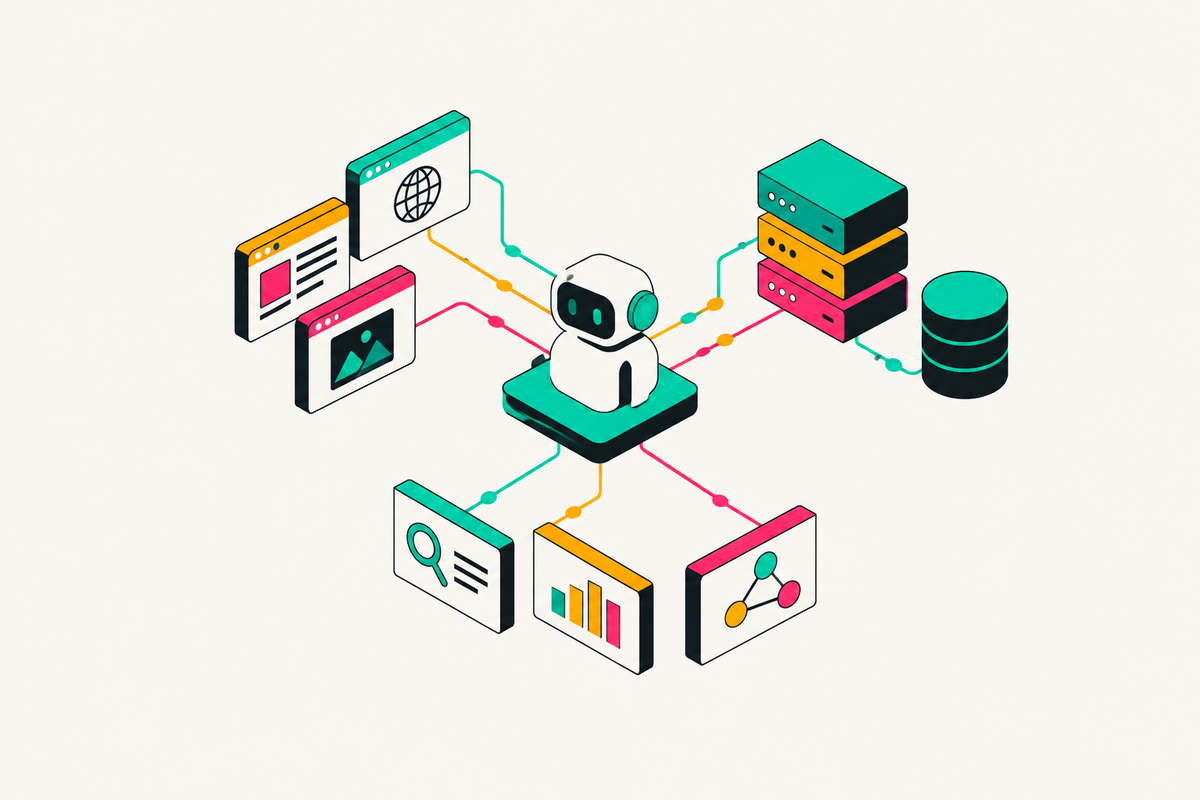
Event-driven monitoring replaces stale batch refreshes to keep agent decisions current.

A unified web data API for AI agents should bring search, scraping, and crawling behind one endpoint, but convenience alone does not make its data fresh. Web data monitoring and freshness strategies shape whether an agent acts on facts that are up to date or on yesterday’s assumptions. Reliable agentic pipelines therefore treat freshness as an architectural requirement, from detecting a page change to validating the data before action.
Why agentic pipelines fail on stale data, not flawed reasoning
An agent can plan a complex task, choose its tools, and confidently act on a price that changed yesterday. The reasoning may be sound. The premise is expired. A more capable model does not repair that mismatch, because better reasoning over an outdated policy still produces an outdated decision.
A source site can redesign its layout, add a paywall, or change its terms without causing an obvious downstream crash. The pipeline may keep running while its agents use stale assumptions or incomplete records. That makes freshness a data-quality problem at the moment of action, even after a successful fetch.
How agentic pipelines are actually structured in 2026, and where freshness fits in each layer
At a minimum, the infrastructure needs object storage, encryption, and an MCP server. Agents use MCP to query data stores dynamically rather than depend on fragile point-to-point API integrations. Access, however, is not proof of freshness. A live query can retrieve old data, so the infrastructure layer must support the checks performed further up the pipeline.
The orchestration layer coordinates when those checks happen. Apache Airflow handles DAG scheduling, dependency resolution, and retry logic, but skipping validation leaves silent data-quality failures undetected. At the sub-agent layer, a specification agent defines the schema, a validation agent runs quality checks, and an execution agent triggers the DAG run. Each works with data at a different freshness threshold. A valid schema alone cannot show whether a price is still up to date.
Event-driven patterns suit real-time processing where latency is the main constraint, while sequential patterns fit simple, low-volume ETL. AWS describes agentic pipelines that monitor streaming telemetry, detect anomalies, choose remediation, and act without human intervention. These systems maintain memory across sessions and query live sources on demand, making synchronization between remembered and current state a practical requirement.
Why batch refresh is the wrong default and event-driven patterns are the right one
A nightly or hourly refresh makes data current at collection time, with the risk that it becomes stale before an agent uses it. That gap is the architectural fault line. Agentic loops also block on external I/O, so postponing every update until the next scheduled run combines stale context with waiting. Batch is the wrong default when decisions depend on changes between runs.
Event-driven pipelines instead trigger an agent chain when a Kafka topic message, an S3 PUT, or a monitored page change occurs. AWS presents three streaming patterns for agentic workloads, including streaming feature engineering with real-time inference followed by action, event-driven agent invocation, and real-time context synchronization. The last uses change data capture, or CDC, to preload relevant state. Without that synchronized context, a query can take 8–12 seconds and five separate API calls across three systems, which adds latency and can cause timeouts.
The speed comes with an operations bill. Event-driven pipelines need dead-letter queues and replay mechanisms that work well before they are safe to use in production. Choose the pattern by maximum acceptable staleness. Batch can remain appropriate where delayed updates are tolerable, while event-driven processing earns its complexity when waiting changes the decision.
What web monitoring actually means for an agent — and the four signals worth tracking
Uptime monitoring checks whether a page is up. Agent-oriented web monitoring asks whether that page still contains what the agent expects, in a form it can extract and under terms that permit access. A healthy response is not enough. Four signals distinguish a useful source from a page that merely answers the door.
Content change means the substance moved, such as a new price, a rewritten policy section, or a discontinued product. Structural change means the extraction path moved instead, perhaps through a changed class name, navigation element, or Next.js hydration blob. These require different responses. The first may call for new reasoning, while the second calls for repairing how the pipeline obtains the facts.
Access change covers a paywall, login gate, or Cloudflare challenge that blocks the fetch. Terms change covers revisions to robots.txt or terms of service that affect permitted use. The notes put the share of sites naming AI crawlers in disallow rules at 12.7%, with a larger share excluding every bot through a wildcard. Those rules can change between runs, so permission requires live monitoring after setup.
Scraping strategy for freshness: choosing the right extraction layer for each data type
The extraction method should match how the page supplies its data. For repeatable jobs with a structured endpoint, API or XHR interception is the fastest, most reliable choice and is less exposed to layout changes. Embedded JSON, including Next.js hydration blobs and JSON-LD, suits structured metadata already present in the HTML. Neither needs a browser just to dress up the request. Skipping JavaScript execution when it is unnecessary lets the agent use the result sooner.
A headless browser is required for rendered pages, auth cookies, infinite scroll, and dashboards. Here, using a lighter extractor can return empty or stale results, while launching browsers slowly can block the agentic loop. APIs serving these workloads need large, warm browser pools. LLM extraction occupies a narrower role, namely one-off cleanup from small pages or PDFs, rather than unverified production data or financial facts at scale.
Extraction in production also needs managed proxy rotation, proper TLS fingerprinting, and rate limiting. These address access reliability, while warm browsers address latency. Neither replaces validation of the returned data. For teams weighing a unified API against self-hosting, the concrete criteria are extraction coverage, response delay, managed access infrastructure, and per-page economics. Self-hosting offers control but adds engineering overhead, while managed APIs remove infrastructure maintenance and make request volume central to the cost decision.
Data format decisions that determine how much freshness survives the trip from web to agent
A fresh fetch can still be a poor input. If useful facts are buried in markup, the agent spends its context window on packaging, leaving less room for meaning. Markdown and plain text suit reading tasks, with Markdown retaining headings and lists that explain the document’s structure. JSON suits programmatically consumed fields, including prices, dates, product attributes, and entity records. The choice follows the task.
Raw HTML averages 5 to 10 times more tokens than the same content as clean Markdown. For RAG reading tasks, Markdown’s hierarchy and lighter representation make it preferable to JSON. Cloudflare’s “Markdown for Agents” converts HTML on the fly at the edge, showing how CDN infrastructure can participate directly in preparing agent input. The practical implication is that the wrong format can erase the usability gain earned by fetching fresh data.
Observability for freshness: what to instrument, and what traditional APM misses
Traditional application performance monitoring was not built for non-deterministic, multi-step agents. A request can succeed even when the decision it feeds goes wrong, so a dashboard can stay green while the agent acts on an old record. System health is only one view. Freshness observability needs to connect retrieval, validation, and action so that the failure is visible before its consequence becomes the first alert.
Trace and span observability follows every LLM call, tool invocation, retrieval step, and decision point. Evaluation and quality scoring asks whether outputs are accurate and on-policy, while cost and latency telemetry tracks token spend, routing efficiency, and tail latency. Behavioral and security monitoring checks for prompt injection, tool abuse, data exfiltration, and unauthorized actions. These views answer different questions. Harmful instructions in a retrieved page pose a different problem from a slow tool call.
For production governance, the lesson is to capture lineage metadata using OpenLineage specifications and set thresholds for data volume, null rates, and processing latency at each stage. Agent decisions need logs too, because choosing to skip a record can explain an outcome that the final output cannot. OpenTelemetry GenAI semantic conventions provide a portable trace schema across platforms, but remain in Development status.
Self-healing as a freshness strategy: how pipelines can detect and recover from stale inputs automatically
An alert is useful, but it still waits for someone. Iterative pipeline patterns let an agent retry or self-correct based on output quality, making them suitable for retry-heavy workflows and failed schema checks. The validation sub-agent supplies the trigger. A null-rate spike, schema mismatch, or structural break can route the job from embedded JSON extraction to a headless browser before the broken record reaches the model.
At the retrieval layer, a forced live crawl performs a similar function by fetching again for a time-sensitive query, bypassing the cached page. Purpose-built agent search indices expose this as an explicit freshness mechanism. It is a useful capability when evaluating retrieval infrastructure. Automatic recovery, however, is only sound when the replacement input is trustworthy enough to use.
MCP introduces a direct objection to unbounded self-healing. Its tool selection relies on natural-language descriptions interpreted by an LLM, creating prompt-injection surfaces, and repeatedly fetching a manipulated source can amplify the problem. A fresher attack is still an attack. The practical guardrail is to configure MCP servers as read-only by default and grant write access only to the execution sub-agent after the validation agent has confirmed data quality.
A freshness-first architecture applied: competitive intelligence monitoring as a worked example
For competitive intelligence, the agent must spot changes, extract pricing and product facts, make sense of them, and send alerts before the information becomes misleading. In this architecture, monitoring watches a defined set of URLs, including competitor pricing pages, regulatory update feeds, and job posting boards. A meaningful change triggers a re-fetch ahead of the next scheduled run. The event starts the work, but does not certify the result.
The extraction layer obtains pricing tables and structured product data through embedded JSON or API interception. Narrative material, such as blog posts and press releases, comes through headless-browser fetches converted to clean Markdown. The agent receives JSON for structured fields and Markdown for reading. Raw HTML stays out of the model input. This separates facts that need programmatic comparison from prose that needs interpretation.
Every fetch is logged with its source URL, fetch timestamp, and schema version. Null-rate alerts flag pages that stop returning the expected fields, and the log of the agent’s decision to act includes the content it used. If a layout change breaks extraction, validation escalates the job to the headless-browser layer. If a Cloudflare challenge interrupts access, a fresh fetch with updated fingerprinting is triggered automatically. Validation keeps the broken record away from the model while the pipeline recovers.
Treating freshness as an architectural requirement, not an operational afterthought
Freshness belongs in the design brief. How old each data type can be should guide the pipeline pattern, while the rendering it needs should guide extraction and the agent’s task should guide the format. Lineage, validation, and recovery then make those choices enforceable at runtime. A unified API can simplify access, but cannot substitute for those controls.
Test data that stays the same can hide a pipeline’s weakest assumption. Production exposes it when a page changes, access narrows, or yesterday’s fact stops being true. The forward-looking infrastructure investment is therefore not just a better reasoning engine, but a dependable path from a changing web to the moment an agent acts.