Evaluating Web Data Platforms for Autonomous Agent Workflows
Unified web data APIs let autonomous agents retrieve current, structured information reliably.
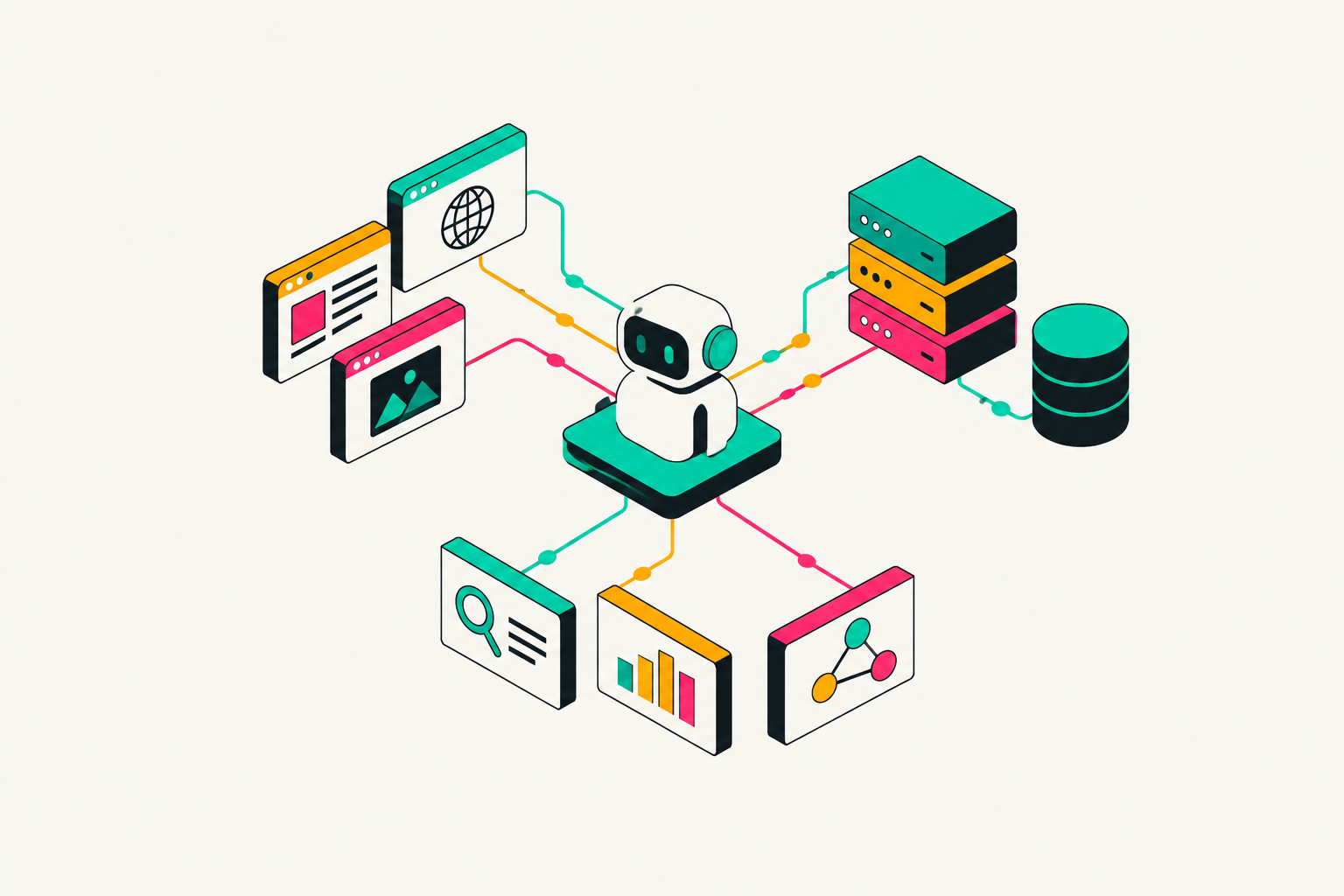
A unified web data API for AI agents puts search, scraping, and crawling behind one interface, so there is less need to stitch together separate services. The best choice for an autonomous workflow is the platform that delivers usable, current data reliably within the task’s time budget. Evaluation should follow the agent’s decisions and operating scale.
Why autonomous agent workflows demand different web data infrastructure than traditional pipelines
Traditional pipelines do what their fixed instructions say, on a set schedule. An autonomous agent pursues a goal, makes multi-step decisions, calls tools, and adjusts its next move based on what happens. Retrieval becomes part of the decision loop. A platform that serves a scheduled batch job well can therefore fail an agent that needs information midway through a task.
The distinction is not simply speed or volume. A copilot helps a person who reviews each step, while an agent runs the loop itself and escalates when it hits a guardrail. A retrieval failure can therefore feed directly into behavior. There may be nobody there to raise an eyebrow.
This is already a production infrastructure problem. HUMAN Security’s 2026 State of AI Traffic & Cyberthreat Benchmark Report found that traffic from AI agents and agentic browsers grew by 7,851% year-over-year. As agents make more web requests without human supervision, judging retrieval tools only by how well they serve human-facing applications misses the central risk. The consumer of the response can act on it.
The six layers an agentic pipeline relies on, and where web data fits
An agentic pipeline can be understood through six layers, which are intent, observability, reasoning engine, action, memory, and governance. Intent gives the task its direction. Observability monitors system health, data quality, and breaches of service commitments. The reasoning engine interprets signals and chooses the next action, while the action layer executes decisions through external tools and infrastructure.
Memory stores past incidents and decisions so they can inform later responses. Governance enforces policies, audit trails, and compliance boundaries. These layers depend on one another. Useful memory needs consistent records, observability needs interpretable signals, and governance needs behavior that can be logged and reviewed. A tool call that succeeds does not by itself show that the whole system worked.
Web retrieval sits between action and reasoning. The agent calls the platform as a tool, then uses the returned data to decide what happens next. Clean Markdown or structured JSON can feed that reasoning step directly, whereas raw HTML requires parsing first. The same response also affects what enters memory and what operators can inspect afterward.
Structured output as a non-negotiable — what “AI-ready” data actually means
For the reasoning engine, output format is a functional requirement. Markdown suits document-style content that an agent will read and reason over. Structured JSON works well for machines when the next steps need data in separate fields. The right format follows the next operation. A document to synthesize and a record to process do not need the same packaging.
A platform that offers both formats, selectable per request, avoids forcing every task through an extra transformation layer. That layer otherwise adds processing time, failure points, and maintenance work. Raw HTML may contain the necessary information, but the agent still needs it separated from the surrounding page machinery. “AI-ready” should mean less cleanup.
Connection standards also shape how readily agents can use that output. Anthropic introduced the Model Context Protocol in late 2024 to standardize how AI systems interact with external tools and data sources. MCP support reduces fragmentation across model providers and resource interfaces. It belongs in the evaluation beside Markdown quality and response latency. A standard connection helps the agent reach the tool, but the returned content still has to suit the task.
Freshness and retrieval model — how a platform’s indexing architecture determines whether agents get current information
Even data that is well structured can describe yesterday’s world. A cached index can return results quickly, but its contents may be hours or days old. An on-demand fetch retrieves the live page at the cost of higher per-request latency. A hybrid model combines these approaches, making it important to understand which route supplies a particular response rather than treating “real-time” as a complete explanation.
When was this page last fetched? A research assistant synthesizing background information can tolerate some staleness, while a pricing agent needs the live page. Neither retrieval model wins every task. Freshness is the acceptable distance between the information returned and the reality the agent must act on.
Monitoring adds another requirement because repeatedly retrieving a page is not the same as identifying its changes. Agents that track competitor websites, pricing pages, or product launches need page-level change detection that shows what changed. An agent ingesting thousands of public reviews needs recent entries and structured output to produce useful themes. Freshness and format must work together, though each needs its own test.
Reliability at scale — what happens to agent workflows when the data platform degrades
Degradation in the data platform can cascade into an incorrect action. Retrieval fails or returns malformed content, the agent treats the result as usable evidence, and its reasoning proceeds from a faulty premise. The resulting action can then be wrong even if the reasoning step behaves as designed. This is more than a delayed data transfer. The damaged input has entered a decision.
Retries complicate that failure path because an agent that retries spends more time waiting at each affected step, while one that proceeds may act on incomplete information. Anti-bot defenses can also cause failures, especially on protected sites. Maintained retrieval infrastructure requires ongoing work because site owners update their defenses. A prototype that works has no lifetime admission ticket.
The lesson for evaluation is to test at production-representative scale. Dozens of pages will not expose the same capacity limits and block rates as thousands of pages or concurrent requests. A unified API can simplify the operational boundary by bringing search, scraping, crawling, and monitoring under one rate-limit model and support relationship. That reduces separate integration surfaces, but it does not prove reliability. The platform still has to deliver under the load the agent will actually generate.
Latency’s role in agent reasoning chains, and how to measure what actually matters
A platform can be dependable and still be too slow for the workflow. Agent tasks often form chains in which each retrieval feeds the next reasoning step. Five sequential web retrievals multiply per-request latency by five before accounting for the reasoning itself. Waiting compounds across the chain. A tolerable delay on one request can become an intolerable delay on the completed task.
For evaluation, the relevant measure is time to structured, usable output. Time-to-first-byte stops the clock too early. A fast HTML response that needs parsing in a later step may reach the reasoning engine after clean Markdown that came back a little later. Measurement should end where the agent can use the content. Streaming can shorten that wait for long documents when it allows processing before delivery finishes.
Extraction methods introduce a further tradeoff between latency, cost, and flexibility. Platforms that use model calls internally to structure content add time and per-request cost. Deterministic parsing is faster and cheaper but may handle unfamiliar page layouts less gracefully. At millions of requests, that distinction can substantially affect operating costs. Tests should weigh how well the extraction method fits the task against how fast it returns a single response.
Developer experience as an evaluation criterion, not an afterthought
Poor developer experience becomes an operational cost. An API that is difficult to integrate, debug, or maintain creates opportunities for bugs that compound as deployment grows. SDKs in the team’s existing languages, commonly Python and TypeScript/JavaScript, reduce the need to maintain custom HTTP clients. This is not about developer comfort alone. Each extra part of an integration gives a production fault another place to hide.
Debugging is especially demanding when an agent produces a wrong answer without an obvious failed request. The team must tell whether the fault lies in the reasoning, the retrieval, or the source data. Platform-level logging, response tracing, structured errors, and response metadata make that distinction possible. Without them, debugging becomes a detective story with the evidence pages torn out. These records also connect developer experience to the pipeline’s observability and governance layers.
The execution model affects integration costs too. Systems that send jobs and process results asynchronously need batch support and completion webhooks so they can work without forced polling. CLI tooling and MCP server access can simplify workflows shared by human developers and autonomous agents. Evaluate how well the platform fits the system’s operations, including how the team investigates it when something goes wrong.
Governance, access controls, and the growing legal surface around agent web retrieval
Web access policies are part of production retrieval. A platform needs access controls, audit logging, and handling for robots.txt compliance alongside the ability to return content. For autonomous systems, this distinction belongs in the platform evaluation because the agent may make requests without someone reviewing each target.
The EU AI Act links this issue to a specific obligation for general-purpose AI providers. Article 53(1)(c) calls for a copyright policy that respects machine-readable rights reservations, and robots.txt serves as a standard for doing this in practice. Enforcement powers apply from August 2, 2026. This is not a standalone robots.txt provision in the Act, nor a reason to treat every retrieval workflow as legally identical. It does make a platform’s handling of access policies a concrete governance concern.
Access restrictions also intersect with reliability. A blocked request returned as malformed content can look like a technical outage to an agent unless the platform returns a clear signal. Logs showing which targets blocked retrieval and why support review of access-policy compliance. Enterprise deployments also need records of what data was retrieved, when, and from where, together with respect for role-based access controls. These capabilities give the governance layer something firmer than a promise to work with.
Which unified web data API is best for an agent workflow?
Research and retrieval-augmented generation agents need freshness and structured output most, give some weight to latency, and often need less scale at first. Their tolerance for older background material changes the acceptable threshold for retrieval age, which they still need to understand. Governance is needed even before enterprise-level requirements come into play.
Competitive monitoring and market intelligence agents need a different weighting. Freshness and page-level change detection take priority, followed by reliable sustained throughput. Audit logging also matters more when the agent is used in an enterprise. High-volume pipeline agents put reliability and cost-efficiency at scale ahead of how fast a single request runs. Their output must be consistent enough for downstream systems to use without a person checking it.
A supervised retrieval agent can operate with safeguards that would be insufficient for a fully autonomous one. Agents that work more on their own need stronger reliability, observability, and governance because people review fewer of their decisions. A single interface can simplify integration, but integration simplicity is not a substitute for those controls.
To put the framework to work, apply these weightings to one workflow the team is actively building. Before choosing the top candidate, test it at the scale it will face in production, checking block rates, latency under load, and whether its output stays consistent. Then revisit governance last as a final review of its implementation. Access controls and audit trails are easy to overlook during a successful demo and hard to retrofit after the agent has the keys.