What Completeness Actually Means for a Web Data Platform Serving AI Agents
Agent-ready web data needs five dimensions working at once.
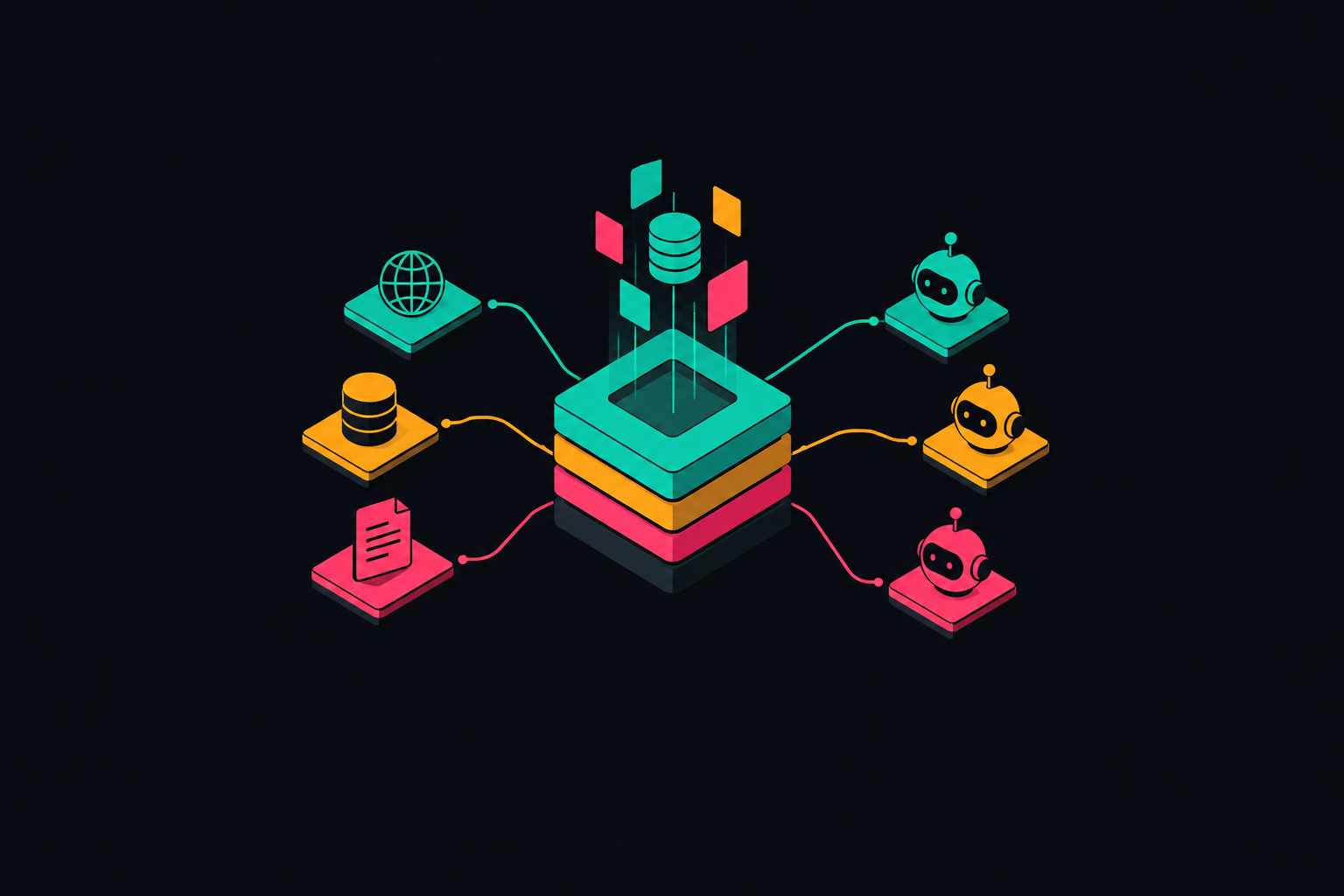
A unified web data API for AI agents brings search, scraping, crawling, mapping, batching, and monitoring into one interface. Freshness, format fidelity, structural coverage, monitoring continuity, and reliability under adversarial web conditions must work together, because failure in any one can break the workflow.
Why AI agents expose a different kind of data problem than analytics stacks were designed to handle
Traditional analytics stacks answered questions about what had just happened. An agent answers a question now and may act on it immediately, so a delay that was acceptable in a report can become an error in a decision. This is a structural mismatch. Even with faster batch processing, there is a gap between the world the data describes and the world the agent acts on.
That gap becomes expensive at the agent layer. An agent with no prior context starts each interaction from scratch, spends tokens on bad inputs, and may produce insights that never reach the workflow that needs them. A stronger model cannot repair every missing connection. The failure starts upstream, in how the information is gathered and passed on, even if the model gets the blame.
Dey and Viradecha (2026) describe autonomous AI agents as “first-class participants in digital infrastructure.” That framing shifts the task from serving another consumer of reports to supporting a participant that can act. An analytics pipeline was not designed for that job.
Completeness is not a volume metric — it is the simultaneous satisfaction of five distinct dimensions
Page counts and record counts measure supply. A platform can have a huge index and still lack the current pricing page an agent needs to make a decision. More stored data does not close that gap. A warehouse full of yesterday is still yesterday, however impressive the shelving.
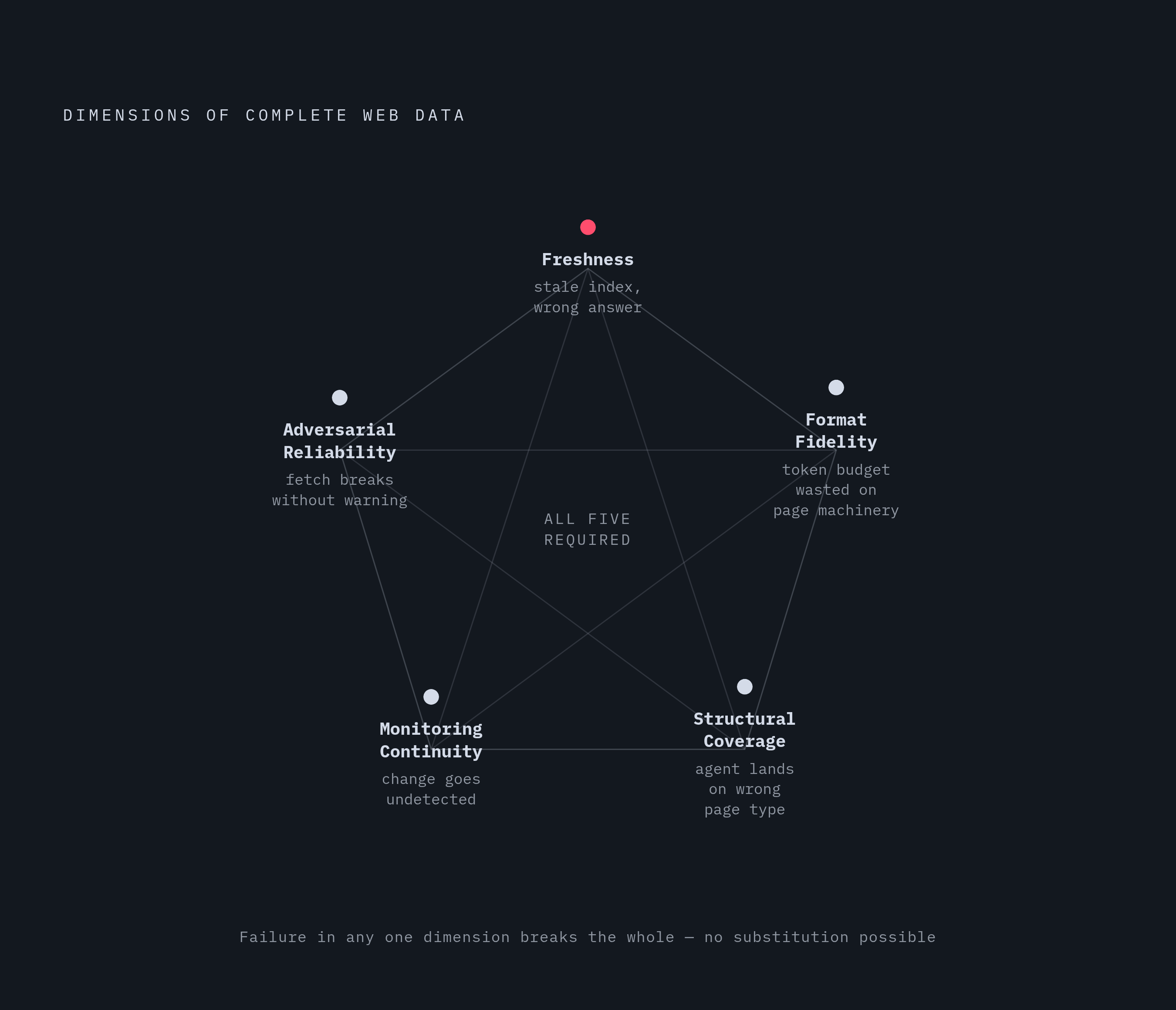
Completeness instead has five dimensions, which are freshness, format fidelity, structural coverage, monitoring continuity, and reliability under adversarial web conditions. Freshness connects an answer to the present, while format fidelity makes its evidence usable without burying it in page machinery. Structural coverage lets the agent find the right kind of source when it retrieves a URL. Monitoring continuity extends that access across time, and adversarial reliability keeps it working when the source changes the conditions of access.
These dimensions constrain one another. A missing dimension can produce a wrong answer, a silent error, or hallucinated context, even when the others perform well. The distinction is categorical. An agent either has evidence it can use for its task or faces a gap that more unrelated data cannot fill.
Freshness: why a stale index answers yesterday's question with last month's data
A crawl index reflects the web when it was collected. If that happened days or weeks ago, an agent asking about current competitor pricing may get a fully accurate account of an offer that no longer exists. The answer can look grounded and still be wrong. For a workflow that acts immediately, the age of the evidence is part of its correctness.
Regulatory notices make the same problem especially clear. A notice posted after the last crawl is absent from the index, regardless of how well retrieval ranks the documents already there. Supplier catalogs and public forum threads pose the same risk because their content can change between when it is collected and when it is used. Fetching live data at query time closes that particular gap by consulting the source when the answer is needed.
Live fetching, however, has a real latency cost. The architectural response is targeted fetch-on-demand for high-change sources, indexed retrieval for stable ones, and monitoring to detect when a supposedly stable source changes. Freshness requires a retrieval path that matches how quickly the source can become misleading.
Format fidelity: how raw HTML turns complete data into an unusable input
An HTML fetch can bring back every byte and still leave the agent with a lot of work to do before it reaches the evidence. Navigation bars, scripts, cookie banners, ads, and boilerplate all compete with useful content in the input. The difficulty of supplying complete, usable evidence has shifted to the input. It now takes up room in the token budget, wearing a cookie banner.
Tokens spent on page machinery that has no bearing on the task cost money and take up space that could be used to reason about the task. At scale, the distinction between tidy and untidy text changes the expense of using the same underlying information on every request.
Clean Markdown can use far fewer tokens while keeping headings, lists, links, and tables. Those elements preserve relationships that help an agent interpret the page. Fidelity keeps the useful meaning and structure without having to keep every part of the format in which the page was delivered. A complete fetch is only useful if the agent can work with what arrives.
Structural coverage: what it means for a platform to understand the shape of a site, not just its pages
Fetching a URL proves that a platform can reach a page. It does not establish which other pages exist, how they relate, or where the useful content sits within the domain. That is a different kind of knowledge. Without it, an agent can retrieve information without navigating with intent.
An agent can run into this when it needs current pricing but lands on a blog post about an earlier offer. Both pages may be readable and freshly fetched, yet only one serves the task. The same distinction separates a product catalog from a support FAQ, or a live regulatory document from an archived version.
Structural coverage depends on sitemap parsing, link graph traversal, schema detection, and the ability to distinguish content types within a domain. Dey and Viradecha identify an evolution from keyword-based agent discovery toward a semantic, trust-weighted Agent DNS. Their proposal concerns agent discovery, but the underlying distinction also helps explain source navigation. Finding a match is not the same as understanding what role that match plays.
Monitoring continuity: a platform that only fetches on demand cannot support agents that act on change
A competitor changes its pricing, a supplier revises its terms, or a regulatory body posts a notice, and the agent needs to know without a user asking it to look. On-demand fetching describes the page at the moment of retrieval.
Continuous observation also needs judgment about the change. A visual or DOM difference can detect that something moved, but a new banner and a revised price are not equally useful signals for a pricing agent. Raw change detection is cheap and noisy. Semantic judgment connects the difference to the purpose of the workflow.
A sequence of pricing changes may be ambiguous event by event but collectively suggest a strategic shift, so an agent needs retained history to read the pattern. If a redesign, paywall, or changed site structure breaks observation, the platform must detect and recover from it rather than leave downstream agents acting on stale assumptions.
Reliability under adversarial web conditions: why the web actively resists automated access
The web is not a passive data store. Bot detection, CAPTCHAs, IP rate limits, paywalls, anti-scraping middleware, and dynamic content loading can interrupt automated access, while JavaScript requirements can change the work needed to retrieve a page. These conditions are actively maintained. A fetch that worked before is not a promise about the next one.
JavaScript rendering shows why uniform handling falls short. A page requiring a headless browser is slower and more expensive to retrieve than a static page. Treating both identically either overspends on the simple page or fails on the complex one.
Cloudflare repositioned its browser rendering product as agent-first infrastructure in 2026, renaming it Browser Run and adding record, replay, and human handoff capabilities. That is a concrete signal that agents require dedicated handling beyond browser workarounds. Self-healing pipelines extend this principle to broken ETL, schema drift, and temporary source outages. If someone has to fix each break by hand, autonomous operation has a hidden human-shaped dependency.
Protocol interoperability: how MCP changes what "accessible" means for agent-ready data
Good data is effectively blocked from an agent that has no usable way to query it. A platform exposing a Model Context Protocol (MCP) server allows MCP-compatible agents to connect without a bespoke connector for each integration. This changes the meaning of accessible. An endpoint existing somewhere is not equivalent to an agent being able to use it.
Protocol interoperability is the access layer across the five dimensions. Clean, current, well-mapped data still needs a route into the agent’s workflow. Conversely, an MCP connection cannot make stale or poorly structured evidence complete. The protocol opens the door without guaranteeing what is inside.
Dey and Viradecha document MCP support for Agentverse as of April 2026, while noting that it operates solely through external adapters. Only a small fraction of sites had deployed MCP Server Cards by then, leaving much of the web opaque to this form of discovery. Provider-side MCP support therefore gives a data platform a way to make its sources accessible to compatible agents despite that broader gap.
Why the five dimensions must be satisfied simultaneously, not sequentially optimized
Freshness can lose its practical advantage when raw HTML consumes the agent’s input budget before useful reasoning begins. Clean output, in turn, cannot trigger a workflow if it only arrives when someone remembers to ask. Monitoring depends on durable access to the source. When bot detection breaks retrieval, the monitoring layer loses the observation it was supposed to interpret.
Structural confusion can direct a live fetch toward an archived document, making current retrieval deliver obsolete evidence in a perfectly readable format. Each capability may seem to work well on its own. What fails is their combination around the agent’s actual task.
A document retrieval system may not need monitoring, and a monitoring pipeline with a tightly defined job may not need deep site mapping. But general agent workflows encounter varied sources and expand over time, turning initially acceptable gaps into blockers. Dey and Viradecha derive a Gap Taxonomy of eight categories and dozens of missing infrastructure capabilities from their production-platform audit. Its breadth supports the harder conclusion that no single excellent capability can stand in for complete infrastructure.
What does a unified web data API for AI agents look like in practice?
A platform built for all five dimensions combines live fetch-on-demand and change monitoring with clean, structured output in Markdown, JSON, or HTML. Site mapping and crawling give the platform structural coverage, while JavaScript rendering, bot mitigation, and tiered pricing by page complexity help it deal with pages that differ in how they can be accessed. An MCP server and native SDKs make those capabilities reachable.
The alternative is to connect separate tools for search, scraping, crawling, monitoring, and format conversion. That arrangement leaves the developer responsible for the seams, including whether the freshness and formatting tools agree on what constitutes a complete page. A unified API brings search, scraping, crawling, mapping, batching, and monitoring into one interface. Its value lies in making completeness a platform property.
Developer experience belongs in that assessment too. An API that is expensive to try, difficult to debug, or limited to one language creates pressure to skip capabilities that the workflow needs. Easy access supports complete use. The tools must therefore work together well enough that the agent never has to compensate for missing capabilities, regardless of how many share an endpoint.