Anti-Bot Systems Every Startup Data Team Needs to Understand
Modern bot defenses score traffic across five layers, not one.
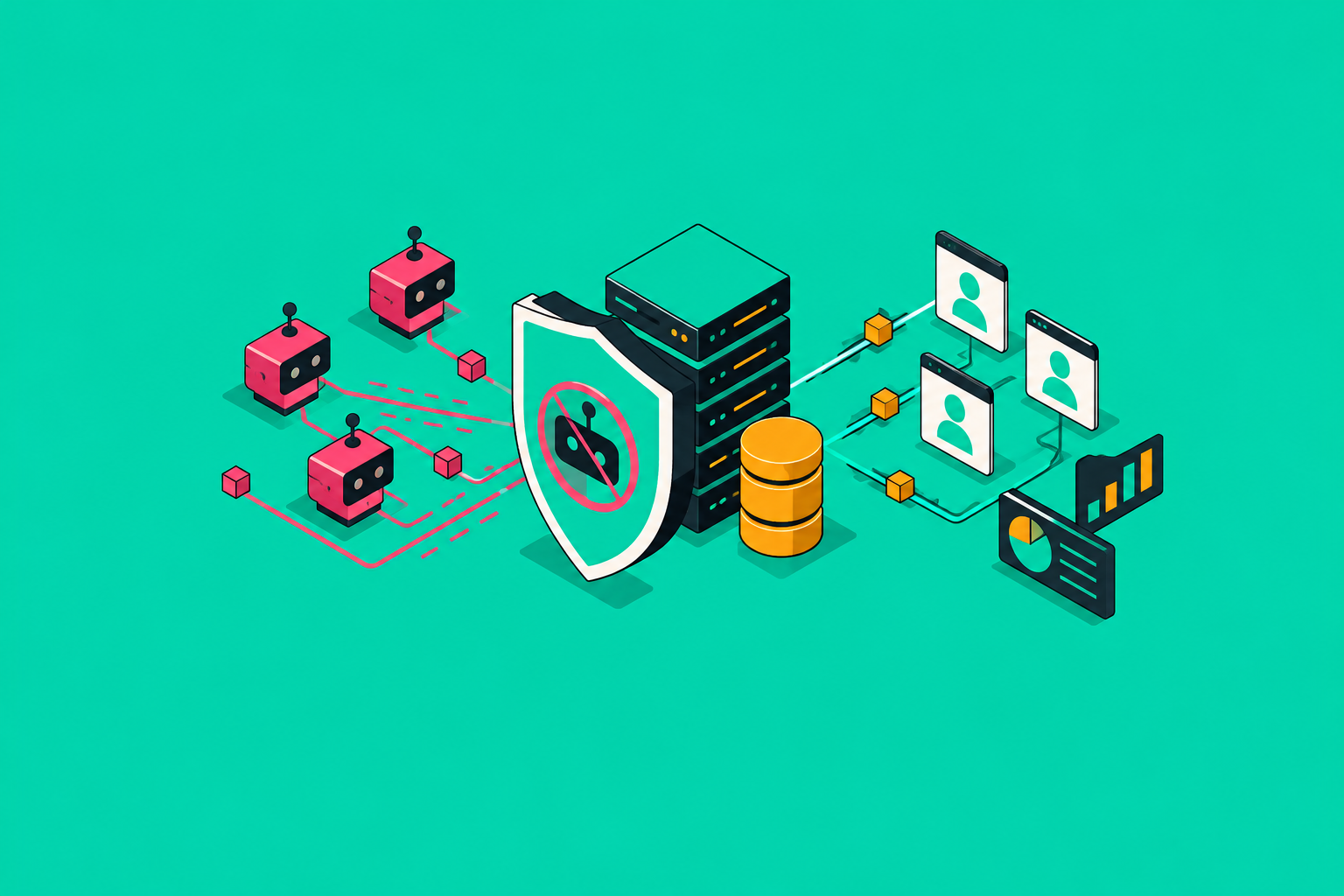
For high-volume startups blocked by anti-bot systems, a managed web scraping API is an infrastructure choice with no guarantee of access. Modern defenses combine multiple detection layers into a probabilistic trust score, so predictable pipelines require layer-specific diagnosis beyond another User-Agent change. The useful comparison considers how infrastructure handles connection fingerprints, browser execution, session behavior, and access identity alongside how many requests it can send.
Why modern anti-bot systems are a data pipeline problem, not a security problem
A pipeline runs fine, then starts sending back 403 responses. Nothing in the extraction code changed. The failure looks mysterious because the team sees only the final verdict while the signals that produced it remain hidden. For a startup pulling live web data, that makes anti-bot protection an operational constraint.
Vendor pricing pages do not show block rates. Teams therefore discover a crucial part of the cost in production, when requests stop yielding useful data. Understanding the scoring engine turns that surprise into a problem with identifiable parts. The server is applying a decision process the pipeline needs to account for.
How automated traffic has changed the web's threat model, and why protection has become layered
Imperva's 2026 Bad Bot Report describes automated traffic as the majority of web requests and reports year-over-year growth in its malicious share. Meanwhile, AI agent frameworks have made browser automation available without the custom engineering it once required. Defenses based on IP reputation have also grown weaker because residential proxies are available.
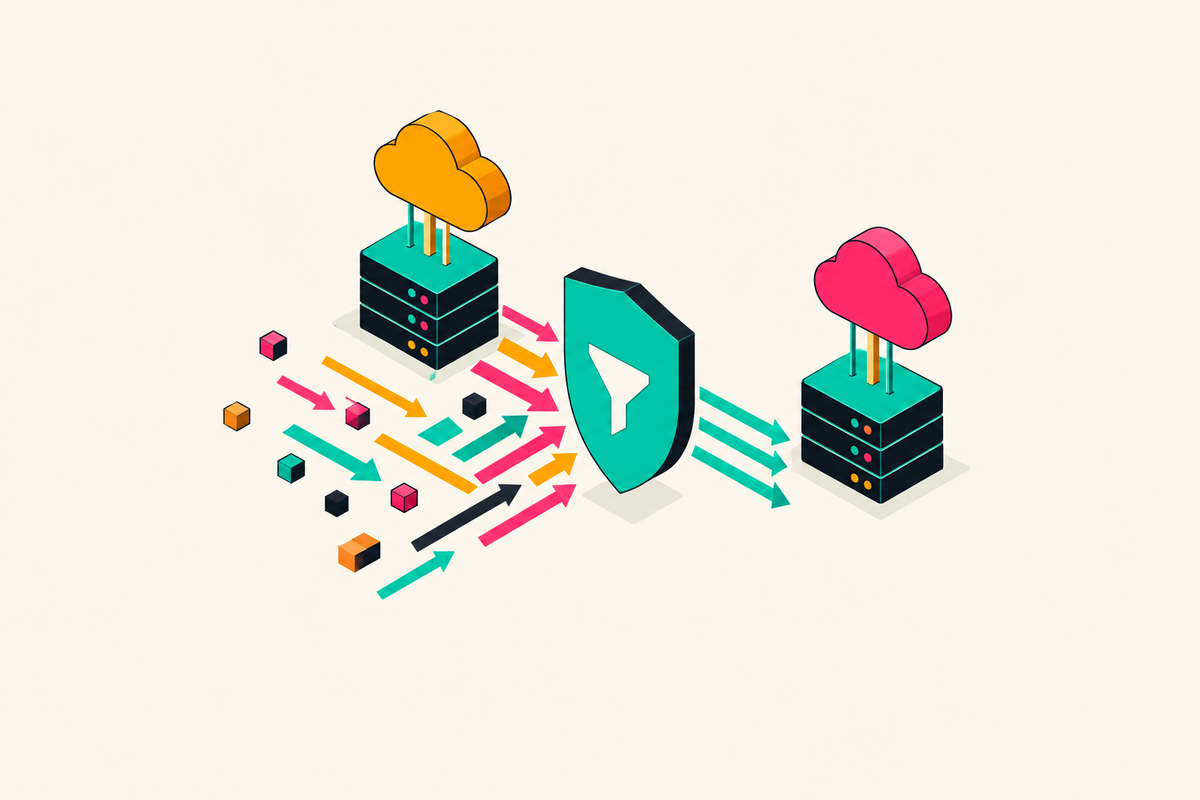
AI-enabled bots can mimic human pacing, rotate identities, and generate realistic interactions. That makes any single signal a shaky basis for trust. Defenders respond by combining independent checks, so traffic that looks plausible at one checkpoint still faces others. Five layers examine different evidence, from the connection handshake to behavior across a session.
The trust score model — how anti-bot systems make probabilistic decisions
The final response may look binary, but the underlying decision is not. Anti-bot systems aggregate sub-scores into a continuous trust score. Above an upper threshold, the request passes and the page loads normally. In the gray zone, the visitor receives a CAPTCHA or JavaScript challenge. Below the lower threshold, it receives a 403 or block page.
Those thresholds depend on the site's priorities. A news site may favor traffic, while an e-commerce checkout favors suppressing fraud, even when both use the same protection stack. Consequently, a scraper need not fail one decisive test to be blocked. Modest inconsistencies across two or three layers can collectively push it below a threshold, while plausible signals across the layers can accumulate enough trust to pass.
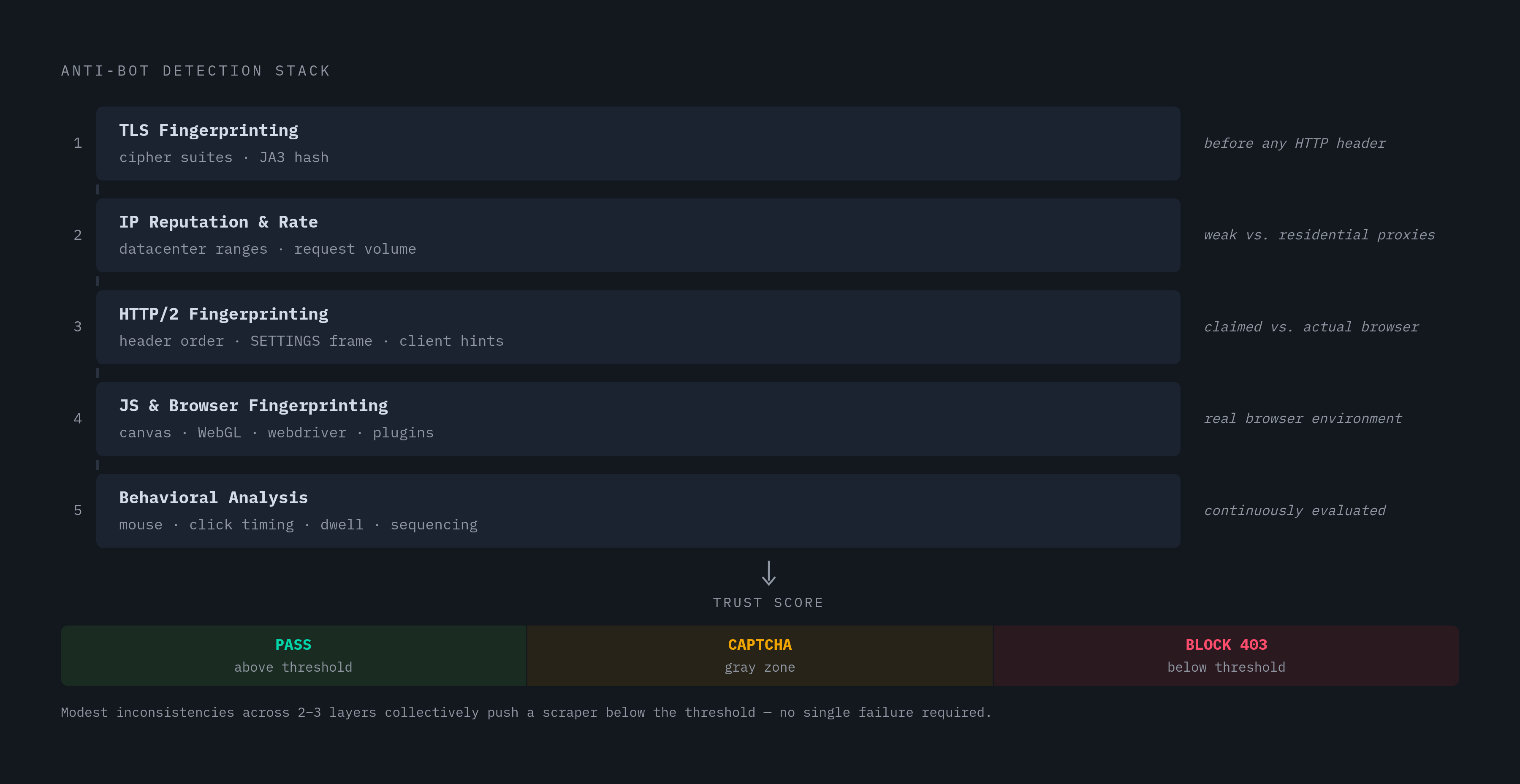
Layer 1 — TLS fingerprinting catches scrapers before a single HTTP header is read
Detection begins before the scraper sends its HTTP headers. During the TLS handshake, the client sends a “Client Hello” containing cipher suites, TLS extensions, supported versions, and elliptic curve parameters. These describe the client's connection configuration. The JA3 technique hashes those values into a short fingerprint. Chrome on Windows produces a different fingerprint from Python's requests library.
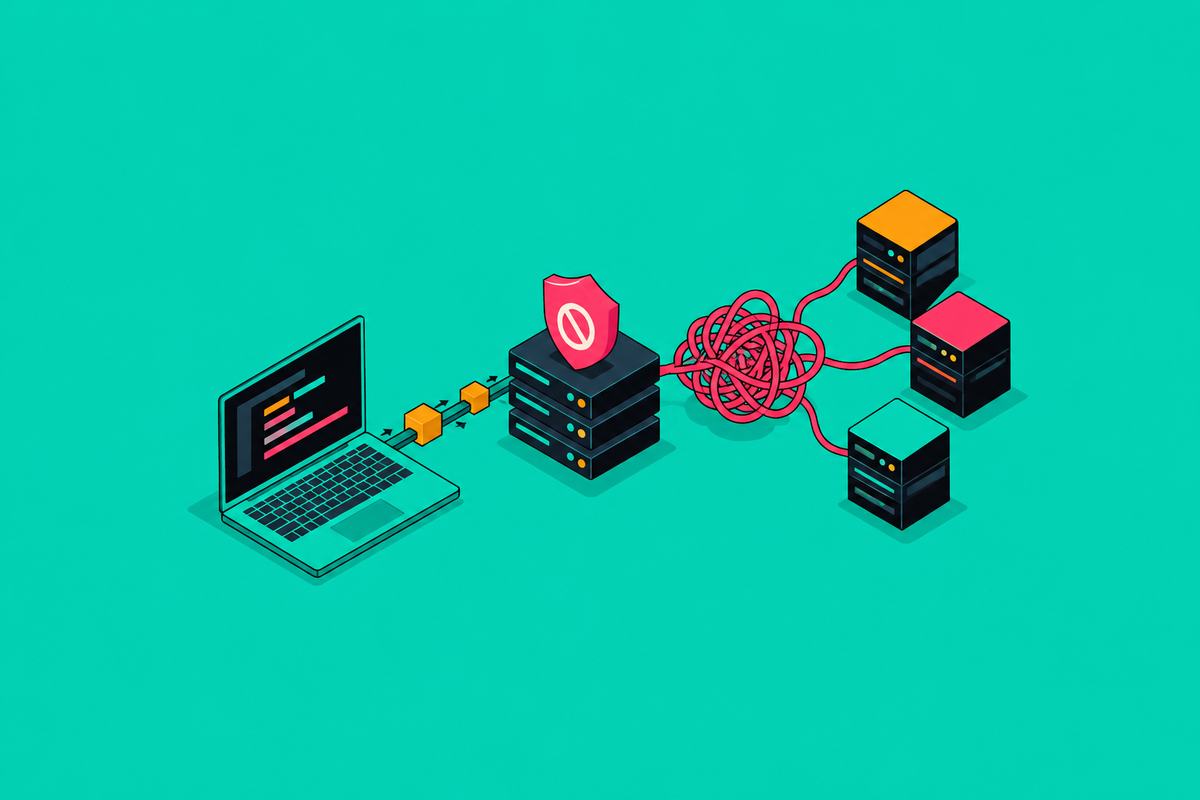
This is why a browser-like User-Agent cannot repair a connection-level mismatch. The HTTP library still generates its own TLS fingerprint, independently of the header that claims to be Chrome. The contradiction can itself become a detection signal.
Layer 2 — IP reputation and rate analysis as a fast first filter, and its limits
IP reputation draws on databases of datacenter ranges, VPN providers, and previously flagged addresses. An address with a history of bot-like behavior starts with lower trust. Rate analysis adds a rolling count of requests per IP, with excessive volume triggering throttling or denial without behavioral inspection. This is a cheap, fast first filter.
Residential addresses tend to start with higher scores because the vast majority of real users connect through residential networks. Yet cheap residential proxies let automated traffic arrive through those same kinds of addresses, weakening reputation as a standalone gate. An ordinary-looking address does not establish an ordinary visitor. IP reputation therefore contributes evidence to the broader score rather than providing sufficient protection by itself. Its limitations explain why the remaining layers exist.
Layer 3 — HTTP and HTTP/2 fingerprinting catches the gap between claimed and actual browser behavior
A clean TLS result does not settle the question. Anti-bot systems also check HTTP header order, pseudo-header order, and HTTP/2 protocol settings. Real browsers send headers in browser-specific sequences, while standard HTTP libraries can produce an order no browser would use. Akamai also validates HTTP/2 SETTINGS frame order against browser behavior.
Client hints provide another opportunity for contradiction. The presence, absence, or contents of Sec-CH-UA headers can conflict with the declared User-Agent. A request claiming Chrome while omitting its expected hints or sending headers in an incompatible order produces an implausible browser profile. This checkpoint is independent of IP reputation and TLS.
Layer 4 — JavaScript and browser fingerprinting verifies that a real browser environment exists
JavaScript inspection moves the test into the browser. It collects canvas output, WebGL vendor and renderer strings, available fonts, AudioContext behavior, navigator properties, and plugin arrays. The combined fingerprint is compared with legitimate browser profiles. A declared operating system that conflicts with the WebGL renderer creates another detectable inconsistency. The environment has to agree with its own story.
Headless browsers execute JavaScript, but automation can leave recognizable artifacts. Unmodified contexts can expose navigator.webdriver as true, empty plugin arrays, missing GPU acceleration, unexpected renderer strings, or different native-object prototype chains. API-level bots are a different case. If they never load a browser environment, this client-side inspection does not run, so the server-side layers are left to assess them. Skipping the JavaScript test is not the same as gaining access, and using a browser is not the same as looking like an ordinary browser.
Layer 5 — Behavioral analysis and why it is the hardest layer to defeat at scale
Behavioral analysis observes a session. It evaluates mouse trajectories, scrolling, click timing, dwell time, and navigation as a continuous stream. Human movement contains changing speed, arcs, jitter, and uneven timing, whereas naive automation often repeats straight paths and uniform intervals. Here, the test keeps running after entry.
DataDome's intent-based detection looks at more than single gestures. Its models for each site check behavioral sequencing, endpoint sensitivity, request rate, and session context. Research into browser-agent interaction traces has also shown that timing, clicks, and navigation can distinguish the underlying AI model.
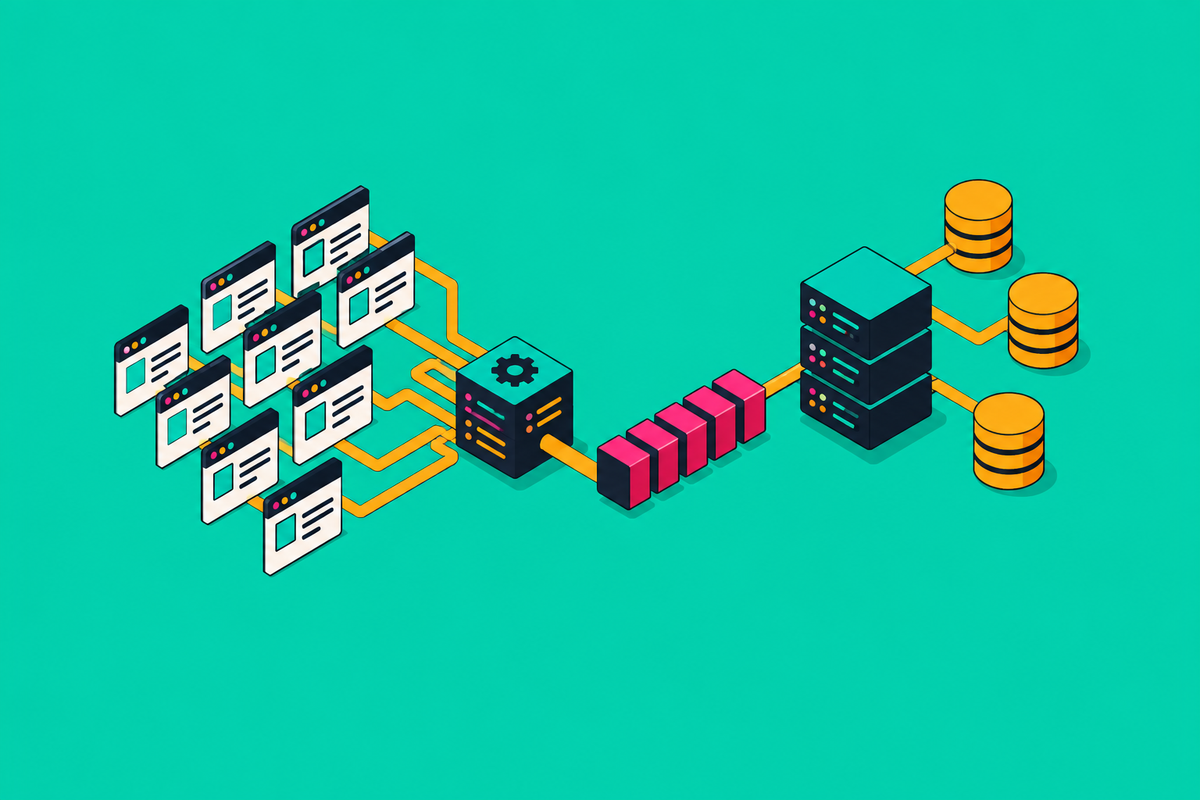
PerimeterX / HUMAN Security compares behavior across its customers' sites to find automation patterns that repeat even when IPs change. That creates a different scaling problem from matching a connection fingerprint. One realistic session is achievable. Maintaining realism across thousands of concurrent sessions without repeated patterns is harder, and no one-time configuration adjustment resolves a continuously evaluated signal.
How the major providers weight these layers differently — and what that means for debugging
Cloudflare, Akamai, and DataDome use the same broad layers with different emphases. Cloudflare combines Turnstile, its CAPTCHA replacement, with JA4+ TLS fingerprinting, JavaScript execution profiling, and challenge escalation informed by IP, ASN, and behavioral history. Managed challenge mode adjusts strictness dynamically.
Akamai emphasizes sensor telemetry covering mouse movement, scrolling, keystroke dynamics, and touch gestures. Its check of the HTTP/2 SETTINGS frame adds a separate checkpoint at the connection level. DataDome uses machine learning models built for each customer, so each protected site has its own assessment. It also checks headless-browser clues such as GPU behavior, screen dimensions, and plugins, and applies intent-based navigation analysis.
The lesson for debugging is to identify the provider before changing configurations. WhatWaf and Wafw00f can help identify the protection service. Cloudflare failures make TLS and JavaScript profiling useful initial suspects, while Akamai failures give behavioral and HTTP/2 checks particular relevance.
The cryptographic identity shift that is restructuring access for AI agents specifically
Declared identity has an obvious weakness. A User-Agent string is an unverified claim. Cloudflare's August 2025 disclosure described Perplexity AI misrepresenting its user agent while crawling, illustrating why self-description cannot establish trust. Web Bot Auth, co-authored by Cloudflare and Google and undergoing IETF standardization, replaces that claim with cryptographic HTTP signatures. Each request is signed with a private key, its public counterpart is published at a well-known URL, and the edge verifies the signature.
Cloudflare's June 2, 2026 Bot Management update introduced a “Signed Agents” classification extending its Verified Bots program. The initial cohort included ChatGPT agent from OpenAI, Goose from Block, Browserbase, and Anchor Browser. Its documentation states that, as of July 1, 2026, signed agents were merged into Verified bots, with Direct versus Intermediary access recorded in BotBase.
Adoption extends beyond that protection stack. AWS WAF, Vercel, and Akamai support verification, while Shopify supports signing so merchants can create keys for third-party crawlers. Web Bot Auth also provides the authentication foundation for Visa TAP and Mastercard Agent Pay. These uses give signed identity a role across access and payment infrastructure.
Cloudflare's policy from September 15, 2026 blocks Training and Agent traffic on pages that show ads for newly onboarded domains while allowing Search. Agents that are unsigned and unverified thus face default restrictions on a growing share of the web that relies on ads. Separately, Cloudflare and Tools for Humanity proposed Trusted Agent Delegation on November 5, 2026. It adds graduated user-identification tiers, with the highest using a proof-of-human credential such as World ID for high-risk actions. Agent identity and user delegation are related, but distinct, access requirements.
How should high-volume startups design and debug pipelines blocked by anti-bot systems?
Connection handling must deal with TLS fingerprints and HTTP behavior that matches a browser, as well as supplying a convincing User-Agent. Residential proxy rotation addresses the IP layer but not the higher checks. Browser execution must account for automation artifacts, while session handling must address continuous behavioral assessment. None of these substitutes for the others.
That distinction also clarifies the choice between direct requests, browser rendering, and managed infrastructure. Simple requests suit static, unprotected pages. A browser-rendering layer provides the browser environment a site needs, while managed scraping infrastructure takes on the work of keeping up with detection layers that would otherwise call for custom engineering. For protected sites, teams should compare how these options handle those duties and their block rates in production, along with how many requests they can send.
Cost should follow the difficulty of the page. The small share requiring full anti-bot treatment can cost roughly 100x more per page than a simple static fetch, so treating every page alike misprices the workload. The efficient AI pattern also separates authorship from execution. Agents write and keep up extraction logic, while managed infrastructure runs that logic at scale. Running LLM inference on every fetched page is economically unsustainable at high volumes.
The signals that are most likely to change — and how to build pipelines that stay predictable when they do
TLS fingerprinting standards and IP classification change less than behavioral analysis and machine learning models do. Leading detection systems keep retraining on live threat feeds, so behavioral checks take a lot of work to keep up with. Yesterday's success provides useful evidence with no guarantee of future success. Meanwhile, as CDNs and payment infrastructure adopt signed agents, cryptographic identity looks set to become something AI agents routinely need for access to the commercial web.
The practical response is to monitor access as a resource. Teams should watch for provider changes and rising block rates on targets that used to work reliably, even when they have a configuration that worked before. Managed infrastructure can handle changing detection layers while engineering attention stays on extraction logic and AI task orchestration. This separation makes changing defenses less entangled with the data product itself. As access becomes negotiated rather than assumed, durable pipelines depend on understanding the architecture, monitoring its layers, and keeping detection separate from extraction.