Scaling Web Scraping Pipelines From Millions to Billions of Requests
Billion-request scraping is a distributed systems problem, not a coding one.
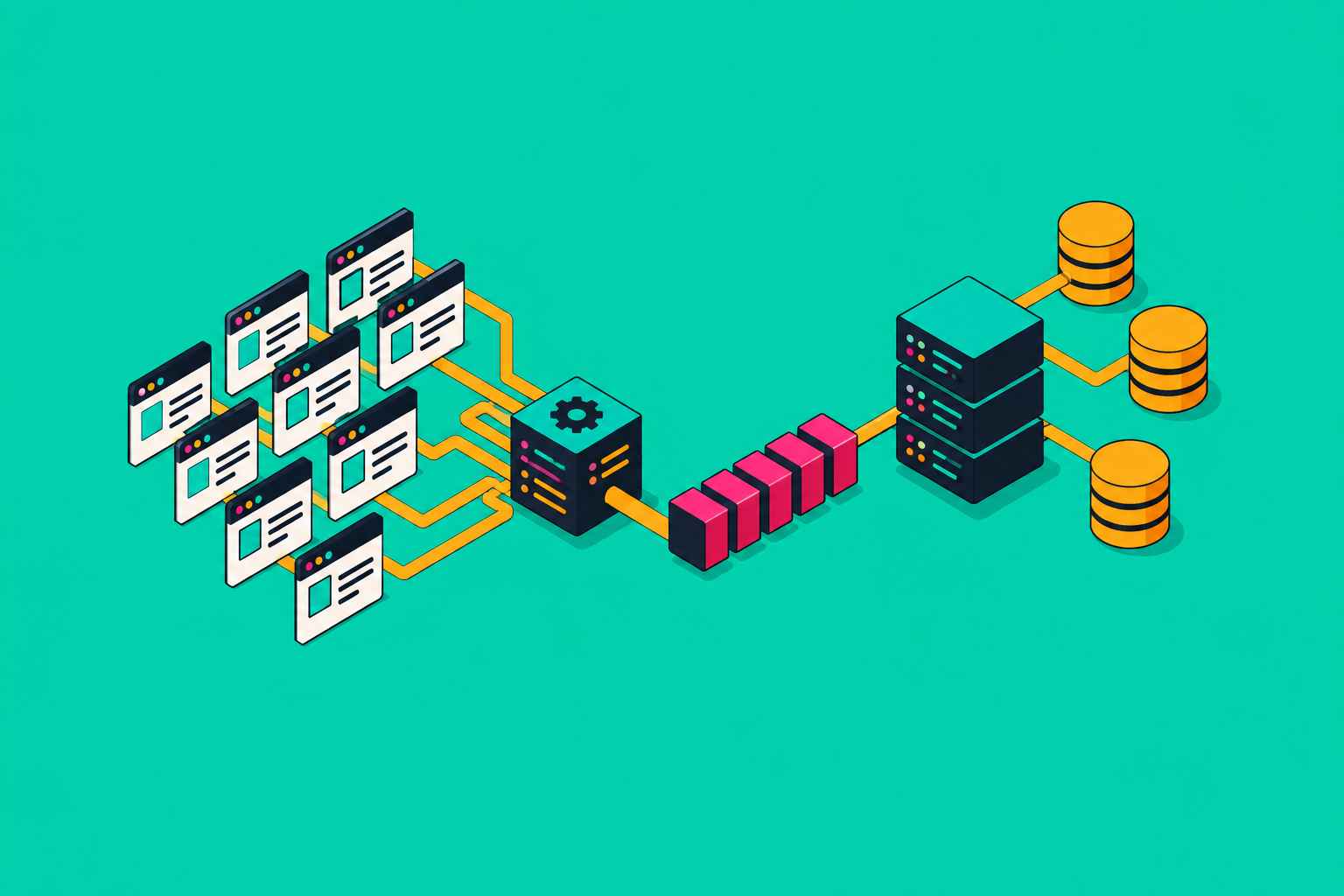
Scaling web scraping from millions to billions of requests requires a distributed system. For high-volume startups blocked by anti-bot systems, a managed web scraping API can take on fingerprinting, rotation, and bypass maintenance, but it cannot replace sound queue design, output validation, and reliable delivery. Buyers must decide which layers to operate themselves and which to entrust to a managed service.
Why scraping at a billion requests stops being a coding problem
A slow source is a nuisance in a small scraping job. In a shared pipeline handling millions of daily requests, it can hold up unrelated work. The parsing code may still be right. What fails is the arrangement around it, because the system has no way to stop one struggling target from starving the rest.
Silent parser failure creates the opposite problem. Work seems to finish, but downstream systems get empty records in place of useful data. Adding workers only gives the failure more horsepower. These are coordination problems, involving how work is distributed, how failures are contained, and how results are judged before delivery. A billion-request pipeline is therefore a distributed system first and a scraper second.
The six-layer architecture that separates production systems from scripts
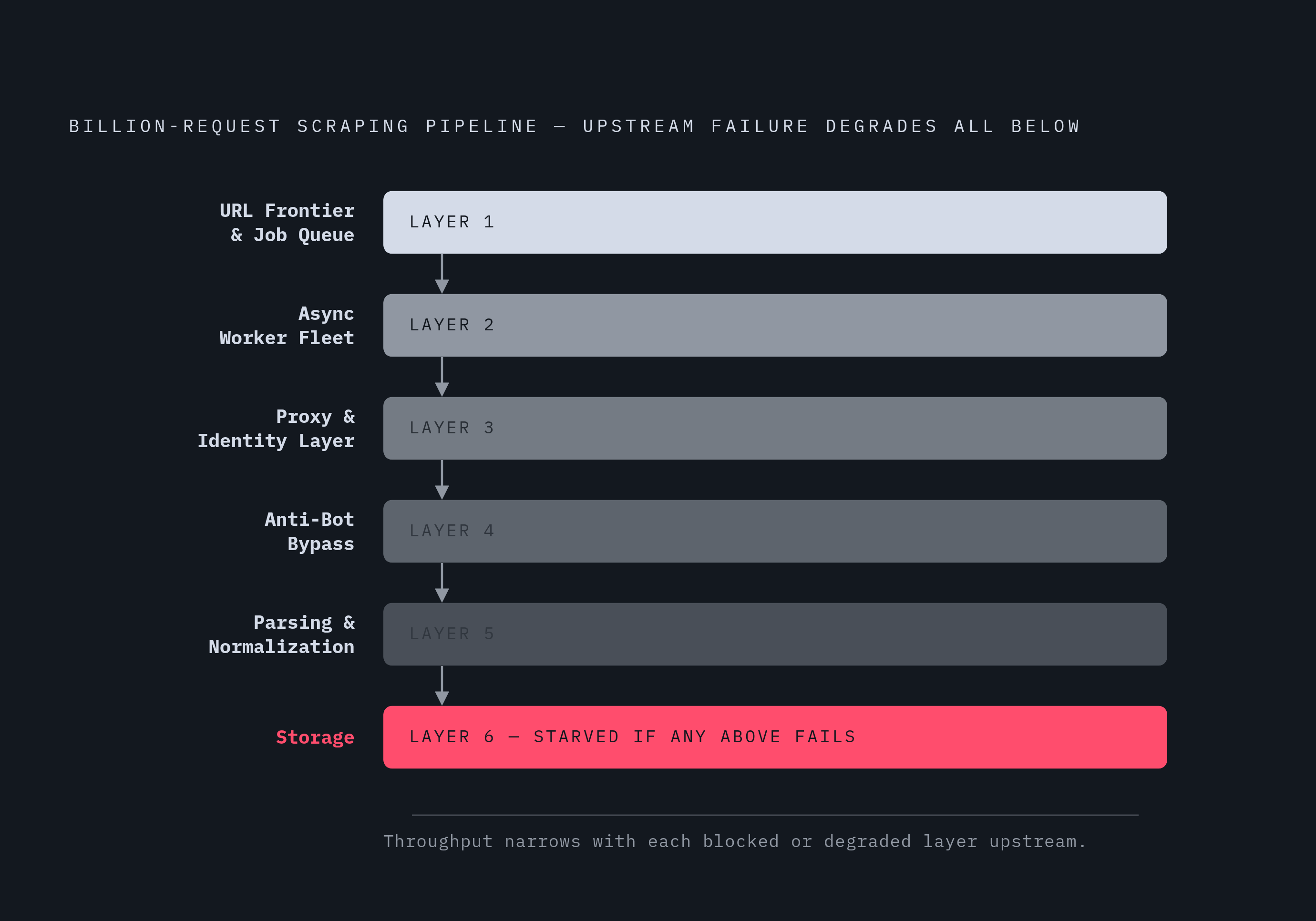
The architecture has six layers, which are the URL frontier and job queue, async worker fleet, proxy and identity layer, anti-bot bypass, parsing and normalization, and storage. The frontier defines the work, and the queue feeds it to workers. Those workers depend on identity management and anti-bot handling to retrieve pages, which parsing and normalization turn into records for storage. A failure upstream degrades everything that follows.
Python 3.9+ supports async I/O, while HTTPX provides fully featured async requests. JavaScript-heavy targets call for Playwright, with Selenium reserved for legacy codebases. Kubernetes manages elastic compute pools of headless browsers. Redis supports task queuing and deduplication, while PostgreSQL or ClickHouse provides structured data persistence.
Storage also needs a boundary between raw archives and processed records. Treating that separation as an infrastructure decision prevents storage from becoming an undifferentiated pile of whatever the workers returned. It also makes the normalization layer a clear hand-off.
This stack is expensive to build and operate. That objection is fair, but the comparison is with engineering time spent repairing unpredictable failures and the loss of data quality when those failures go unnoticed. The architecture must assign that work to the appropriate layers, including those a managed service can take over.
Async concurrency and distributed queuing as the first unlock
Async I/O lets a worker make progress on other requests while one request waits. However, opening connections without a bound replaces idle time with connection exhaustion. A semaphore supplies that bound, making concurrency a controlled resource rather than a contest to see how many sockets can be opened before lunch.
Tuning starts at 10–50 concurrent workers and adjusts to the target site's tolerance. Every request needs a timeout, because a hung connection otherwise holds on to its semaphore slot. In Python, asyncio.gather() runs tasks concurrently, while awaiting each request in a sequential loop defeats the intended gain. The useful measure is sustained throughput.
Concurrency and request rate need separate controls. A semaphore limits simultaneous work, while a token-bucket rate limiter controls the pressure an IP places on a target over time. Both belong in the async layer. Without rate limiting, running faster can lead to bans that wipe out the gains in throughput. The system needs a brake as well as an accelerator.
Asyncio solves throughput on a single machine. When jobs must survive machine failure, span multiple workers, or have observable retry behavior, a distributed task queue such as Celery with Redis or RabbitMQ becomes necessary. The dispatcher can split URL lists into batches of about 1,000 and save results per chunk. This bounds memory use and allows partial recovery when a worker dies mid-job.
Each target requires its own rate limit, retry logic, rendering method, and expected output volume, because sources tolerate very different levels of pressure. A global configuration turns those differences into shared failures. Queue priority and throttling are therefore part of the concurrency design from the outset.
Proxy management and identity rotation at high request volumes
Once workers can send requests concurrently, their shared identity becomes a constraint. Sending more traffic through too few network identities makes it easier to block the pipeline. At this scale, a proxy pool is needed, and the question is how to route requests intelligently through it, including rotating residential proxies.
Detection uses behavioral signals as well as IP frequency, so a fresh address cannot compensate for every other signal the request presents. Meanwhile, millions of daily requests can use up the pool of working proxies as sources start to block whole IP ranges. Collection then drops without an obvious error in the scraping code. The proxy layer needs to be treated as part of retrieval reliability.
Some proxy waste starts before any request is sent. Concurrent workers can pick up the same URL and spend retrieval budget on duplicate work. Deduplication at ingestion, using Bloom filters or Redis sets, prevents that repetition. This is a direct link between queue design and proxy economics, because the cheapest duplicate request is the one the system never schedules.
What modern anti-bot systems actually detect and how pipeline design responds
By 2026, bot detection checks more than page content and how often requests arrive. TLS fingerprints, behavioral signals, and machine learning classifiers all shape whether traffic is accepted. Cursor movement, scroll timing, and browser fingerprint consistency can expose patterns that IP rotation leaves untouched. Changing the address is not the same as changing the identity.
Adaptive detection also changes the maintenance burden. Models that learn from live traffic can respond to newly observed bypass techniques, leaving a static configuration with a limited useful life. Anti-bot handling remains an ongoing infrastructure responsibility after a setup succeeds during initial testing.
The design response includes dynamic User-Agent rotation, TLS fingerprinting emulation, and automated CAPTCHA handling. Realistic browsing behavior must also be supported where behavioral checks require it. These tools belong in a service layer that is kept up to date. Scattering them across individual scraping jobs makes every source another place where the same operational problem must be handled.
For a startup asking what scraping API can handle Cloudflare-protected sites at massive scale, the useful comparison is the maintenance responsibility each option accepts. A self-managed stack leaves fingerprinting, rotation, and bypass upkeep with the team. A managed API can abstract those tasks, which is its strongest argument when building that layer is prohibitively expensive. Neither arrangement removes the need to validate the data that comes back.
That distinction shapes the evaluation criteria. Fingerprinting, rotation, bypass maintenance, and output reliability are more useful criteria than an unqualified promise to avoid blocks. Automated health checks must check each run against the expected output counts and required fields, because detection can cause data to fail silently even when the request seems to work.
Structuring scraped output for LLM consumption at pipeline scale
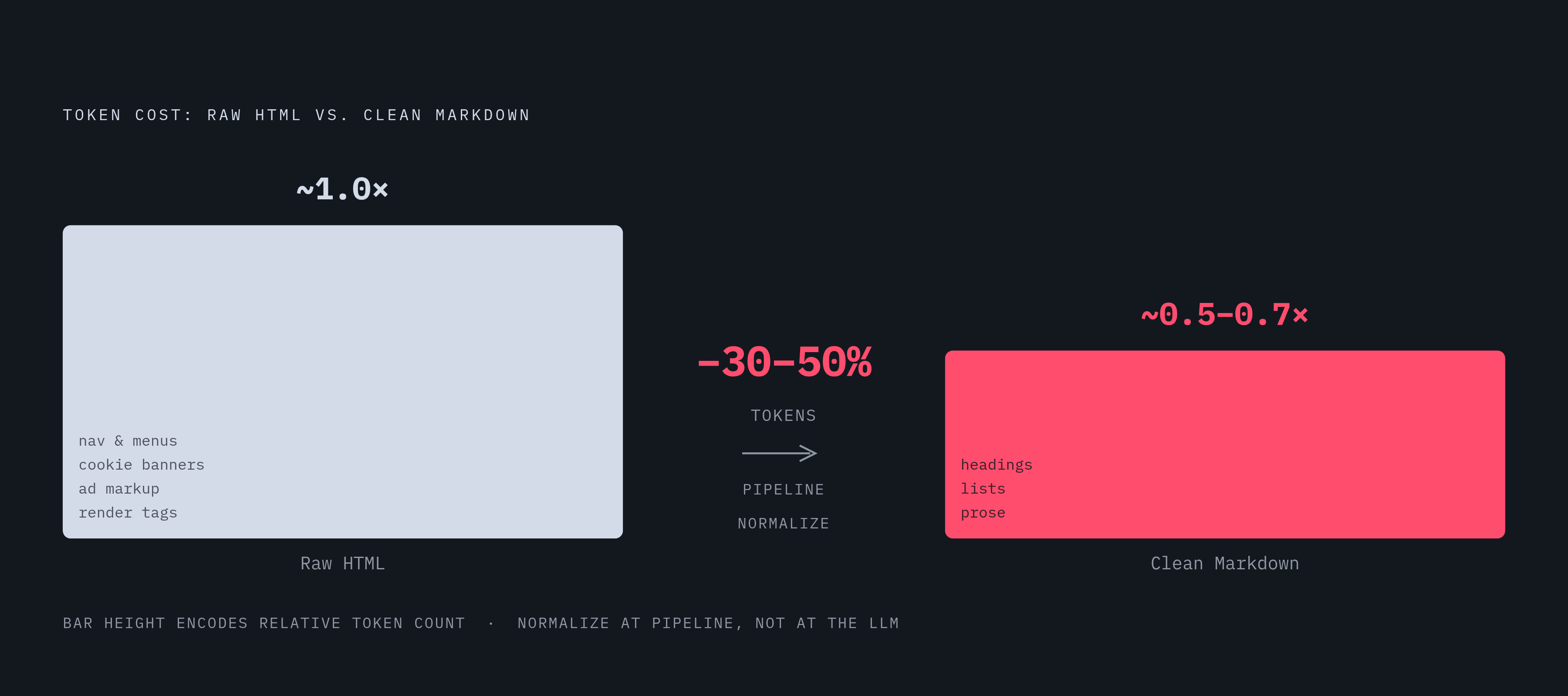
Successful retrieval is only the beginning of useful output. Raw HTML mixes page content with navigation, ads, cookie banners, and rendering markup, forcing an LLM to process structural noise along with meaning. That wastes context and inflates token costs. At pipeline scale, normalization turns retrieved clutter into usable AI input.
Clean Markdown preserves headings, lists, and prose hierarchy while removing rendering artifacts. HTML-to-Markdown cleaning pipelines can reduce token usage by 30–50% compared with raw HTML. The value is not just fewer tokens. A denser representation keeps relevant content and its structure together, supporting retrieval and reasoning without asking the model to sift through the page's furniture.
That cleanup belongs in the pipeline. Asking an LLM to clean its own input spends context on work that should already be complete and introduces inconsistency. The output decision should therefore be made at design time and enforced uniformly. Clean Markdown serves LLM input, while structured JSON serves database persistence, with both derived from the same normalization step.
Discovery can be separated just as deliberately. Parsing a sitemap first defines the crawl's scope before extraction requests begin and avoids the sequential discovery bottleneck of traditional crawlers. It also allows discovery-layer rate limits without stalling extraction workers.
Selector-based scrapers can break silently when the DOM changes, while schema-driven extraction defines the required data and lets the extraction layer find it structurally. This makes it more resilient to redesigns, but validation remains necessary. Without validation, downstream AI systems can get stale or empty records without knowing that collection has stopped bringing back useful content.
Monitoring, parser maintenance, and the operational discipline that sustains billion-request pipelines
At billion-request scale, monitoring can require more sophistication than scraping itself. There is too much data to check by hand, and a request can finish without bringing back the expected data. Each source therefore needs output thresholds that set out its record counts, required fields, and structural integrity checks.
Those checks need to run after every run. Deviations should trigger alerts before the next delivery cycle, and a parser returning fewer records than expected should be treated as a failure. This catches blockage and breakage before a business team notices wrong dashboard numbers.
Parser upkeep is a standing engineering workload. Sites redesign their DOM, and across hundreds of sources, yesterday's working selectors become today's maintenance tasks. Treating each repair as a one-time exception keeps engineers reacting, consuming time needed to build product. When half their time goes into keeping the scraper alive, the pipeline has become a maintenance liability.
Delivery also needs separation from collection timing. Downstream systems can receive data on a defined schedule instead of depending directly on when a scraping run finishes. This decoupling helps the pipeline absorb transient detection events, proxy exhaustion, and worker failure without passing every disruption straight to the AI application. It does not excuse stale data, so output thresholds and alerts remain part of the same design.
A script can send a burst of requests that looks impressive. Infrastructure earns the name by making the resulting data dependable.