How Startups Should Choose Between DIY Scrapers and Managed APIs
Managed APIs usually win on protected sites once you count engineering hours.
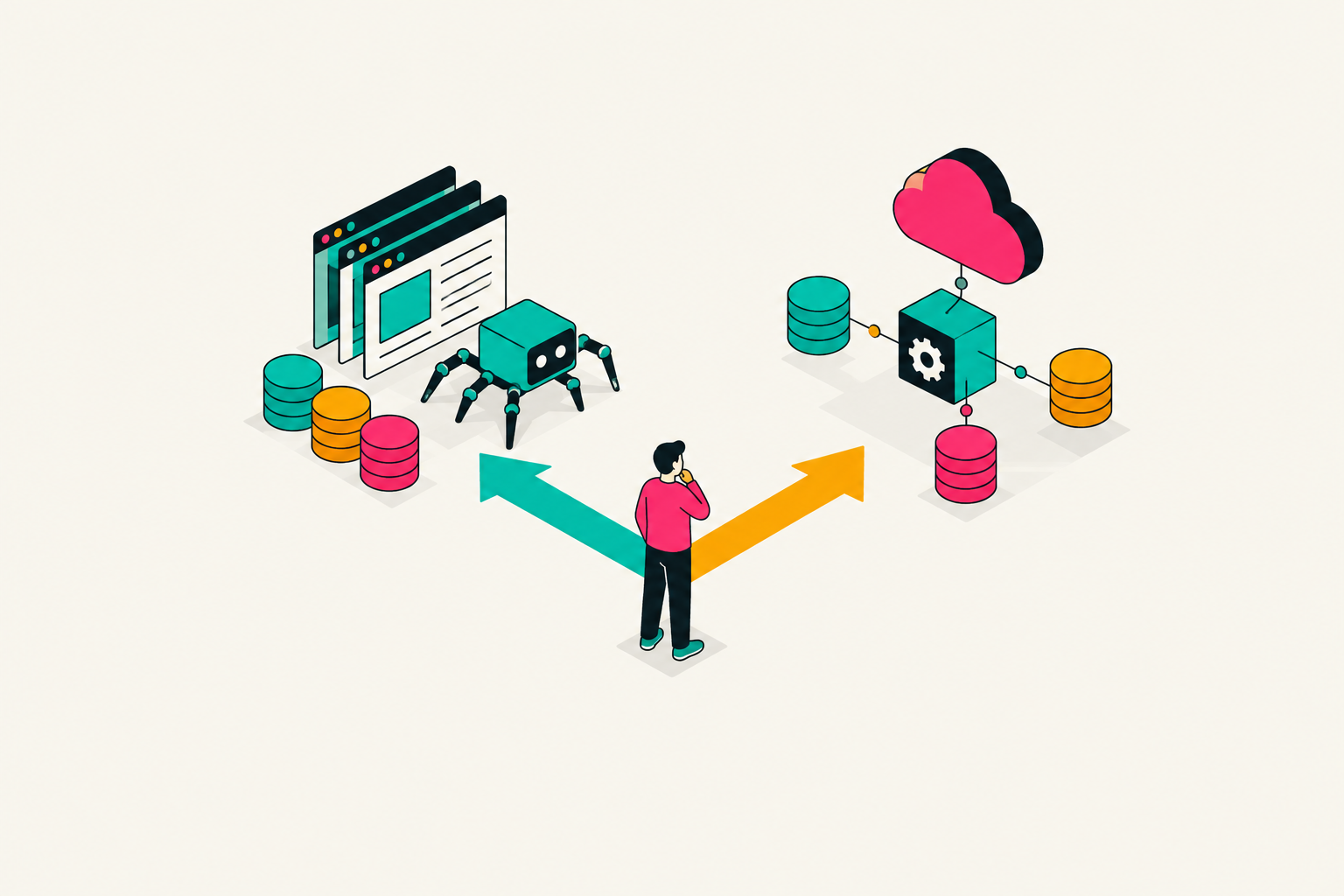
For startups scraping high volumes from sites with strong anti-bot systems, managed APIs are usually the better choice because running browsers and repairing scrapers take more engineering time than request counts suggest. DIY wins when targets are simple, control is essential, or scraping infrastructure is already in place. The right choice comes from total engineering cost, target complexity, and delivery speed.
Why the DIY vs. managed API debate is really an engineering cost calculation
A developer gets a new data requirement, a deadline, and a quoted API price. The price is visible. The hours needed to build and maintain an alternative are not, which makes a quick script look like an obvious saving. That comparison puts a subscription beside a prototype and leaves out the work needed to turn the prototype into a production system.
Compare what each option will cost over the coming year. The cost depends on how complex the targets are, how much maintenance they need, and how soon the system must be ready. Simple sites make DIY much cheaper, but repairs that keep coming raise its cost over time. A compressed timeline makes managed infrastructure the default because building the plumbing delays the product.
What production-ready DIY scraping actually requires, before writing a single line of business logic
A production scraper has six independently complex subsystems. The first is an HTTP client with retries, exponential backoff, timeout handling, and error classification. Sending a request is the easy part. Handling the ways it can fail takes more work than most teams budget, before the scraper has extracted anything useful.
The second subsystem is a proxy pool, including sourcing, rotation, ban detection, and health monitoring. Buying access does not finish the job. The team still has to manage which proxies it uses and detect when the pool stops working well. That adds an operational responsibility separate from the code that reads the page.
JavaScript rendering adds the third subsystem. Playwright or Puppeteer provides browser automation, but production use also requires configuring Chromium, managing browser instances, and handling memory leaks. The browser becomes infrastructure. A script that opens a page locally has not yet solved those problems.
The fourth subsystem is website compatibility, including TLS fingerprinting, request header mimicry, and behavioral patterns for advanced detection systems. This can be the most time-consuming component. Challenge resolution then adds a fifth subsystem through integration with a third-party service for interactive challenge pages. The scraper now has quite a staff for something introduced as “just a script.”
Maintenance is the sixth subsystem, and it never gets to graduate. A working scraper can need repairs whenever a target changes its HTML, adopts a new JavaScript framework, or updates its bot detection. Maintenance takes roughly 5–20 hours per month per scraper, plus the time to build it, which depends heavily on how complex the targets are. Those changes happen on the target’s schedule.
The honest cost comparison at different volume tiers
When volume is low, the work to set up DIY is spread across just a few pages. Managed APIs therefore have a strong cost advantage. Their fee can be a fraction of the total cost of maintaining a custom stack, even when the infrastructure bill alone looks modest. Developer time is the large item that a server invoice conveniently leaves out.
At meaningful monthly volume, a DIY system can still cost many times more than a managed starter plan serving the same volume. Proxy costs and cloud compute contribute to the gap, but setup and ongoing maintenance hours dominate the calculation. For planning, the maintenance range gives teams something concrete to price. Multiplying those hours by the loaded cost of engineering time produces a more useful estimate than comparing request prices alone.
Very high monthly page volumes can change the economics. That can happen once the team has paid for the initial engineering work and DIY infrastructure costs fall below managed pricing. Volume alone does not guarantee that outcome. As demand grows, anti-bot mitigation and browser orchestration can take so much engineering time that a team that started with DIY moves to managed infrastructure instead.
It is fair to object to paying for a subscription forever. So is the repair bill that keeps arriving. Even a few hours of senior developer time each month can make the managed option cheaper, before counting the product work delayed by those repairs. The defensible comparison includes initial build time, recurring infrastructure, and maintenance for both options, with internal labor counted as a cost.
The four scenarios where DIY genuinely wins
The first clear DIY case is one or two simple, static sites with no bot protection and no JavaScript rendering requirement. A lightweight scraper has little infrastructure to manage. The initial build is small, the maintenance tail is short, and there is no need for an ongoing proxy or challenge-resolution stack.
The second case is a real-time application with sub-second latency requirements. When the round-trip through an API endpoint introduces unacceptable delay, direct control of the fetching path is an architectural requirement.
The third case is a business whose core product is scraping. The extraction layer is the competitive advantage itself. Custom fingerprinting, protocol-level interception, or bespoke authentication flows belong in the team’s control when those capabilities distinguish the product. Outsourcing that layer would outsource the moat.
The fourth case is a team with proxy contracts, browser infrastructure, and engineers whose primary job is scraping. The fixed costs are already sunk. With all that in place, the marginal cost of DIY is close to zero, so buying another fetching layer may leave the team paying as much or more.
Complex authenticated workflows also favor direct control of the scraper. With multi-step login, 2FA, and OAuth, the team has to handle cookies and session state with care. DIY gives the team more control over those flows than most managed APIs expose.
When should high-volume startups blocked by anti-bot systems choose a managed API?
On protected sites, DIY maintenance can grow faster than scraping volume, so managed APIs can compete on cost sooner than an estimate based on request counts suggests. The expensive work includes parser repairs when layouts change silently, residential proxy rotation, and countermeasures for browser fingerprinting and behavioral analysis. More requests are not the only source of more work.
The contest is also uneven in scale. Anti-bot vendors iterate continuously and serve many targets, while a startup team maintains countermeasures for individual sites. That structural imbalance makes a working scraper a temporary achievement.
JavaScript-heavy targets add another source of cost because headless Chromium consumes CPU and memory at scale. As the number of daily requests grows, a Playwright or Puppeteer cluster becomes a fleet of browsers that the team has to run. The browser stops being a supporting character. Running it can become one of the team’s biggest infrastructure jobs, even before it deals with the target’s latest detection changes.
The practical signal is recurring engineering work to keep access working. A startup in that position should judge a managed API by its advertised request price, its fit for the protected targets, and the rendering work it can take off the team’s hands. There is no basis here for a promise of unlimited, block-free access.
What AI pipelines add to the format requirement, and why that changes the tool calculus
An AI application needs more than a successfully fetched page. It needs content in a form the model can use without spending tokens on noise. Raw HTML has navigation, boilerplate, scripts, and ads that give the model little it can use. Fetch success is therefore only part of the job.
RAG over live web data makes that distinction concrete. The pipeline scrapes current pages, stores their content in a vector database, and retrieves relevant chunks at query time. This lets an agent answer from current information. But the content must be clean enough for embedding and retrieval, so output quality becomes an architectural requirement.
Clean Markdown or schema-shaped JSON can remove a separate post-processing build. For an AI startup, native support for those formats deserves as much attention as scraping success rate. A DIY approach can still fit the pipeline. Its cost needs to include fetching HTML and turning fetched pages into usable input.
LLM-augmented extraction changes another part of that calculation. Instead of maintaining site-specific CSS selectors through redesigns, teams can describe the desired data in natural language and pay per-token inference costs. This trades developer maintenance for model usage. For workloads spanning many different sites, that trade often favors inference, but even “AI magic” belongs in the cost model.
The hybrid pattern that most production teams converge on
The durable production pattern separates application logic from fetching infrastructure. The team owns what the scraper does, while a managed layer handles fetching, rendering, and bot evasion. Ownership need not be an all-or-nothing purchase.
The concrete approach begins with a local prototype using a standard browser automation library to validate extraction logic. Production then connects that code to a managed scraping browser through the browser’s remote connection protocol. The application logic does not need a rewrite. The connection moves while the team retains control of navigation and extraction.
That boundary also reduces vendor dependency. With extraction logic held in the team’s codebase and the remote connection preserved, changing providers can require only a connection-string change. The managed service handles the hard work of running the browser. It does not have to become the home of the startup’s business rules.
Monitoring workloads make the split especially useful, including competitive pricing, job listing aggregation, and property tracking. An agent can navigate to a page, extract current data, and store it, while the managed layer absorbs rendering and evasion complexity. The extraction code still has to handle layout changes.
A decision framework founders and developers can apply to their specific situation
The decision path starts with one override. If scraping is the core product and competitive advantage depends on the extraction layer, build DIY. That control requirement takes priority over the convenience of managed infrastructure because the business is selling the capability that would otherwise be outsourced.
Otherwise, Step 1 is target complexity. If the targets are static HTML with no bot protection, use DIY with a lightweight parser. That is a clear exit from the framework. If they require JavaScript rendering, use bot detection, or change layouts frequently, continue to Step 2.
Step 2 is the downstream format requirement. If an LLM pipeline needs Markdown or structured JSON, choose a managed API with native AI-ready output so there is no need to build a separate conversion layer. If raw HTML is acceptable, continue to Step 3. The decision turns on usable output.
Step 3 is current maintenance time. If an existing scraper takes significant engineering hours each month to repair, move to managed access because it is almost certainly cheaper at the current volume. If maintenance is near zero, proceed to the final comparison. Existing proxy contracts, browser infrastructure, and dedicated scraping engineers support staying DIY, while an unacceptable API round-trip rules managed access out.
For a new system without those advantages, start managed, especially when the delivery deadline is tight. Keep custom extraction logic in the application layer so that the fetching provider does not own it. Monitor the API line item quarterly and revisit DIY only when managed costs exceed the loaded cost of an engineer fully dedicated to scraping infrastructure.